Sapkota Shraddha, Huan Tao, Tran Tran, Zheng Jiamin, Camicioli Richard, Li Liang, Dixon Roger A
Neuroscience and Mental Health Institute, University of Alberta, Edmonton, AB, Canada.
Department of Chemistry, University of Alberta, Edmonton, AB, Canada.
Front Aging Neurosci. 2018 Oct 2;10:296. doi: 10.3389/fnagi.2018.00296. eCollection 2018.
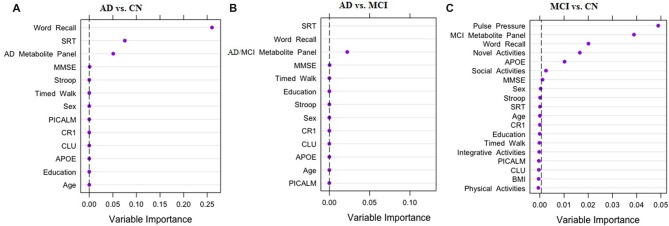
: Among the neurodegenerative diseases of aging, sporadic Alzheimer's disease (AD) is the most prevalent and perhaps the most feared. With virtually no success at finding pharmaceutical therapeutics for altering progressive AD after diagnosis, research attention is increasingly directed at discovering biological and other markers that detect AD risk in the long asymptomatic phase. Both early detection and precision preclinical intervention require systematic investigation of multiple modalities and combinations of AD-related biomarkers and risk factors. We extend recent unbiased metabolomics research that produced a set of metabolite biomarker panels tailored to the discrimination of cognitively normal (CN), cognitively impaired and AD patients. Specifically, we compare the prediction importance of these panels with five other sets of modifiable and non-modifiable AD risk factors (genetic, lifestyle, cognitive, functional health and bio-demographic) in three clinical groups. : The three groups were: CN ( = 35), mild cognitive impairment (MCI; = 25), and AD ( = 22). In a series of three pairwise comparisons, we used machine learning technology random forest analysis (RFA) to test relative predictive importance of up to 19 risk biomarkers from the six AD risk domains. : The three RFA multimodal prediction analyses produced significant discriminating risk factors. First, discriminating AD from CN was the AD metabolite panel and two cognitive markers. Second, discriminating AD from MCI was the AD/MCI metabolite panel and two cognitive markers. Third, discriminating MCI from CN was the MCI metabolite panel and seven markers from four other risk modalities: genetic, lifestyle, cognition and functional health. : Salivary metabolomics biomarker panels, supplemented by other risk markers, were robust predictors of: (1) clinical differences in impairment and dementia and even; (2) subtle differences between CN and MCI. For the latter, the metabolite panel was supplemented by biomarkers that were both modifiable (e.g., functional) and non-modifiable (e.g., genetic). Comparing, integrating and identifying important multi-modal predictors may lead to novel combinations of complex risk profiles potentially indicative of neuropathological changes in asymptomatic or preclinical AD.
在衰老相关的神经退行性疾病中,散发性阿尔茨海默病(AD)最为常见,也可能是最令人恐惧的。在诊断后寻找改变进行性AD的药物治疗方法几乎没有取得成功,研究注意力越来越多地转向发现能够在长期无症状阶段检测AD风险的生物学和其他标志物。早期检测和精准的临床前干预都需要对多种模式以及AD相关生物标志物和风险因素的组合进行系统研究。我们扩展了近期的无偏代谢组学研究,该研究产生了一组代谢物生物标志物面板,专门用于区分认知正常(CN)、认知受损和AD患者。具体而言,我们在三个临床组中比较了这些面板与其他五组可改变和不可改变的AD风险因素(遗传、生活方式、认知、功能健康和生物人口统计学)的预测重要性。
CN(n = 35)、轻度认知障碍(MCI;n = 25)和AD(n = 22)。在一系列三次两两比较中,我们使用机器学习技术随机森林分析(RFA)来测试来自六个AD风险领域的多达19种风险生物标志物的相对预测重要性。
这三次RFA多模式预测分析产生了显著的鉴别风险因素。首先,将AD与CN区分开来的是AD代谢物面板和两个认知标志物。其次,将AD与MCI区分开来的是AD/MCI代谢物面板和两个认知标志物。第三,将MCI与CN区分开来的是MCI代谢物面板以及来自其他四个风险模式(遗传、生活方式、认知和功能健康)的七个标志物。
唾液代谢组学生物标志物面板,辅以其他风险标志物,是以下情况的有力预测指标:(1)损伤和痴呆的临床差异,甚至;(2)CN和MCI之间的细微差异。对于后者,代谢物面板由可改变(如功能方面)和不可改变(如遗传方面)的生物标志物进行补充。比较、整合和识别重要的多模式预测指标可能会导致复杂风险概况的新组合,这些组合可能指示无症状或临床前AD中的神经病理变化。