Kwak Seong-Eun, Lee Ji-Hyun, Zhang Didi, Song Wook
J Exerc Nutrition Biochem. 2018 Sep 30;22(3):21-26. doi: 10.20463/jenb.2018.0020.
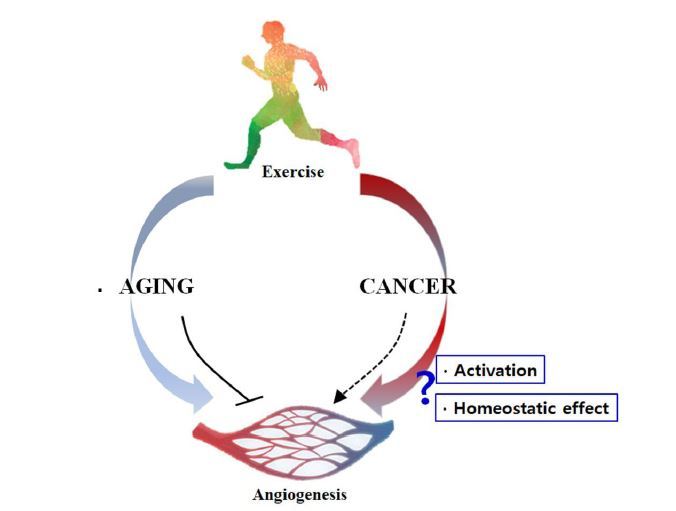
Although it is known that exercise induces angiogenesis, a clear mechanism has remained elusive due to various experimental limitations. This review presents the current status of angiogenesis-related experiments and future directions of experimentation in relation to exercise, aging, and cancer.
We conducted a PubMed search of the available literature to identify reported exercise related changes of angiogenic factors obtained in vitro using C2C12 cells and endothelial cells, and in vivo using animal experiments and in clinical studies.
Exercise induced angiogenesis under normal conditions. Aging decreased angiogenic factors and increased during exercise. On the other hand, in cancer, the results indicate that angiogenic factors tend to increase in general, and that the effects of exercise need to be studied more. The exact mechanism remains unclear.
The effect of exercise on angiogenesis appears positive. Both resistance and aerobic exercise have positive effects, but many evidences suggest that the effects are more pronounced with aerobic exercise. Further research on the precise mechanism(s) is necessary. It is expected that these studies will include models of aging and cancer.
尽管已知运动可诱导血管生成,但由于各种实验限制,明确的机制仍不明确。本综述介绍了与运动、衰老和癌症相关的血管生成实验的现状及未来实验方向。
我们在PubMed上搜索了现有文献,以确定在体外使用C2C12细胞和内皮细胞、在体内使用动物实验以及在临床研究中报道的与运动相关的血管生成因子变化。
正常情况下运动可诱导血管生成。衰老会降低血管生成因子,而运动时会增加。另一方面在癌症中,结果表明血管生成因子总体上倾向于增加,运动的影响需要更多研究。确切机制尚不清楚。
运动对血管生成的影响似乎是积极的。抗阻运动和有氧运动都有积极作用,但许多证据表明有氧运动的效果更明显。有必要对精确机制进行进一步研究。预计这些研究将包括衰老和癌症模型。