Yue Yuan, Qiu Zi-Dong, Qu Xian-You, Deng Ai-Ping, Yuan Yuan, Huang Lu-Qi, Lai Chang-Jiang-Sheng
Chongqing Academy of Chinese Materia Medica, Chongqing Key Laboratory of Traditional Chinese Medicine Resources, Chongqing Sub-center of National Resource Center for Chinese Materia Medica, China Academy of Chinese Medical Sciences, Chongqing 400065, PR China.
National Resource Center for Chinese Materia Medica, China Academy of Chinese Medical Sciences, State Key Laboratory Breeding Base of Dao-di Herbs, Beijing100700, PR China.
J Pharm Anal. 2018 Oct;8(5):312-317. doi: 10.1016/j.jpha.2018.08.003. Epub 2018 Aug 23.
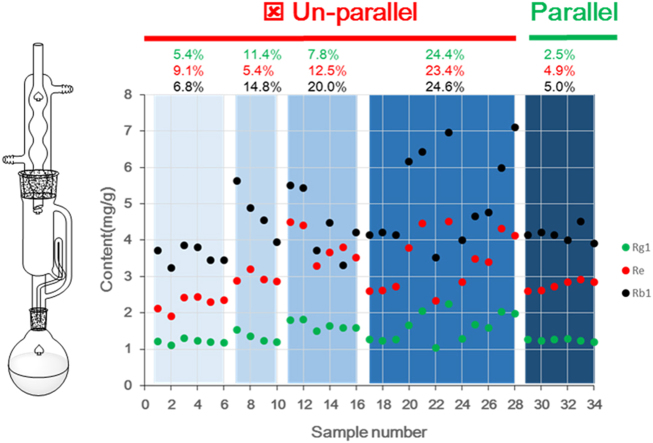
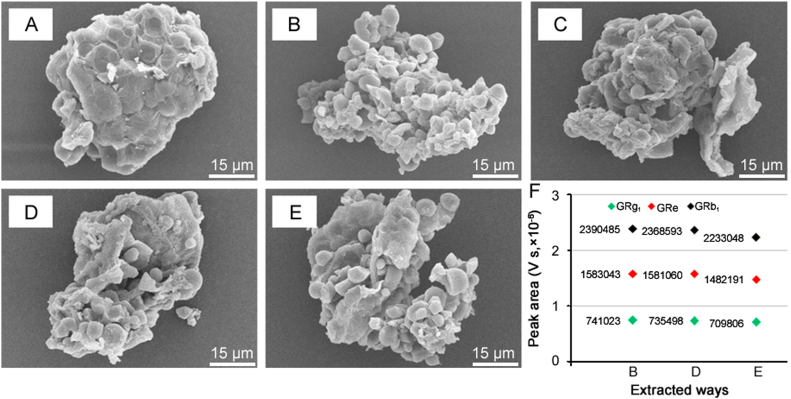
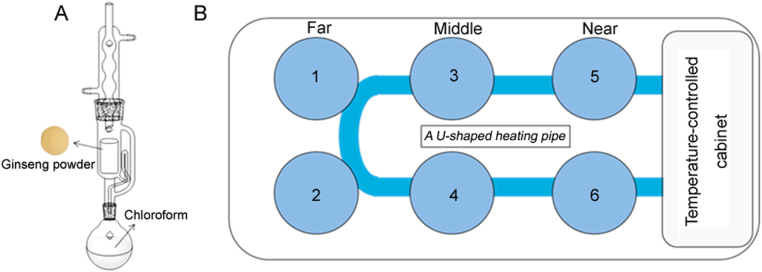
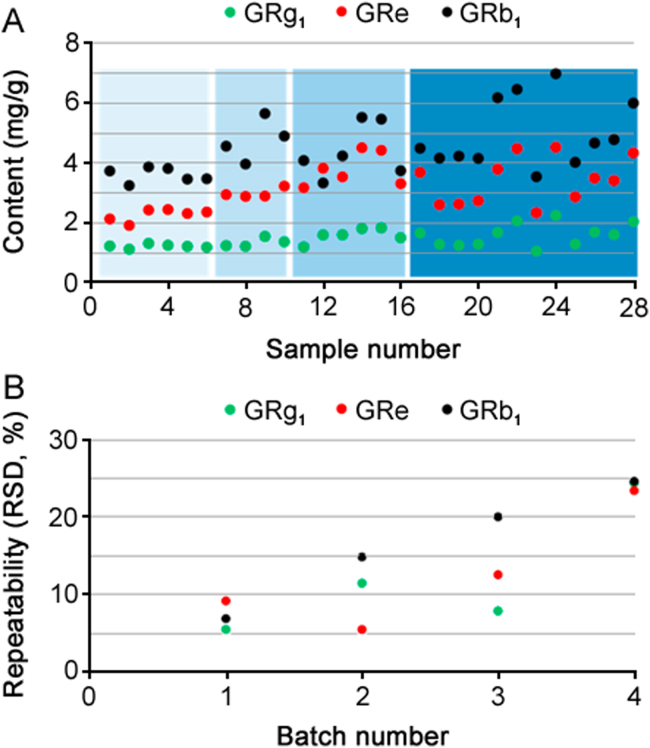
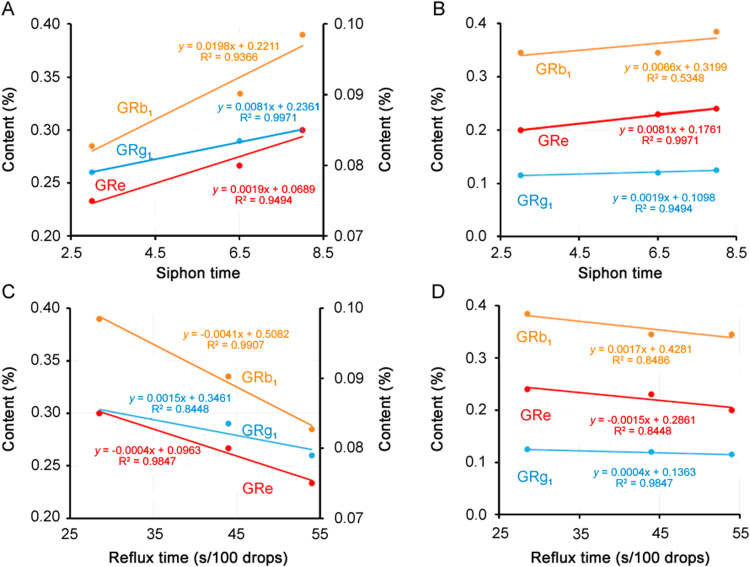
Soxhlet extraction is a common method of sample preparation. However, there has been no discussion about the efficiency of Soxhlet extraction from different batches and the factors that cause content fluctuation. In this study, was selected as a model sample. Soxhlet extraction by means of a water bath, which has always been neglected, was identified as a novel key factor in the poor repeatability in different batches of Soxhlet extraction, as it can affect the siphon times and reflux time, which have been positively correlated with the ginsenoside contents. By substituting round bottom flasks in the same column, the relative standard deviation of the most fluctuated compound, ginsenoside Rb, was decreased from 24.6% to 5.02%. Scanning electron microscopy analysis confirmed that the breakdown of the surface of the ginseng powder in the Soxhlet extraction led to a better dissolution of ginsenosides, indicating that chloroform may promote the extraction of ginsenosides by disrupting the cell structure. Moreover, 70% methanol was regarded as the better solvent for extracting the ginsenosides. Overall, this work offers a practical and effective protocol for improving the accuracy and repeatability of Soxhlet extraction methodology for ginsenosides and other analytes.
索氏提取法是一种常见的样品制备方法。然而,关于不同批次索氏提取法的效率以及导致含量波动的因素,尚未有相关讨论。在本研究中,[具体物质]被选为模型样品。一直被忽视的水浴索氏提取法被确定为不同批次索氏提取法重复性差的一个新关键因素,因为它会影响虹吸次数和回流时间,而虹吸次数和回流时间与人参皂苷含量呈正相关。通过在同一柱中替换圆底烧瓶,波动最大的化合物人参皂苷Rb的相对标准偏差从24.6%降至5.02%。扫描电子显微镜分析证实,索氏提取过程中人参粉表面的破裂导致人参皂苷的更好溶解,这表明氯仿可能通过破坏细胞结构促进人参皂苷的提取。此外,70%甲醇被认为是提取人参皂苷的更佳溶剂。总体而言,这项工作为提高人参皂苷和其他分析物索氏提取方法的准确性和重复性提供了一个实用有效的方案。