Fenton Sally A M, Duda Joan L, Appleton Paul R, Barrett Timothy G
School of Sport, Exercise and Rehabilitation Sciences, University of Birmingham, Edgbaston, Birmingham B15 2TT, UK.
School of Clinical and Experimental Medicine, University of Birmingham, Edgbaston, Birmingham B15 2TT, UK.
J Sport Health Sci. 2017 Dec;6(4):423-433. doi: 10.1016/j.jshs.2016.03.006. Epub 2016 Mar 31.
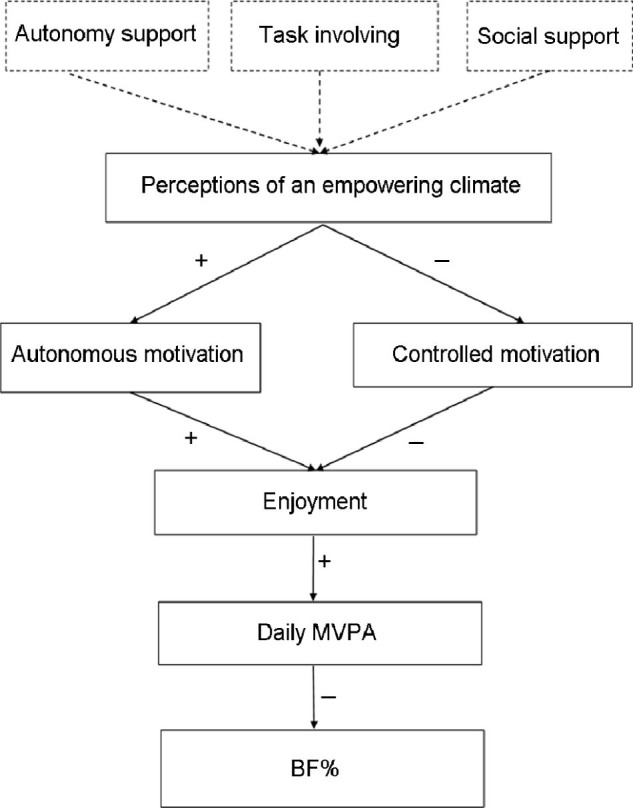
Evidence suggests involvement in youth sport does not guarantee daily guidelines for moderate-to-vigorous physical activity (MVPA) are met, and participation may not mitigate the risks associated with physical inactivity. The need to promote higher habitual MVPA engagement amongst children active in the youth sport context has therefore been underlined. Framed by self-determination theory, the aim of the present study was to examine the implications of the motivational climate created in youth sport, for children's daily engagement in MVPA and associated adiposity. Specifically, we sought to test a motivational sequence in which children's perceptions of an empowering coach-created motivational climate were related to autonomous and controlled motivation, which in turn predicted sport-related enjoyment. Finally, enjoyment was assumed to predict accelerometer assessed daily MVPA and, following this, adiposity.
Male and female youth sport participants aged 9-16 years ( = 112) completed multi-section questionnaires assessing their perceptions of the motivational climate created in youth sport (i.e., autonomy supportive, task involving, socially supportive), autonomous and controlled motivation, and sport-related enjoyment. Daily MVPA engagement was determined via 7 days of accelerometry. Percent body fat (BF%) was estimated using bio-electrical impedance analysis.
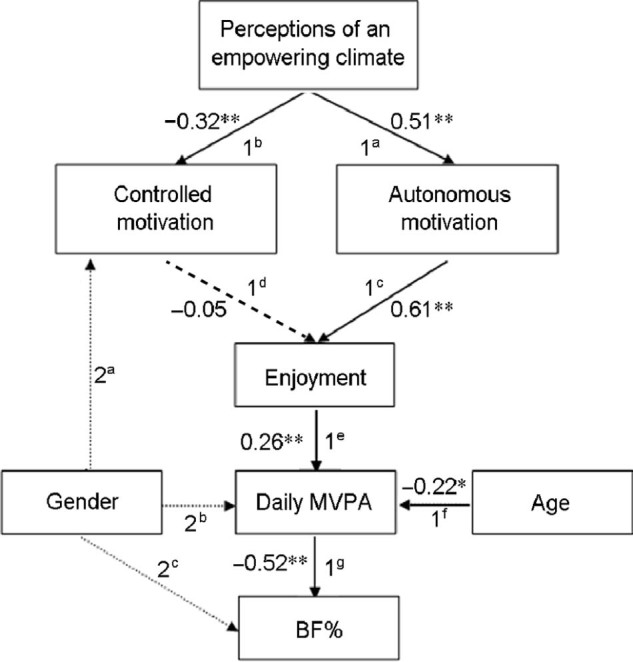
Path analysis revealed perceptions of an empowering motivational climate positively predicted players' autonomous motivation, and in turn, sport-related enjoyment. Enjoyment was also significantly negatively related to players' BF%, via a positive association with daily MVPA.
Fostering more empowering youth sport environments may hold implications for the prevention of excess adiposity, through encouraging higher habitual MVPA engagement. Findings may inform the optimal design of youth sport settings for MVPA promotion, and contribute towards associated healthy weight maintenance amongst youth active in this context. Longitudinal and intervention studies are required to confirm these results.
有证据表明,参与青少年体育运动并不能保证达到中度至剧烈身体活动(MVPA)的每日指导方针,而且这种参与可能无法减轻与缺乏身体活动相关的风险。因此,强调了有必要促进在青少年体育环境中积极参与的儿童更高水平的习惯性MVPA参与度。本研究以自我决定理论为框架,旨在探讨青少年体育中所营造的动机氛围对儿童日常MVPA参与度及相关肥胖问题的影响。具体而言,我们试图检验一种动机序列,即儿童对教练营造的赋予权力的动机氛围的认知与自主动机和受控动机相关,而这又反过来预测与运动相关的乐趣。最后,假设乐趣能预测通过加速度计评估的每日MVPA,进而预测肥胖程度。
9至16岁的青少年体育参与者(n = 112),包括男性和女性,完成了多部分问卷,评估他们对青少年体育中所营造的动机氛围(即自主支持、任务参与、社会支持)、自主动机和受控动机以及与运动相关的乐趣的认知。通过7天的加速度计测量来确定每日MVPA参与度。使用生物电阻抗分析估计体脂百分比(BF%)。
路径分析表明,对赋予权力的动机氛围的认知能正向预测运动员的自主动机,进而预测与运动相关的乐趣。乐趣还通过与每日MVPA的正相关,与运动员的BF%显著负相关。
营造更具赋权性的青少年体育环境可能对预防肥胖过多具有意义,即通过鼓励更高水平的习惯性MVPA参与。研究结果可为促进MVPA的青少年体育环境的优化设计提供参考,并有助于在此环境中积极参与的青少年维持相关的健康体重。需要纵向和干预研究来证实这些结果。