Feliatra Feli, Muchlisin Zainal Abidin, Teruna Hiwan Yuda, Utamy Widya Rahmi, Nursyirwani Nursyirwani, Dahliaty Andi
Marine Microbiology Laboratory, Department of Marine Science, Fisheries and Marine Sciences Faculty, University of Riau, Riau, Indonesia.
Department of Aquaculture, Faculty of Marine and Fisheries, Syiah Kuala University, Banda Aceh, Indonesia.
F1000Res. 2018 Mar 29;7:415. doi: 10.12688/f1000research.13958.1. eCollection 2018.
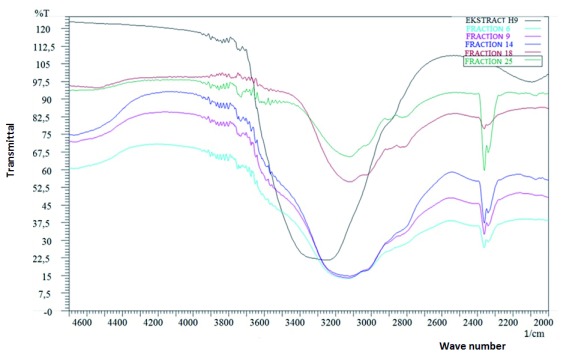
: Bacteriocin has been used widely in industry as a biopreservative agent. The objective of the present study was to investigate the potency of Bacteriocin isolated from tiger prawn and freshwater shrimp as an anti-bacterial on fish. : A total of ten candidates of probiotic bacteria consisted of five isolates from tiger shrimps (H1, H2, H3, H4, H5) and five isolates from freshwater prawns (W1, W2, W3, W4, W5) were evaluated. Bacteriocin wasBacteriocin was produced by centrifugation at a speed of 150 rpm and at 37 °C for 24 hours. The bacteriocin extract was purified by adding sulphate ammonium salt {(NH4) 2SO4} at 80% of the saturation level. Bacteriocin activity was determined using a diffusion method against pathogenic bacteria , and . Bacteriocins were analyzed usinganalyzedusing High Performance Liquid Chromatography (HPLC) and Fourier Transform Infra-Red (FTIR). The data were subjected to analysis of variance (ANOVA) and followed with Duncans multiple range test. : Bacteriocins produced by bacteria isolate H4 from tiger prawn indicated the highest bacteriocin activity againstbacteriocin activity against at at the diameter of inhibition zone of 887.10 ± 409.24 mm /mL. While isolate W2 from freshwater shrimp indicated inhibition zone of 1466.96 ± 127.62 mm /mL. Both bacteriocins were purified by chromatography column using Sephadex LH-20. : This finding showed that bacterial isolates H4 and W2 have the potential to produce bacteriocins which inhibit the pathogenic bacteria. FTIR analysis showed an amide group at wave number 1652cm contained in the bacteriocins of isolates H4 and W2.
细菌素已作为一种生物防腐剂在工业中广泛应用。本研究的目的是调查从虎虾和淡水虾中分离出的细菌素对鱼类的抗菌效力。:总共评估了十种益生菌候选菌株,其中五种来自虎虾(H1、H2、H3、H4、H5),五种来自淡水虾(W1、W2、W3、W4、W5)。细菌素通过在37℃以150转/分钟的速度离心24小时产生。细菌素提取物通过添加饱和度为80%的硫酸铵盐{(NH4)2SO4}进行纯化。使用扩散法测定细菌素对致病菌 和 的活性。使用高效液相色谱(HPLC)和傅里叶变换红外光谱(FTIR)对细菌素进行分析。数据进行方差分析(ANOVA),随后进行邓肯多重范围检验。:从虎虾中分离出的细菌菌株H4产生的细菌素对 的抑菌活性最高,抑菌圈直径为887.10±409.24毫米/毫升。而从淡水虾中分离出的菌株W2的抑菌圈直径为1466.96±127.62毫米/毫升。两种细菌素都使用Sephadex LH - 20通过色谱柱进行纯化。:这一发现表明,细菌菌株H4和W2有产生抑制致病菌的细菌素的潜力。FTIR分析显示,分离株H4和W2的细菌素中在波数1652cm处含有酰胺基团。