School of Experimental Psychology, University of Bristol, Bristol, UK.
MRC Integrative Epidemiology Unit, University of Bristol, Bristol, UK.
Nicotine Tob Res. 2019 May 21;21(6):731-738. doi: 10.1093/ntr/nty230.
Cigarette smokers are at increased risk of poor sleep behaviors. However, it is largely unknown whether these associations are due to shared (genetic) risk factors and/or causal effects (which may be bidirectional).
We obtained summary-level data of genome-wide association studies of smoking (smoking initiation [n = 74 035], cigarettes per day [n = 38 181], and smoking cessation [n = 41 278]) and sleep behaviors (sleep duration and chronotype, or "morningness" [n = 128 266] and insomnia [n = 113 006]). Using linkage disequilibrium (LD) score regression, we calculated genetic correlations between smoking and sleep behaviors. To investigate causal effects, we employed Mendelian randomization (MR), both with summary-level data and individual-level data (n = 333 581 UK Biobank participants). For MR with summary-level data, individual genetic variants were combined with inverse variance-weighted meta-analysis, weighted median regression, MR-Robust Adjusted Profile Score, and MR Egger methods.
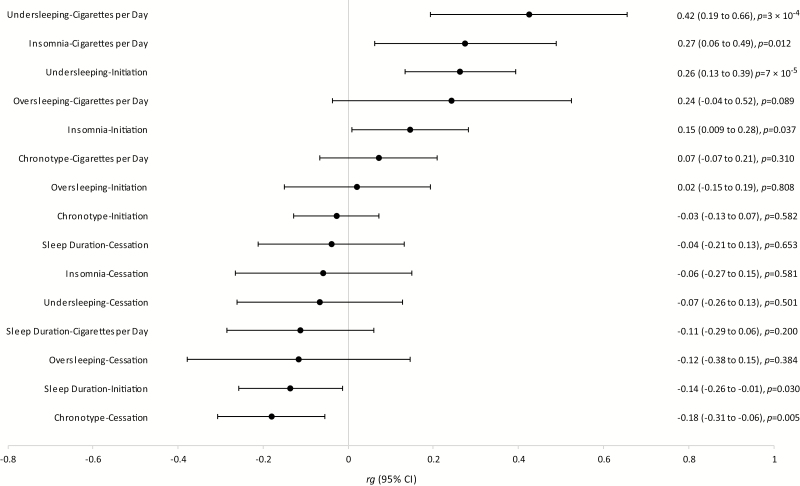
We found negative genetic correlations between smoking initiation and sleep duration (rg = -.14, 95% CI = -0.26 to -0.01) and smoking cessation and chronotype (rg = -.18, 95% CI = -0.31 to -0.06), and positive genetic correlations between smoking initiation and insomnia (rg = .27, 95% CI = 0.06 to 0.49) and cigarettes per day and insomnia (rg = .15, 95% CI = 0.01 to 0.28). MR provided strong evidence that smoking more cigarettes causally decreases the odds of being a morning person, (RAPS) and weak evidence that insomnia causally increases smoking heaviness and decreases smoking cessation odds.
Smoking and sleep behaviors show moderate genetic correlation. Heavier smoking seems to causally affect circadian rhythm and there is some indication that insomnia increases smoking heaviness and hampers cessation. Our findings point to sleep as a potentially interesting smoking treatment target.
Using LD score regression, we found evidence that smoking and different sleep behaviors (sleep duration, chronotype (morningness), and insomnia) are moderately genetically correlated-genetic variants associated with less or poorer sleep also increased the odds of smoking (more heavily). MR analyses suggested that heavier smoking causally affects circadian rhythm (decreasing the odds of being a morning person) and there was some indication that insomnia increases smoking heaviness and hampers smoking cessation. Our findings indicate a complex, bidirectional relationship between smoking and sleep behaviors and point to sleep as a potentially interesting smoking treatment target.
吸烟会增加不良睡眠行为的风险。然而,这些关联是否归因于共同的(遗传)风险因素和/或因果效应(可能是双向的),在很大程度上尚不清楚。
我们获得了关于吸烟(吸烟开始[n = 74035]、每天吸烟量[n = 38181]和戒烟[n = 41278])和睡眠行为(睡眠持续时间和昼夜节律或“早起性”[n = 128266]和失眠[n = 113006])的全基因组关联研究的汇总水平数据。使用连锁不平衡(LD)得分回归,我们计算了吸烟和睡眠行为之间的遗传相关性。为了研究因果效应,我们使用了孟德尔随机化(MR),包括汇总水平数据和个体水平数据(333581 名英国生物库参与者)。对于汇总水平数据的 MR,个体遗传变异与逆方差加权荟萃分析、加权中位数回归、MR-稳健调整轮廓评分和 MR Egger 方法相结合。
我们发现,吸烟开始与睡眠持续时间(rg = -.14,95%CI = -0.26 至 -0.01)和戒烟与昼夜节律(rg = -.18,95%CI = -0.31 至 -0.06)之间存在负遗传相关性,而吸烟开始与失眠(rg =.27,95%CI = 0.06 至 0.49)和每天吸烟量与失眠(rg =.15,95%CI = 0.01 至 0.28)之间存在正遗传相关性。MR 提供了强有力的证据表明,吸烟量增加会导致成为早起者的几率降低(RAPS),而有较弱的证据表明,失眠会增加吸烟量和降低戒烟几率。
吸烟和睡眠行为表现出中度的遗传相关性。吸烟量增加似乎会对昼夜节律产生因果影响,并且有一些迹象表明,失眠会增加吸烟量并阻碍戒烟。我们的研究结果表明,睡眠可能是一个潜在的有趣的吸烟治疗靶点。
使用 LD 得分回归,我们发现有证据表明,吸烟和不同的睡眠行为(睡眠持续时间、昼夜节律(早起性)和失眠)在遗传上中度相关——与睡眠较差或较差相关的遗传变异也增加了吸烟的几率(更严重)。MR 分析表明,吸烟量增加会对昼夜节律产生因果影响(降低成为早起者的几率),并且有一些迹象表明,失眠会增加吸烟量并阻碍戒烟。我们的研究结果表明,吸烟和睡眠行为之间存在复杂的、双向关系,并指出睡眠可能是一个潜在的有趣的吸烟治疗靶点。