Center for Health, Work & Environment, Colorado School of Public Health, University of Colorado, Anschutz Medical Campus, 13001 E. 17th Pl., 3rd Floor, Mail Stop B119 HSC, Aurora, CO 80045, USA.
Department of Environmental and Occupational Health, Colorado School of Public Health, University of Colorado, Anschutz Medical Campus, 13001 E. 17th Pl., 3rd Floor, Mail Stop B119 HSC, Aurora, CO 80045, USA.
Int J Environ Res Public Health. 2018 Oct 31;15(11):2416. doi: 10.3390/ijerph15112416.
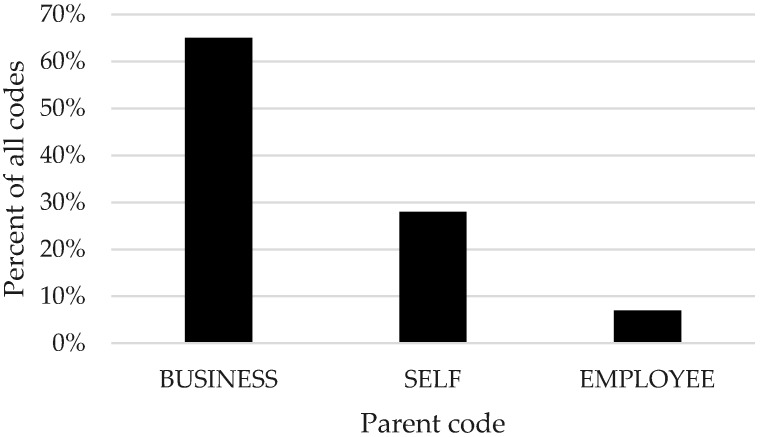
Total Worker Health (TWH) frameworks call for attention to organizational leadership in the implementation and effectiveness of TWH approaches. It is especially important to study this within in the small business environment where employees face significant health, safety, and well-being concerns and employers face barriers to addressing these concerns. The purpose of this study was to gain a better understanding of how small business leaders perceive employee health, safety, and well-being in the context of their own actions. We conducted semi-structured interviews with 18 small business senior leaders and used a qualitative coding approach to analyze the transcripts to determine the frequency with which leaders discussed each code. When we asked leaders about their leadership practices for health, safety, and well-being, leaders reflected upon their business (65%), themselves (28%), and their employees (7%). Leaders rarely discussed the ways in which they integrate health, safety, and well-being. The interviews demonstrate that small business leaders care about the health of their employees, but because of the perceived value to their business, not to employees or themselves. Thus, they may lack the knowledge and skills to be successful TWH leaders. The present study supports a need for continued small business TWH leadership research.
全面职工健康(TWH)框架呼吁关注组织领导在 TWH 方法的实施和有效性中的作用。在小企业环境中研究这一点尤为重要,因为员工面临着重大的健康、安全和福利问题,而雇主则面临着解决这些问题的障碍。本研究的目的是更好地了解小企业领导者如何在自身行动的背景下看待员工的健康、安全和福利。我们对 18 名小企业高级领导进行了半结构化访谈,并使用定性编码方法分析了转录本,以确定领导者讨论每个代码的频率。当我们询问领导者关于他们的健康、安全和福利的领导实践时,领导者反思了他们的业务(65%)、自己(28%)和他们的员工(7%)。领导者很少讨论他们整合健康、安全和福利的方式。这些访谈表明,小企业领导者关心员工的健康,但由于对业务的重视,而不是对员工或自己的重视。因此,他们可能缺乏成为成功的 TWH 领导者的知识和技能。本研究支持需要继续进行小企业 TWH 领导力研究。