Neurosciences Research Center, Tabriz University of Medical Sciences, Tabriz, Iran; Department of Medical Physics, Tabriz University of Medical Sciences, Tabriz, Iran; ProNeuroLIGHT LLC, Phoenix, AZ, USA.
Neurosciences Research Center, Tabriz University of Medical Sciences, Tabriz, Iran.
Brain Res Bull. 2019 Jan;144:213-222. doi: 10.1016/j.brainresbull.2018.10.010. Epub 2018 Oct 29.
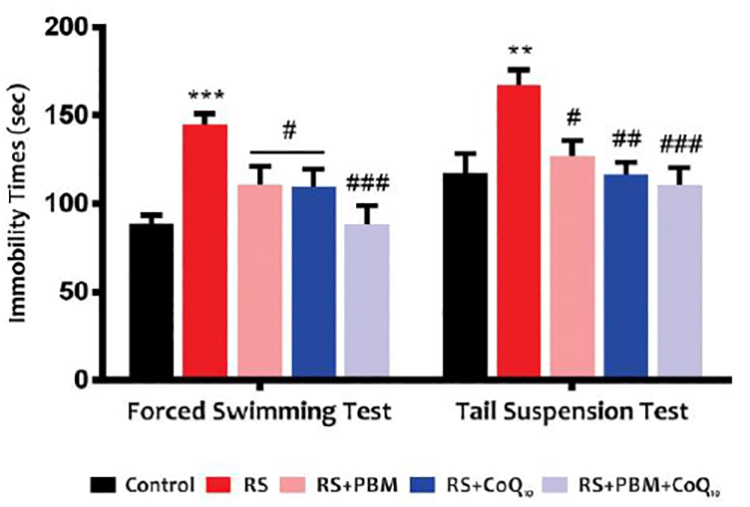
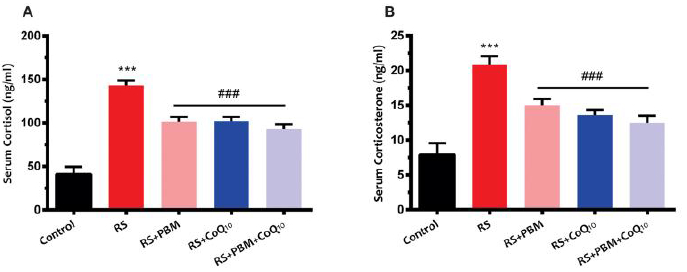
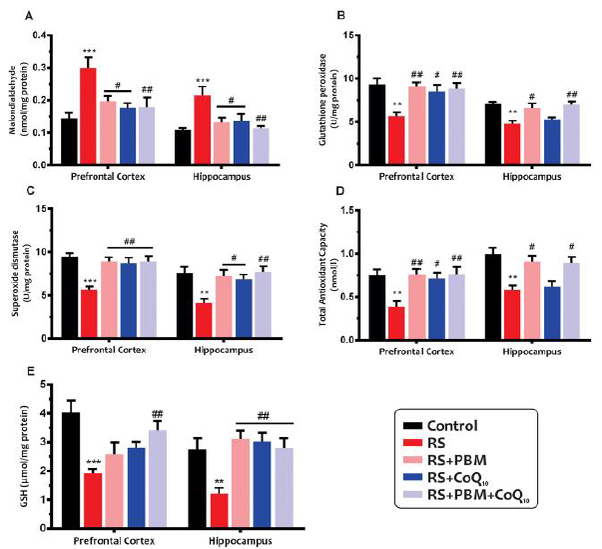
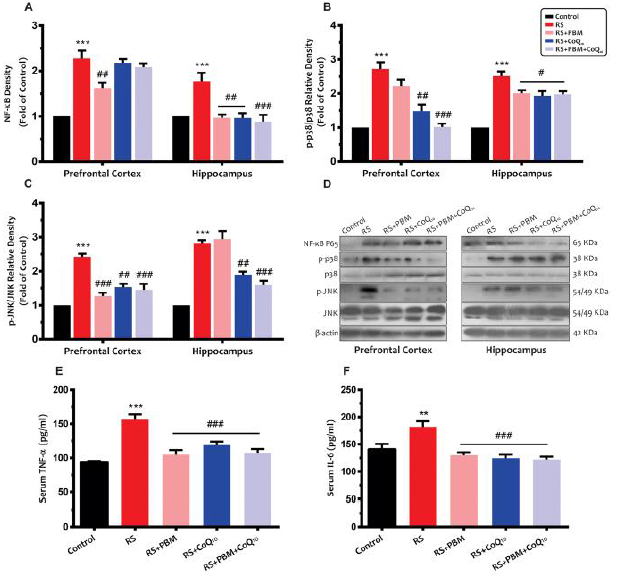
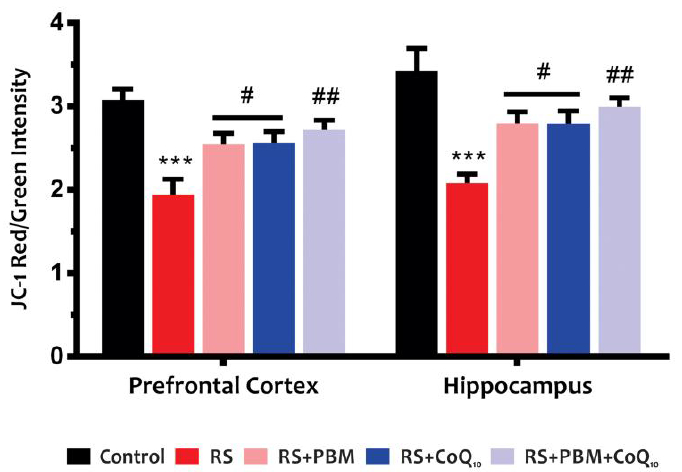
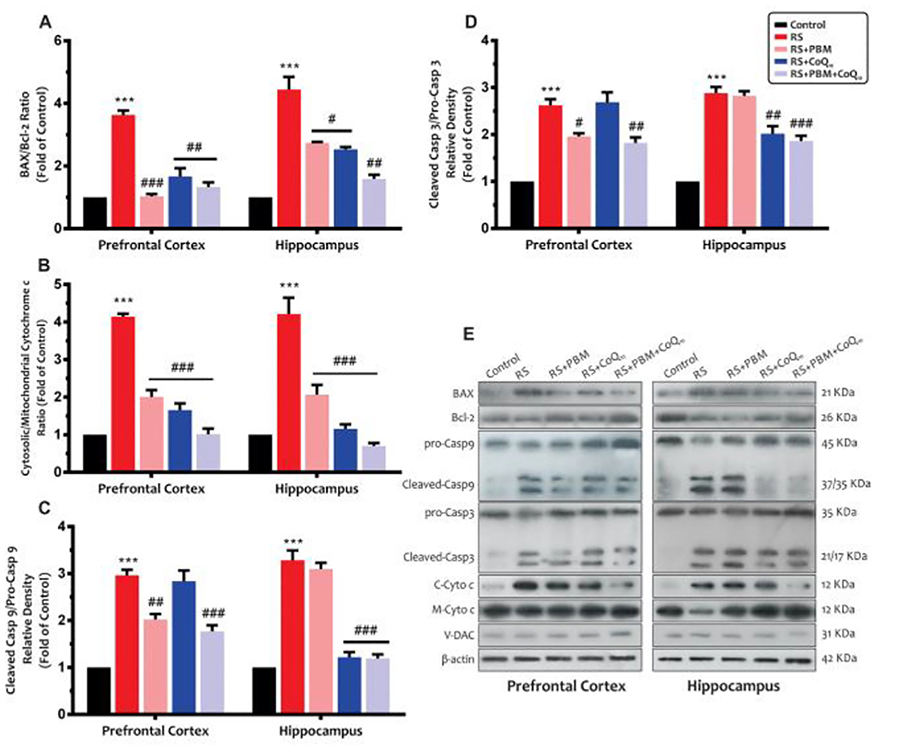
This study was aimed to evaluate the effects of near-infrared (NIR) photobiomodulation (PBM) combined with coenzyme Q (CoQ) on depressive-like behavior, cerebral oxidative stress, inflammation, and apoptosis markers in mice. To induce a depressive-like model, mice were subjected to sub-chronic restraint stress for 5 consecutive days. NIR PBM (810 nm laser, 33.3 J/cm) and/or CoQ (500 mg/kg/day, gavage) were administered for five days concomitantly with immobilization. Behavior was evaluated by the forced swim test (FST), tail suspension test (TST), and open field test (OFT). Mitochondrial membrane potential as well as oxidative stress, neuroinflammatory, and markers of apoptosis were evaluated in the prefrontal cortex (PFC) and hippocampus (HIP). The serum levels of pro-inflammatory cytokines, cortisol, and corticosterone were also measured. PBM or CoQ, or the combination, ameliorated depressive-like behaviors induced by restraint stress as indicated by decreased immobility time in both the FST and TST. PBM and/or CoQ treatments decreased lipid peroxidation and enhanced total antioxidant capacity (TAC), GSH levels, GPx and SOD activities in both brain areas. The neuroinflammatory response in the HIP and PFC was suppressed, as indicated by decreased NF-kB, p38, and JNK levels in PBM and/or CoQ groups. Intrinsic apoptosis biomarkers, BAX, Bcl-2, cytochrome c release, and caspase-3 and -9, were also significantly down-regulated by both treatments. Furthermore, both treatments decreased the elevated serum levels of cortisol, corticosterone, TNF-α, and IL-6 induced by restraint stress. Transcranial NIR PBM and CoQ therapies may be effective antidepressant strategies for the prevention of psychopathological and behavioral symptoms induced by stress.
这项研究旨在评估近红外(NIR)光生物调节(PBM)联合辅酶 Q(CoQ)对小鼠抑郁样行为、大脑氧化应激、炎症和细胞凋亡标志物的影响。为了诱导抑郁样模型,将小鼠连续 5 天进行慢性束缚应激。NIR PBM(810nm 激光,33.3J/cm)和/或 CoQ(500mg/kg/天,灌胃)在固定的同时连续 5 天给药。通过强迫游泳试验(FST)、悬尾试验(TST)和旷场试验(OFT)评估行为。评估前额叶皮层(PFC)和海马(HIP)中的线粒体膜电位以及氧化应激、神经炎症和细胞凋亡标志物。还测量了促炎细胞因子、皮质醇和皮质酮的血清水平。PBM 或 CoQ 或两者的组合改善了由束缚应激引起的抑郁样行为,表现为 FST 和 TST 中不动时间减少。PBM 和/或 CoQ 治疗降低了两个脑区的脂质过氧化作用,增加了总抗氧化能力(TAC)、GSH 水平、GPx 和 SOD 活性。在 PBM 和/或 CoQ 组中,HIP 和 PFC 中的神经炎症反应受到抑制,NF-kB、p38 和 JNK 水平降低。两种治疗方法还显著下调了内在凋亡标志物 BAX、Bcl-2、细胞色素 c 释放以及 caspase-3 和 caspase-9。此外,两种治疗方法均降低了束缚应激引起的皮质醇、皮质酮、TNF-α和 IL-6 血清水平的升高。经颅 NIR PBM 和 CoQ 治疗可能是预防应激引起的心理病理和行为症状的有效抗抑郁策略。