van den Driesche Sander, Lucklum Frieder, Bunge Frank, Vellekoop Michael J
Institute for Microsensors, -actuators and ⁻systems (IMSAS), University of Bremen, 28359 Bremen, Germany.
Microsystems Center Bremen (MCB), University of Bremen, 28359 Bremen, Germany.
Micromachines (Basel). 2018 Feb 6;9(2):71. doi: 10.3390/mi9020071.
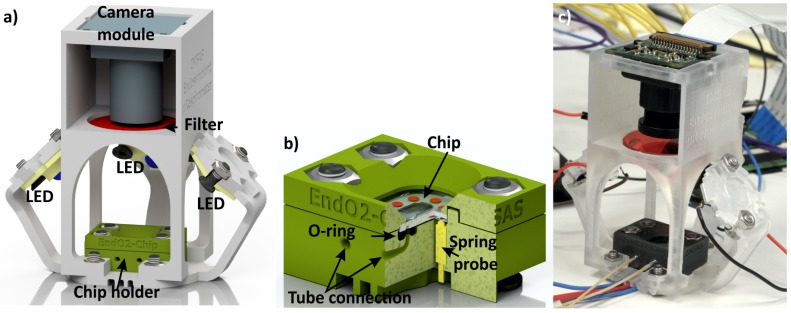
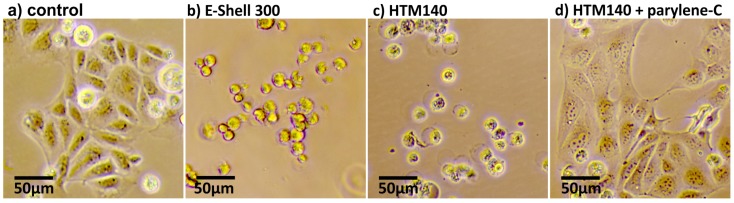
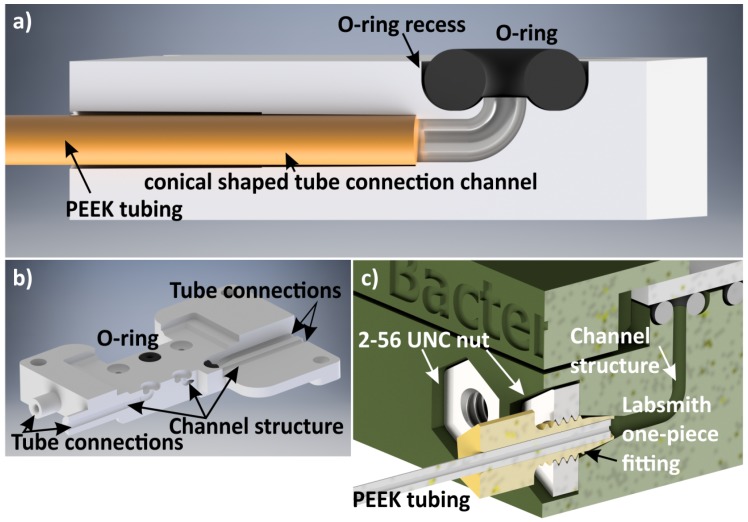
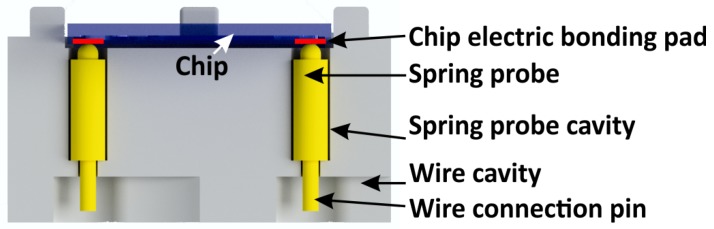
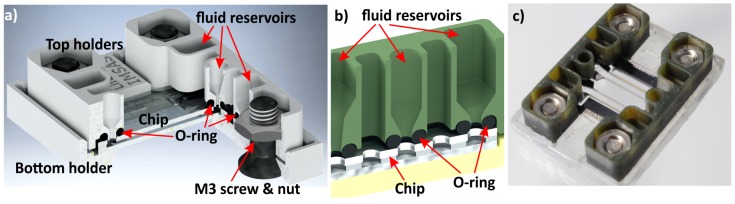
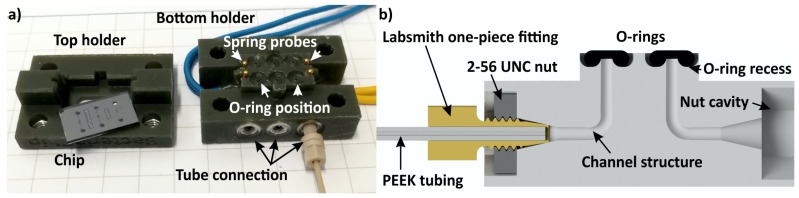
The connection of microfluidic devices to the outer world by tubes and wires is an underestimated issue. We present methods based on 3D printing to realize microfluidic chip holders with reliable fluidic and electric connections. The chip holders are constructed by microstereolithography, an additive manufacturing technique with sub-millimeter resolution. The fluidic sealing between the chip and holder is achieved by placing O-rings, partly integrated into the 3D-printed structure. The electric connection of bonding pads located on microfluidic chips is realized by spring-probes fitted within the printed holder. Because there is no gluing or wire bonding necessary, it is easy to change the chip in the measurement setup. The spring probes and O-rings are aligned automatically because of their fixed position within the holder. In the case of bioanalysis applications such as cells, a limitation of 3D-printed objects is the leakage of cytotoxic residues from the printing material, cured resin. This was solved by coating the 3D-printed structures with parylene-C. The combination of silicon/glass microfluidic chips fabricated with highly-reliable clean-room technology and 3D-printed chip holders for the chip-to-world connection is a promising solution for applications where biocompatibility, optical transparency and accurate sample handling must be assured. 3D printing technology for such applications will eventually arise, enabling the fabrication of complete microfluidic devices.
通过管子和电线将微流控设备与外部世界连接起来是一个被低估的问题。我们提出了基于3D打印的方法,以实现具有可靠流体和电气连接的微流控芯片固定器。芯片固定器通过微立体光刻技术构建,这是一种具有亚毫米分辨率的增材制造技术。芯片与固定器之间的流体密封通过放置O形环来实现,这些O形环部分集成在3D打印结构中。位于微流控芯片上的焊盘的电气连接通过安装在打印固定器内的弹簧探针来实现。由于无需胶合或引线键合,因此在测量设置中更换芯片很容易。由于弹簧探针和O形环在固定器内的位置固定,它们会自动对齐。在细胞等生物分析应用中,3D打印物体的一个局限性是打印材料(固化树脂)中细胞毒性残留物的泄漏。通过用聚对二甲苯-C涂覆3D打印结构解决了这个问题。采用高度可靠的洁净室技术制造的硅/玻璃微流控芯片与用于芯片与外部连接的3D打印芯片固定器相结合,对于必须确保生物相容性、光学透明度和精确样品处理的应用来说是一个有前途的解决方案。用于此类应用的3D打印技术最终将会出现,从而能够制造完整的微流控设备。