School of Engineering, Newcastle University, Newcastle, United Kingdom.
Institute for Cell and Molecular Biosciences, Newcastle University, Newcastle, United Kingdom.
PLoS One. 2020 Oct 28;15(10):e0240237. doi: 10.1371/journal.pone.0240237. eCollection 2020.
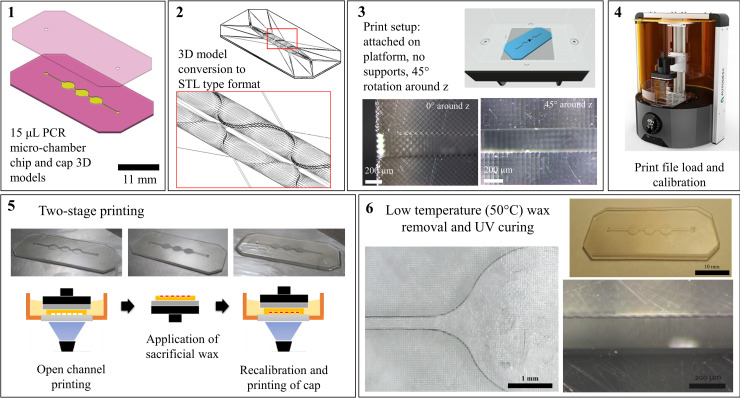
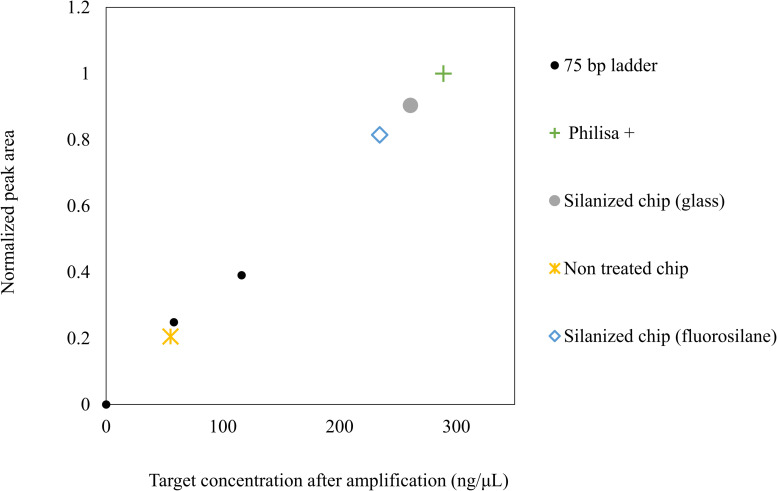
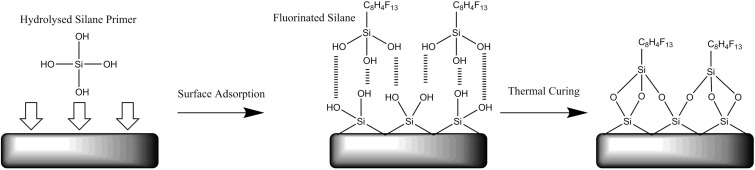
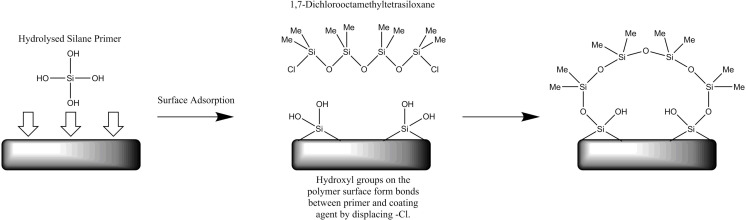
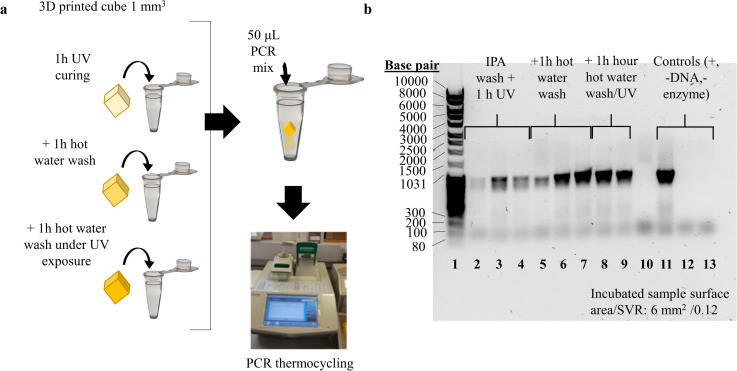
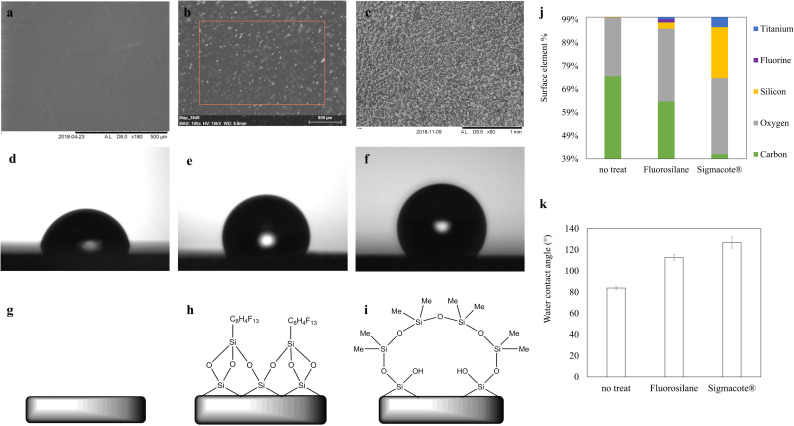
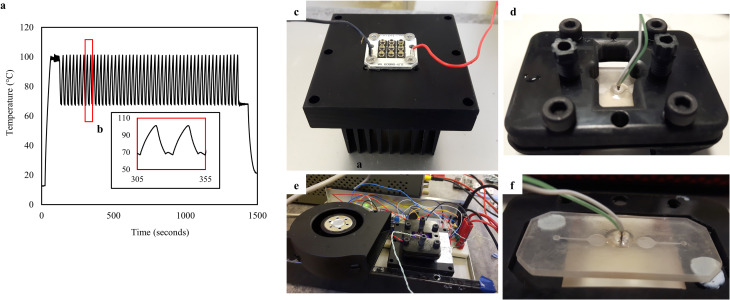
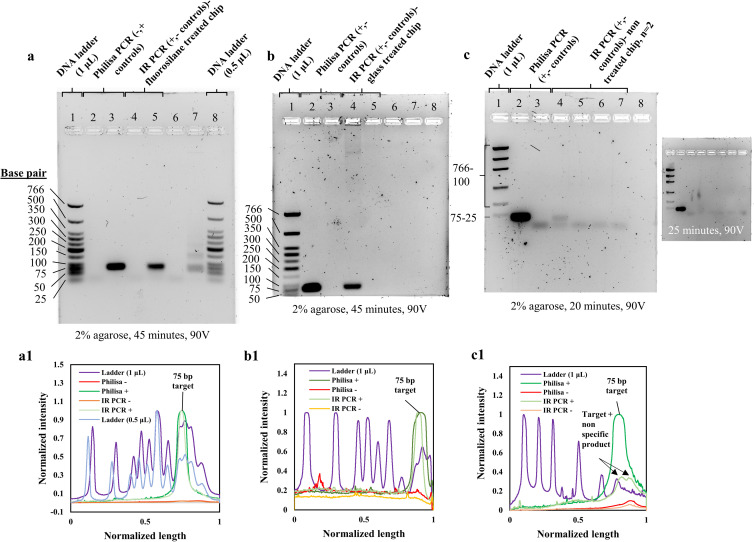
Digital Light Processing (DLP) stereolithography (SLA) as a high-resolution 3D printing process offers a low-cost alternative for prototyping of microfluidic geometries, compared to traditional clean-room and workshop-based methods. Here, we investigate DLP-SLA printing performance for the production of micro-chamber chip geometries suitable for Polymerase Chain Reaction (PCR), a key process in molecular diagnostics to amplify nucleic acid sequences. A DLP-SLA fabrication protocol for printed micro-chamber devices with monolithic micro-channels is developed and evaluated. Printed devices were post-processed with ultraviolet (UV) light and solvent baths to reduce PCR inhibiting residuals and further treated with silane coupling agents to passivate the surface, thereby limiting biomolecular adsorption occurences during the reaction. The printed devices were evaluated on a purpose-built infrared (IR) mediated PCR thermocycler. Amplification of 75 base pair long target sequences from genomic DNA templates on fluorosilane and glass modified chips produced amplicons consistent with the control reactions, unlike the non-silanized chips that produced faint or no amplicon. The results indicated good functionality of the IR thermocycler and good PCR compatibility of the printed and silanized SLA polymer. Based on the proposed methods, various microfluidic designs and ideas can be validated in-house at negligible costs without the requirement of tool manufacturing and workshop or clean-room access. Additionally, the versatile chemistry of 3D printing resins enables customised surface properties adding significant value to the printed prototypes. Considering the low setup and unit cost, design flexibility and flexible resin chemistries, DLP-SLA is anticipated to play a key role in future prototyping of microfluidics, particularly in the fields of research biology and molecular diagnostics. From a system point-of-view, the proposed method of thermocycling shows promise for portability and modular integration of funcitonalitites for diagnostic or research applications that utilize nucleic acid amplification technology.
数字光处理(DLP)立体光刻(SLA)作为一种高分辨率 3D 打印工艺,与传统的洁净室和车间方法相比,为微流控几何形状的原型制作提供了一种低成本的选择。在这里,我们研究了 DLP-SLA 打印性能,以生产适合聚合酶链反应(PCR)的微腔芯片几何形状,PCR 是分子诊断中扩增核酸序列的关键过程。开发并评估了用于制造具有整体微通道的打印微腔器件的 DLP-SLA 制造协议。通过紫外线(UV)光和溶剂浴对打印器件进行后处理,以减少抑制 PCR 的残留物,并进一步用硅烷偶联剂处理,使表面钝化,从而限制反应过程中生物分子的吸附。在专门构建的红外(IR)介导的 PCR 热循环仪上评估了打印设备。从基因组 DNA 模板扩增 75 个碱基对长的靶序列,在氟硅烷和玻璃修饰的芯片上产生的扩增子与对照反应一致,而未硅烷化的芯片则产生微弱或无扩增子。结果表明,IR 热循环仪功能良好,打印和硅烷化 SLA 聚合物的 PCR 兼容性良好。基于所提出的方法,可以以微不足道的成本在内部验证各种微流控设计和想法,而无需制造工具和车间或洁净室的访问。此外,3D 打印树脂的多功能化学特性使定制的表面特性具有显著的附加值。考虑到低设置和单位成本、设计灵活性和灵活的树脂化学特性,DLP-SLA 有望在微流控的未来原型制作中发挥关键作用,特别是在研究生物学和分子诊断领域。从系统的角度来看,所提出的热循环方法有望为利用核酸扩增技术的诊断或研究应用的功能性的便携性和模块化集成提供前景。