Center for Bioinformatics and Computational Biology, University of Maryland, College Park, College Park, MD, USA.
School of Public Health, University of Maryland, College Park, College Park, MD, USA.
Microbiome. 2018 Nov 5;6(1):197. doi: 10.1186/s40168-018-0582-5.
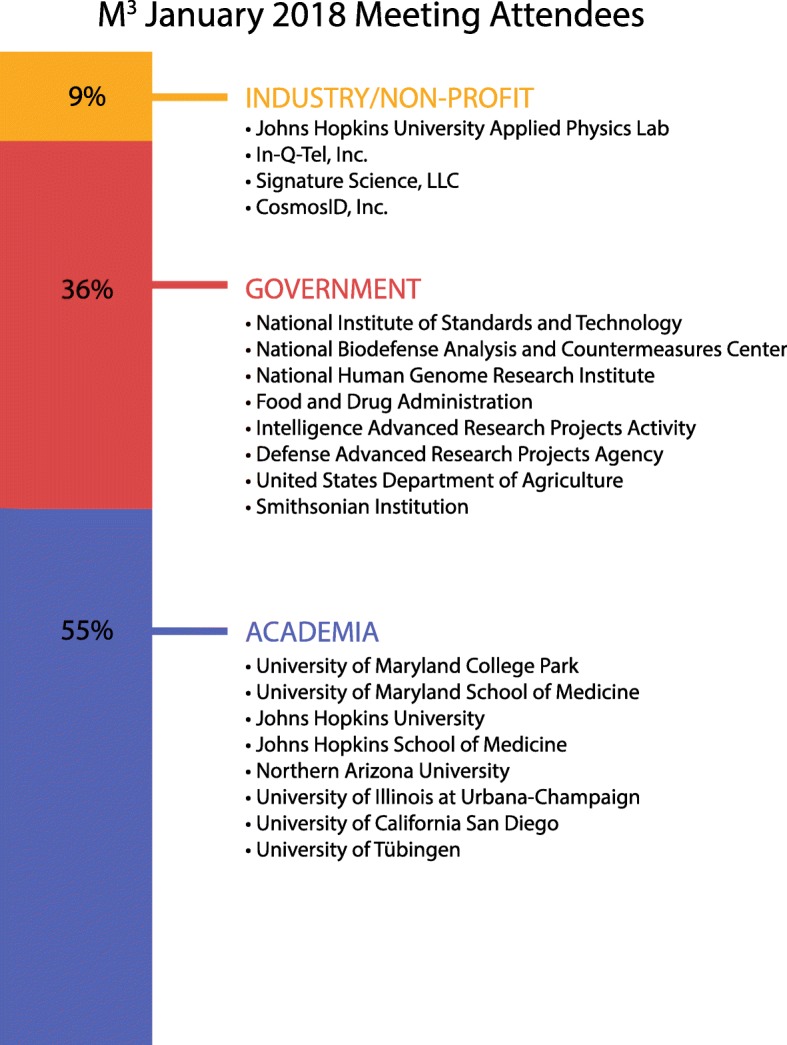
The Mid-Atlantic Microbiome Meet-up (M) organization brings together academic, government, and industry groups to share ideas and develop best practices for microbiome research. In January of 2018, M held its fourth meeting, which focused on recent advances in biodefense, specifically those relating to infectious disease, and the use of metagenomic methods for pathogen detection. Presentations highlighted the utility of next-generation sequencing technologies for identifying and tracking microbial community members across space and time. However, they also stressed the current limitations of genomic approaches for biodefense, including insufficient sensitivity to detect low-abundance pathogens and the inability to quantify viable organisms. Participants discussed ways in which the community can improve software usability and shared new computational tools for metagenomic processing, assembly, annotation, and visualization. Looking to the future, they identified the need for better bioinformatics toolkits for longitudinal analyses, improved sample processing approaches for characterizing viruses and fungi, and more consistent maintenance of database resources. Finally, they addressed the necessity of improving data standards to incentivize data sharing. Here, we summarize the presentations and discussions from the meeting, identifying the areas where microbiome analyses have improved our ability to detect and manage biological threats and infectious disease, as well as gaps of knowledge in the field that require future funding and focus.
中大西洋微生物组见面会(M)组织汇聚了学术、政府和产业界团体,以分享微生物组研究的想法和最佳实践。2018 年 1 月,M 举行了第四次会议,重点关注生物防御方面的最新进展,特别是与传染病相关的进展,以及宏基因组方法在病原体检测中的应用。演讲强调了下一代测序技术在识别和追踪跨空间和时间的微生物群落成员方面的实用性。然而,他们也强调了基因组方法在生物防御方面的当前局限性,包括对低丰度病原体的检测灵敏度不足,以及无法量化有活力的生物。与会者讨论了社区可以改进软件可用性的方法,并分享了用于宏基因组处理、组装、注释和可视化的新计算工具。展望未来,他们确定了需要更好的生物信息学工具包进行纵向分析,改进用于表征病毒和真菌的样本处理方法,以及更一致地维护数据库资源。最后,他们解决了需要改进数据标准以激励数据共享的问题。在这里,我们总结了会议的演讲和讨论,确定了微生物组分析在提高我们检测和管理生物威胁和传染病能力方面的领域,以及该领域需要未来资金和关注的知识空白。