Mavragani Amaryllis, Ochoa Gabriela, Tsagarakis Konstantinos P
Department of Computing Science and Mathematics, University of Stirling, Stirling, Scotland, United Kingdom.
Department of Environmental Engineering, Democritus University of Thrace, Xanthi, Greece.
J Med Internet Res. 2018 Nov 6;20(11):e270. doi: 10.2196/jmir.9366.
In the era of information overload, are big data analytics the answer to access and better manage available knowledge? Over the last decade, the use of Web-based data in public health issues, that is, infodemiology, has been proven useful in assessing various aspects of human behavior. Google Trends is the most popular tool to gather such information, and it has been used in several topics up to this point, with health and medicine being the most focused subject. Web-based behavior is monitored and analyzed in order to examine actual human behavior so as to predict, better assess, and even prevent health-related issues that constantly arise in everyday life.
This systematic review aimed at reporting and further presenting and analyzing the methods, tools, and statistical approaches for Google Trends (infodemiology) studies in health-related topics from 2006 to 2016 to provide an overview of the usefulness of said tool and be a point of reference for future research on the subject.
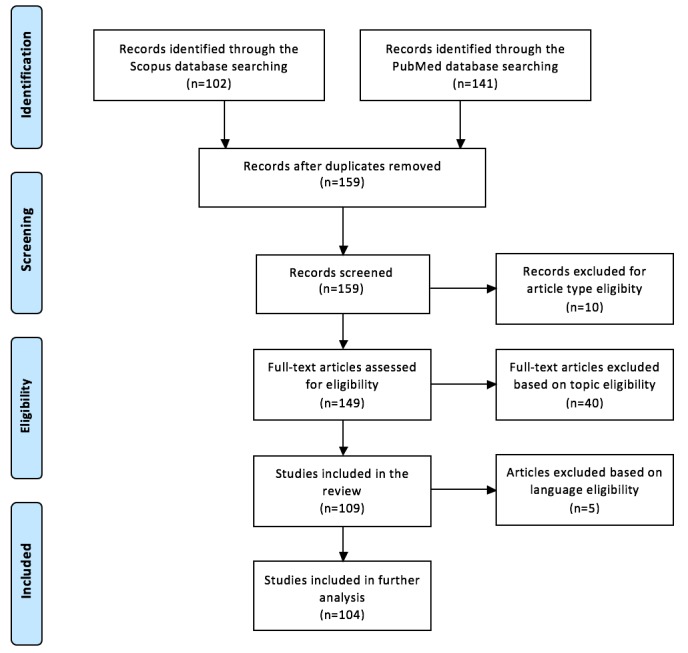
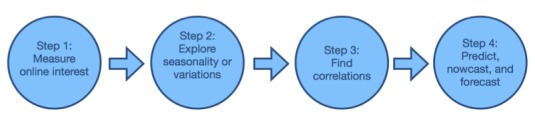
Following the Preferred Reporting Items for Systematic Reviews and Meta-Analyses guidelines for selecting studies, we searched for the term "Google Trends" in the Scopus and PubMed databases from 2006 to 2016, applying specific criteria for types of publications and topics. A total of 109 published papers were extracted, excluding duplicates and those that did not fall inside the topics of health and medicine or the selected article types. We then further categorized the published papers according to their methodological approach, namely, visualization, seasonality, correlations, forecasting, and modeling.
All the examined papers comprised, by definition, time series analysis, and all but two included data visualization. A total of 23.1% (24/104) studies used Google Trends data for examining seasonality, while 39.4% (41/104) and 32.7% (34/104) of the studies used correlations and modeling, respectively. Only 8.7% (9/104) of the studies used Google Trends data for predictions and forecasting in health-related topics; therefore, it is evident that a gap exists in forecasting using Google Trends data.
The monitoring of online queries can provide insight into human behavior, as this field is significantly and continuously growing and will be proven more than valuable in the future for assessing behavioral changes and providing ground for research using data that could not have been accessed otherwise.
在信息过载的时代,大数据分析是获取和更好地管理现有知识的答案吗?在过去十年中,基于网络的数据在公共卫生问题中的应用,即信息流行病学,已被证明在评估人类行为的各个方面是有用的。谷歌趋势是收集此类信息最受欢迎的工具,截至目前,它已被用于多个主题,其中健康和医学是最受关注的主题。通过监测和分析基于网络的行为来研究实际的人类行为,以便预测、更好地评估甚至预防日常生活中不断出现的与健康相关的问题。
本系统评价旨在报告、进一步展示和分析2006年至2016年期间谷歌趋势(信息流行病学)在健康相关主题研究中的方法、工具和统计方法,以概述该工具的实用性,并为该主题的未来研究提供参考。
按照系统评价和Meta分析的首选报告项目指南选择研究,我们在2006年至2016年期间的Scopus和PubMed数据库中搜索“谷歌趋势”一词,并对出版物类型和主题应用特定标准。共提取了109篇已发表的论文,排除了重复的论文以及那些不属于健康和医学主题或所选文章类型的论文。然后,我们根据其方法学方法,即可视化、季节性、相关性、预测和建模,对已发表的论文进行了进一步分类。
根据定义,所有审查的论文都包括时间序列分析,除了两篇论文外,其他所有论文都包括数据可视化。共有23.1%(24/104)的研究使用谷歌趋势数据来研究季节性,而分别有39.4%(41/104)和32.7%(34/104)的研究使用相关性和建模。只有8.7%(9/104)的研究使用谷歌趋势数据对健康相关主题进行预测;因此,很明显,在使用谷歌趋势数据进行预测方面存在差距。
对在线查询的监测可以洞察人类行为,因为这一领域正在显著且持续地发展,并且在未来对于评估行为变化以及为使用其他方式无法获取的数据进行研究提供依据方面将被证明具有极高的价值。