• 文献检索
  • 文档翻译
  • 深度研究
  • 学术资讯
  • Suppr Zotero 插件Zotero 插件
  • 邀请有礼
  • 套餐&价格
  • 历史记录
应用&插件
Suppr Zotero 插件Zotero 插件浏览器插件Mac 客户端Windows 客户端微信小程序
定价
高级版会员购买积分包购买API积分包
服务
文献检索文档翻译深度研究API 文档MCP 服务
关于我们
关于 Suppr公司介绍联系我们用户协议隐私条款
关注我们

Suppr 超能文献

核心技术专利:CN118964589B侵权必究
粤ICP备2023148730 号-1Suppr @ 2026

文献检索

告别复杂PubMed语法,用中文像聊天一样搜索,搜遍4000万医学文献。AI智能推荐,让科研检索更轻松。

立即免费搜索

文件翻译

保留排版,准确专业,支持PDF/Word/PPT等文件格式,支持 12+语言互译。

免费翻译文档

深度研究

AI帮你快速写综述,25分钟生成高质量综述,智能提取关键信息,辅助科研写作。

立即免费体验

过去15年中关于自闭症病因及治疗的网络搜索趋势:探索性信息流行病学研究

Trends in Web Searches About the Causes and Treatments of Autism Over the Past 15 Years: Exploratory Infodemiology Study.

作者信息

Saposnik Florencia E, Huber Joelene F

机构信息

Faculty of Social Sciences, McMaster University, Hamilton, ON, Canada.

Paediatric Medicine, The Hospital for Sick Children, Toronto, ON, Canada.

出版信息

JMIR Pediatr Parent. 2020 Dec 7;3(2):e20913. doi: 10.2196/20913.

DOI:10.2196/20913
PMID:33284128
原文链接:https://pmc.ncbi.nlm.nih.gov/articles/PMC7752533/
Abstract

BACKGROUND

Ninety percent of adults in the United States use the internet, and the majority of internet users report looking on the web for health information using search engines. The rising prevalence of autism spectrum disorder (ASD), uncertainty surrounding its etiology, and variety of intervention approaches contribute to questions about its causes and treatments. It is not known which terms people search most frequently about ASD and whether web search queries have changed over time. Infodemiology is an area of health informatics research using big data analytics to understand web search behavior.

OBJECTIVE

The objectives were to (1) use infodemiological data to analyze trends in web-based searches about the causes and treatments of ASD over time and (2) inform clinicians and ASD organizations about web queries regarding ASD.

METHODS

Google Trends was used to analyze web searches about the causes and treatments of ASD in the United States from 2004 to 2019. The search terms analyzed for queries about causes of ASD included vaccines, genetics, environmental factors, and microbiome and those for therapies included applied behavior analysis (ABA), gluten-free diet, chelation therapy, marijuana, probiotics, and stem cell therapy.

RESULTS

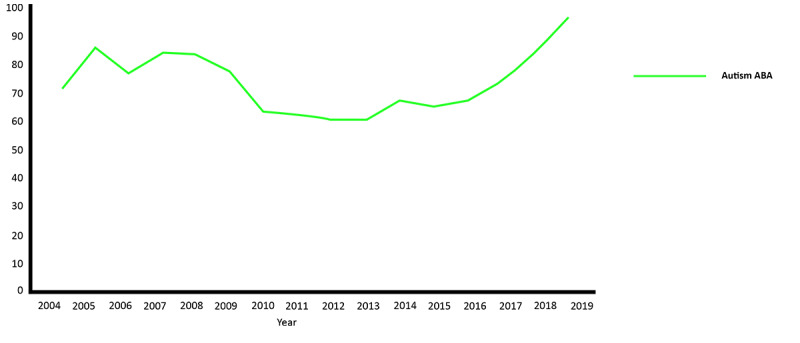
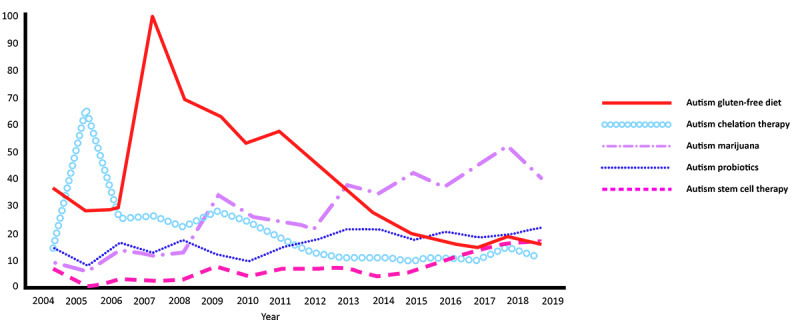
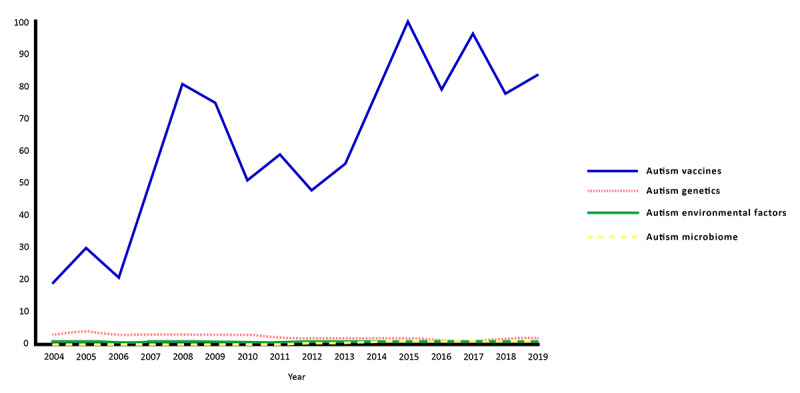
Google Trends results are normalized on a scale ranging from 0 to 100 to represent the frequency and relative interest of search topics. For searches about ASD causes, vaccines had the greatest frequency compared to other terms, with an initial search peak observed in 2008 (scaled score of 81), reaching the highest frequency in 2015 (scaled score of 100), and a current upward trend. In comparison, searches about genetics, environmental factors, and microbiome occurred less frequently. For web searches about ASD therapies, ABA consistently had a high frequency of search interest since 2004, reaching a maximum scaled score of 100 in 2019. The analyses of chelation therapy and gluten-free diet showed trending interest in 2005 (scaled score of 68) and 2007 (scaled score of 100), respectively, followed by a steady decline since (scaled scores of only 10 and 16, respectively, in 2019). Searches related to ASD and marijuana showed a rise in 2009 (scaled score of 35), and they continue to trend upward. Searches about probiotics and stem cell therapy have been relatively low (scaled scores of 22 and 18, respectively), but are gradually gaining interest. Web search volumes for stem cell therapy in 2019 surpassed both gluten-free diet and chelation therapy as web-searched interventions for ASD.

CONCLUSIONS

Google Trends is an effective infodemiology tool to analyze large-scale web search trends about ASD. The results showed informative variation in search trends over 15 years. These data are useful to inform clinicians and organizations about web queries on topics related to ASD, identify knowledge gaps, and target web-based education and knowledge translation strategies.
https://cdn.ncbi.nlm.nih.gov/pmc/blobs/e1d0/7752533/99760e50f867/pediatrics_v3i2e20913_fig4.jpg
https://cdn.ncbi.nlm.nih.gov/pmc/blobs/e1d0/7752533/1e562d252238/pediatrics_v3i2e20913_fig1.jpg
https://cdn.ncbi.nlm.nih.gov/pmc/blobs/e1d0/7752533/e1868ddc01c1/pediatrics_v3i2e20913_fig2.jpg
https://cdn.ncbi.nlm.nih.gov/pmc/blobs/e1d0/7752533/954e3e4aab27/pediatrics_v3i2e20913_fig3.jpg
https://cdn.ncbi.nlm.nih.gov/pmc/blobs/e1d0/7752533/99760e50f867/pediatrics_v3i2e20913_fig4.jpg
https://cdn.ncbi.nlm.nih.gov/pmc/blobs/e1d0/7752533/1e562d252238/pediatrics_v3i2e20913_fig1.jpg
https://cdn.ncbi.nlm.nih.gov/pmc/blobs/e1d0/7752533/e1868ddc01c1/pediatrics_v3i2e20913_fig2.jpg
https://cdn.ncbi.nlm.nih.gov/pmc/blobs/e1d0/7752533/954e3e4aab27/pediatrics_v3i2e20913_fig3.jpg
https://cdn.ncbi.nlm.nih.gov/pmc/blobs/e1d0/7752533/99760e50f867/pediatrics_v3i2e20913_fig4.jpg
摘要

背景

在美国,90%的成年人使用互联网,且大多数互联网用户表示会使用搜索引擎在网上查找健康信息。自闭症谱系障碍(ASD)的患病率不断上升,其病因存在不确定性,干预方法多种多样,这些都引发了关于其病因和治疗的诸多问题。目前尚不清楚人们搜索ASD最频繁的词汇是什么,以及网络搜索查询是否随时间发生了变化。信息流行病学是健康信息学研究的一个领域,利用大数据分析来理解网络搜索行为。

目的

目标是(1)利用信息流行病学数据分析基于网络搜索ASD病因和治疗方法随时间的趋势,以及(2)为临床医生和ASD组织提供有关ASD网络查询的信息。

方法

使用谷歌趋势分析2004年至2019年美国关于ASD病因和治疗方法的网络搜索。分析ASD病因查询的搜索词包括疫苗、遗传学、环境因素和微生物群,分析治疗方法的搜索词包括应用行为分析(ABA)、无麸质饮食、螯合疗法、大麻、益生菌和干细胞疗法。

结果

谷歌趋势结果在0到100的范围内进行了标准化处理,以代表搜索主题的频率和相对关注度。对于ASD病因的搜索,与其他词汇相比,疫苗的搜索频率最高,2008年出现首个搜索高峰(缩放分数为81),2015年达到最高频率(缩放分数为100),目前呈上升趋势。相比之下,关于遗传学、环境因素和微生物群的搜索频率较低。对于ASD治疗方法的网络搜索,自2004年以来,ABA的搜索兴趣频率一直很高,2019年达到最大缩放分数100。螯合疗法和无麸质饮食的分析分别显示在2005年(缩放分数为68)和2007年(缩放分数为100)出现搜索兴趣趋势,随后自那时起稳步下降(2019年分别仅为10和16的缩放分数)。与ASD和大麻相关的搜索在2009年有所上升(缩放分数为35),并且继续呈上升趋势。关于益生菌和干细胞疗法的搜索一直相对较低(分别为22和18的缩放分数),但兴趣逐渐增加。2019年干细胞疗法的网络搜索量超过了无麸质饮食和螯合疗法,成为ASD的网络搜索干预手段。

结论

谷歌趋势是分析关于ASD大规模网络搜索趋势的有效信息流行病学工具。结果显示了15年搜索趋势中的丰富变化。这些数据有助于为临床医生和组织提供有关ASD相关主题网络查询的信息,识别知识差距,并针对基于网络的教育和知识转化策略。

相似文献

1
Trends in Web Searches About the Causes and Treatments of Autism Over the Past 15 Years: Exploratory Infodemiology Study.过去15年中关于自闭症病因及治疗的网络搜索趋势:探索性信息流行病学研究
JMIR Pediatr Parent. 2020 Dec 7;3(2):e20913. doi: 10.2196/20913.
2
Infodemiology of autoimmune encephalitis, autoimmune seizures, and autoimmune epilepsy: An analysis of online search behavior using Google Trends.自身免疫性脑炎、自身免疫性癫痫发作和自身免疫性癫痫的信息流行病学:使用 Google Trends 分析在线搜索行为。
Epilepsy Behav. 2022 Jul;132:108730. doi: 10.1016/j.yebeh.2022.108730. Epub 2022 May 24.
3
Using Application Programming Interfaces (APIs) to Access Google Data and Gain Insights Into Searches on Birth Control in Louisiana and Mississippi, 2014-2018: Infoveillance Study.利用应用程序编程接口 (API) 获取谷歌数据并深入了解路易斯安那州和密西西比州 2014-2018 年的避孕措施搜索情况:信息监测研究。
J Med Internet Res. 2021 Jul 12;23(7):e25923. doi: 10.2196/25923.
4
Infodemiology of systemic lupus erythematous using Google Trends.利用谷歌趋势研究系统性红斑狼疮的信息流行病学。
Lupus. 2017 Jul;26(8):886-889. doi: 10.1177/0961203317691372. Epub 2017 Feb 5.
5
Using Application Programming Interfaces to Access Google Data for Health Research: Protocol for a Methodological Framework.使用应用程序编程接口访问谷歌数据用于健康研究:方法框架协议
JMIR Res Protoc. 2020 Jul 6;9(7):e16543. doi: 10.2196/16543.
6
Emerging Trends in Information-Seeking Behavior for Alpha-Gal Syndrome: Infodemiology Study Using Time Series and Content Analysis.新兴的α-半乳糖综合征信息搜索行为趋势:使用时间序列和内容分析法的信息流行病学研究。
J Med Internet Res. 2024 May 8;26:e49928. doi: 10.2196/49928.
7
Exploring Google Searches for Out-of-Clinic Medication Abortion in the United States During 2020: Infodemiology Approach Using Multiple Samples.2020年美国非诊所药物流产的谷歌搜索探索:使用多样本的信息流行病学方法
JMIR Infodemiology. 2022 May 12;2(1):e33184. doi: 10.2196/33184. eCollection 2022 Jan-Jun.
8
The Influence of Media Coverage and Governmental Policies on Google Queries Related to COVID-19 Cutaneous Symptoms: Infodemiology Study.媒体报道和政府政策对与 COVID-19 皮肤症状相关的谷歌查询的影响:信息流行病学研究。
JMIR Public Health Surveill. 2021 Feb 25;7(2):e25651. doi: 10.2196/25651.
9
What Motivates Internet Users to Search for Asperger Syndrome and Autism on Google?是什么促使互联网用户在谷歌上搜索阿斯伯格综合征和自闭症?
Int J Environ Res Public Health. 2020 Dec 15;17(24):9386. doi: 10.3390/ijerph17249386.
10
Using Search Trends to Analyze Web-Based Interest in Lower Urinary Tract Symptoms-Related Inquiries, Diagnoses, and Treatments in Mainland China: Infodemiology Study of Baidu Index Data.利用搜索趋势分析中国大陆与下尿路症状相关查询、诊断和治疗的网络关注度:基于百度指数数据的信息流行病学研究。
J Med Internet Res. 2021 Jul 6;23(7):e27029. doi: 10.2196/27029.

引用本文的文献

1
Anti-ableism and scientific accuracy in autism research: a false dichotomy.自闭症研究中的反能力歧视与科学准确性:一种错误的二分法。
Front Psychiatry. 2023 Sep 8;14:1244451. doi: 10.3389/fpsyt.2023.1244451. eCollection 2023.
2
Using Social Media Data to Investigate Public Perceptions of Cannabis as a Medicine: Narrative Review.利用社交媒体数据调查公众对大麻作为药物的看法:叙事性综述。
J Med Internet Res. 2023 Feb 27;25:e36667. doi: 10.2196/36667.
3
Social media discourse and internet search queries on cannabis as a medicine: A systematic scoping review.

本文引用的文献

1
Gastrointestinal disorders in children with autism spectrum disorder.自闭症谱系障碍儿童的胃肠道疾病
Pol Merkur Lekarski. 2020 Feb 26;48(283):69-72.
2
Prevalence of Autism Spectrum Disorder Among Children Aged 8 Years - Autism and Developmental Disabilities Monitoring Network, 11 Sites, United States, 2016.2016 年,美国 11 个监测点自闭症和发育障碍监测网络对 8 岁儿童自闭症谱系障碍流行率的调查。
MMWR Surveill Summ. 2020 Mar 27;69(4):1-12. doi: 10.15585/mmwr.ss6904a1.
3
Composition of Gut Microbiota in Children with Autism Spectrum Disorder: A Systematic Review and Meta-Analysis.
社交媒体上关于大麻作为药物的讨论和互联网搜索查询:系统范围综述。
PLoS One. 2023 Jan 20;18(1):e0269143. doi: 10.1371/journal.pone.0269143. eCollection 2023.
4
Consumer-Generated Discourse on Cannabis as a Medicine: Scoping Review of Techniques.消费者生成的关于大麻作为药物的论述:技术范围综述。
J Med Internet Res. 2022 Nov 16;24(11):e35974. doi: 10.2196/35974.
自闭症谱系障碍儿童肠道微生物群的组成:系统评价和荟萃分析。
Nutrients. 2020 Mar 17;12(3):792. doi: 10.3390/nu12030792.
4
Possible therapeutic applications of cannabis in the neuropsychopharmacology field.大麻在神经精神药理学领域的可能治疗应用。
Eur Neuropsychopharmacol. 2020 Jul;36:217-234. doi: 10.1016/j.euroneuro.2020.01.013. Epub 2020 Feb 10.
5
Parental use of conventional and complementary therapy for autism in Jordan.约旦父母对自闭症的传统和补充疗法的使用。
Complement Ther Med. 2020 Jan;48:102275. doi: 10.1016/j.ctim.2019.102275. Epub 2019 Dec 6.
6
Human Gut Microbiota from Autism Spectrum Disorder Promote Behavioral Symptoms in Mice.自闭症谱系障碍患者的肠道微生物群可促进小鼠的行为症状
Cell. 2019 May 30;177(6):1600-1618.e17. doi: 10.1016/j.cell.2019.05.004.
7
Google Trends in Infodemiology and Infoveillance: Methodology Framework.信息流行病学与信息监测中的谷歌趋势:方法框架。
JMIR Public Health Surveill. 2019 May 29;5(2):e13439. doi: 10.2196/13439.
8
Seasonality Patterns of Internet Searches on Mental Health: Exploratory Infodemiology Study.心理健康相关互联网搜索的季节性模式:探索性信息流行病学研究。
JMIR Ment Health. 2019 Apr 24;6(4):e12974. doi: 10.2196/12974.
9
Role of the Gut Microbiome in Autism Spectrum Disorders.肠道微生物群在自闭症谱系障碍中的作用。
Adv Exp Med Biol. 2019;1118:253-269. doi: 10.1007/978-3-030-05542-4_13.
10
Stem cell therapy in autism: recent insights.自闭症的干细胞疗法:最新见解
Stem Cells Cloning. 2018 Oct 23;11:55-67. doi: 10.2147/SCCAA.S155410. eCollection 2018.