Department of Haematology, University of Cambridge, Cambridge CB2 0XY, UK.
Wellcome Trust Sanger Institute, Wellcome Genome Campus, Hinxton CB10 1SA, UK.
Dis Model Mech. 2018 Nov 5;11(11):dmm036525. doi: 10.1242/dmm.036525.
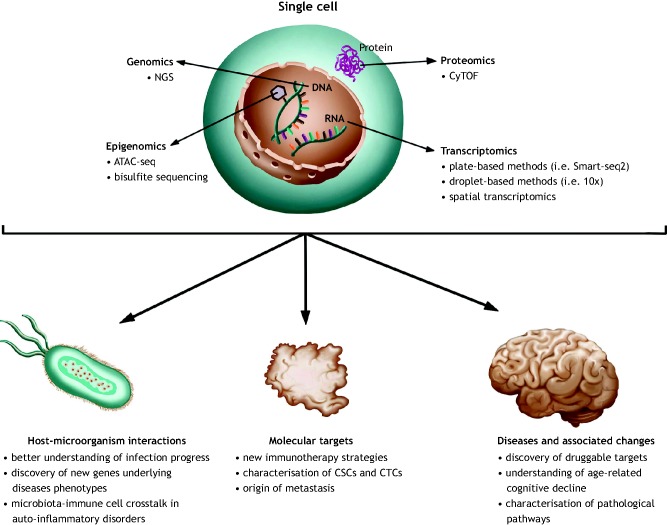
Probing cellular population diversity at single-cell resolution became possible only in recent years. The popularity of single-cell 'omic' approaches, which allow researchers to dissect sample heterogeneity and cell-to-cell variation, continues to grow. With continuous technological improvements, single-cell omics are becoming increasingly prevalent and contribute to the discovery of new and rare cell types, and to the deciphering of disease pathogenesis and outcome. Animal models of human diseases have significantly facilitated our understanding of the mechanisms driving pathologies and resulted in the development of more efficient therapies. The application of single-cell omics to animal models improves the precision of the obtained insights, and brings single-cell technology closer to the clinical field. This Review focuses on the use of single-cell omics in cellular and animal models of diseases, as well as in samples from human patients. It also highlights the potential of these approaches to further improve the diagnosis and treatment of various pathologies, and includes a discussion of the advantages and remaining challenges in implementing these technologies into clinical practice.
近年来,人们才能够在单细胞分辨率水平上探究细胞群体多样性。单细胞“组学”方法的普及使研究人员能够剖析样本异质性和细胞间的变异,其应用也在不断增加。随着技术的不断进步,单细胞组学越来越普及,有助于发现新的和罕见的细胞类型,并解析疾病的发病机制和转归。人类疾病的动物模型极大地促进了我们对驱动病理的机制的理解,并促成了更有效的治疗方法的发展。将单细胞组学应用于动物模型提高了所得见解的精确性,并使单细胞技术更接近临床领域。这篇综述重点介绍了单细胞组学在疾病的细胞和动物模型以及来自人类患者的样本中的应用。它还强调了这些方法在改善各种病理的诊断和治疗方面的潜力,并讨论了将这些技术应用于临床实践的优势和尚存的挑战。