Peking University Institute of Advanced Agricultural Sciences, Shandong Laboratory of Advanced Agricultural Sciences in Weifang, Weifang 261325, China.
Genomics Proteomics Bioinformatics. 2024 Jul 3;22(2). doi: 10.1093/gpbjnl/qzae026.
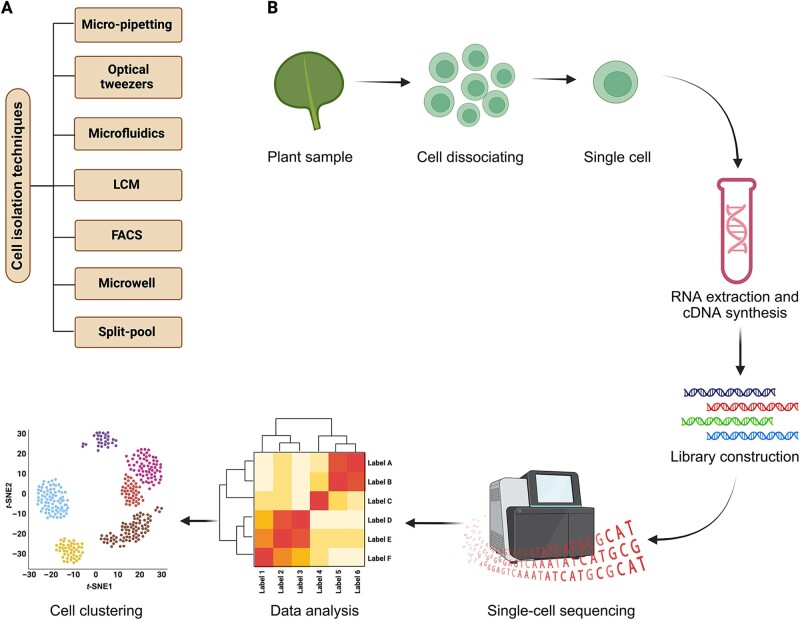
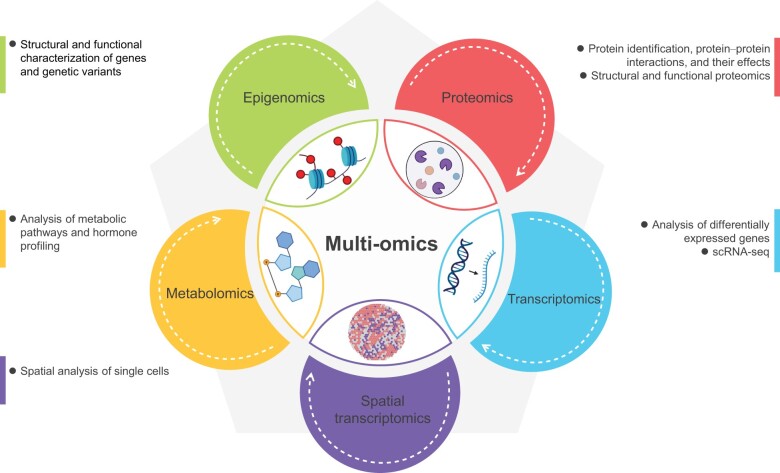
Plants possess diverse cell types and intricate regulatory mechanisms to adapt to the ever-changing environment of nature. Various strategies have been employed to study cell types and their developmental progressions, including single-cell sequencing methods which provide high-dimensional catalogs to address biological concerns. In recent years, single-cell sequencing technologies in transcriptomics, epigenomics, proteomics, metabolomics, and spatial transcriptomics have been increasingly used in plant science to reveal intricate biological relationships at the single-cell level. However, the application of single-cell technologies to plants is more limited due to the challenges posed by cell structure. This review outlines the advancements in single-cell omics technologies, their implications in plant systems, future research applications, and the challenges of single-cell omics in plant systems.
植物具有多样的细胞类型和复杂的调控机制,以适应自然界不断变化的环境。人们采用了各种策略来研究细胞类型及其发育进程,包括单细胞测序方法,该方法提供了高维目录以解决生物学问题。近年来,转录组学、表观基因组学、蛋白质组学、代谢组学和空间转录组学的单细胞测序技术在植物科学中得到了越来越多的应用,以揭示单细胞水平上复杂的生物学关系。然而,由于细胞结构带来的挑战,单细胞技术在植物中的应用受到更多限制。本综述概述了单细胞组学技术的进展、它们在植物系统中的意义、未来的研究应用以及植物系统中单细胞组学的挑战。