Kang Tae Hyun, Kim Hyun Jung
Department of Biomedical Engineering, The University of Texas at Austin, Austin, TX 78712, USA.
Micromachines (Basel). 2016 Jun 27;7(7):107. doi: 10.3390/mi7070107.
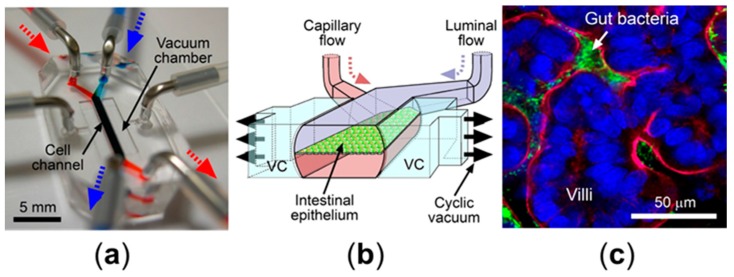
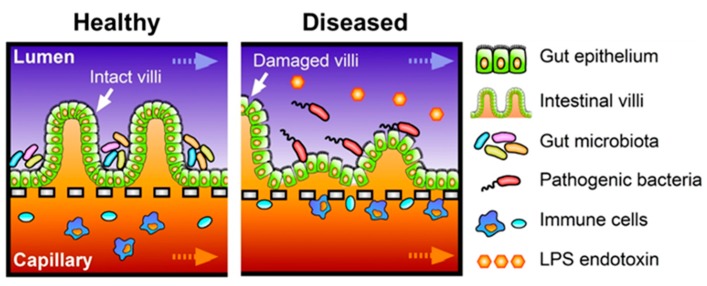
The human intestine is a dynamic organ where the complex host-microbe interactions that orchestrate intestinal homeostasis occur. Major contributing factors associated with intestinal health and diseases include metabolically-active gut microbiota, intestinal epithelium, immune components, and rhythmical bowel movement known as peristalsis. Human intestinal disease models have been developed; however, a considerable number of existing models often fail to reproducibly predict human intestinal pathophysiology in response to biological and chemical perturbations or clinical interventions. Intestinal organoid models have provided promising cytodifferentiation and regeneration, but the lack of luminal flow and physical bowel movements seriously hamper mimicking complex host-microbe crosstalk. Here, we discuss recent advances of human intestinal microphysiological systems, such as the biomimetic human "Gut-on-a-Chip" that can employ key intestinal components, such as villus epithelium, gut microbiota, and immune components under peristalsis-like motions and flow, to reconstitute the transmural 3D lumen-capillary tissue interface. By encompassing cutting-edge tools in microfluidics, tissue engineering, and clinical microbiology, gut-on-a-chip has been leveraged not only to recapitulate organ-level intestinal functions, but also emulate the pathophysiology of intestinal disorders, such as chronic inflammation. Finally, we provide potential perspectives of the next generation microphysiological systems as a personalized platform to validate the efficacy, safety, metabolism, and therapeutic responses of new drug compounds in the preclinical stage.
人类肠道是一个动态器官,协调肠道内稳态的复杂宿主-微生物相互作用在此发生。与肠道健康和疾病相关的主要促成因素包括具有代谢活性的肠道微生物群、肠上皮、免疫成分以及被称为蠕动的有节律的肠道运动。人类肠道疾病模型已经建立;然而,相当数量的现有模型往往无法可重复地预测人类肠道在生物和化学扰动或临床干预下的病理生理学。肠道类器官模型已展现出有前景的细胞分化和再生能力,但缺乏管腔内流动和物理性肠道运动严重阻碍了对复杂宿主-微生物相互作用的模拟。在此,我们讨论人类肠道微生理系统的最新进展,例如仿生人类“芯片肠道”,它可以利用关键的肠道成分,如绒毛上皮、肠道微生物群和免疫成分,在类似蠕动的运动和流动条件下,重建跨壁的三维管腔-毛细血管组织界面。通过整合微流体学、组织工程和临床微生物学等前沿工具,芯片肠道不仅被用于概括器官水平的肠道功能,还被用于模拟肠道疾病的病理生理学,如慢性炎症。最后,我们提供了下一代微生理系统作为个性化平台的潜在前景,以在临床前阶段验证新药物化合物的疗效、安全性、代谢和治疗反应。