Department of Pharmacognosy, Faculty of Pharmacy, Ain Shams University, African Union Organization Street, Abbassia, Cairo, 11566, Egypt.
Graduate Institute of Natural Products, College of Pharmacy, Kaohsiung Medical University, Kaohsiung, 80708, Taiwan.
BMC Complement Altern Med. 2018 Nov 9;18(1):299. doi: 10.1186/s12906-018-2359-6.
Brachychiton rupestris and Brachychiton discolor (Malvaceae) are ornamental trees native to Australia. Some members of Brachychiton and its highly related genus, Sterculia, are employed in traditional medicine for itching, dermatitis and other skin diseases. However, scientific studies on these two genera are scarce. Aiming to reveal the scientific basis of the folk medicinal use of these plants, the cytotoxicity, anti-inflammatory and anti-allergic activities of Brachychiton rupestris and Brachychiton discolor leaves extracts and fractions were evaluated. Also, phytochemical investigation of B. rupestris was performed to identify the compounds exerting the biological effect.
Extracts as well as fractions of Brachychiton rupestris and Brachychiton discolor were tested for their cytotoxicity versus hepatoma HepG2, lung A549, and breast MDA-MB-231 cancer cell lines. Assessment of the anti-allergic activity was done using degranulation assay in RBL-2H3 mast cells. Anti-inflammatory effect was tested by measuring the suppression of superoxide anion production as well as elastase release in fMLF/CB-induced human neutrophils. Phytochemical investigation of the n-hexane, dichloromethane and ethyl acetate fractions of B. rupestris was done using different chromatographic and spectroscopic techniques.
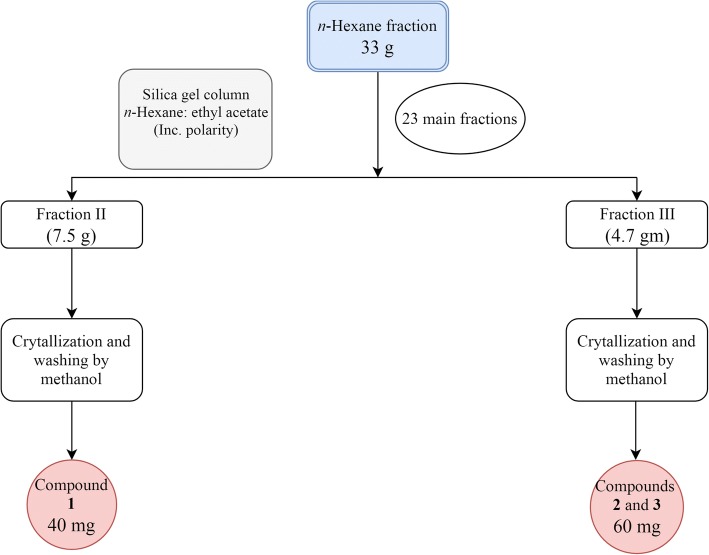
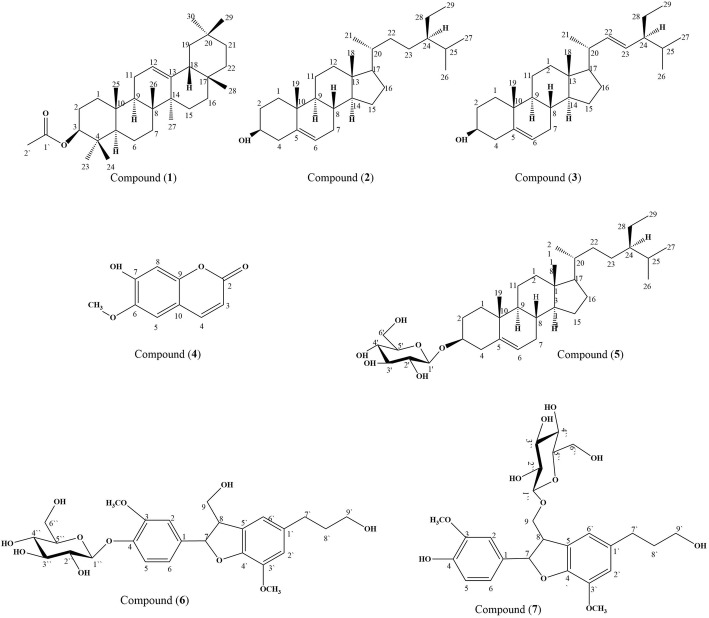
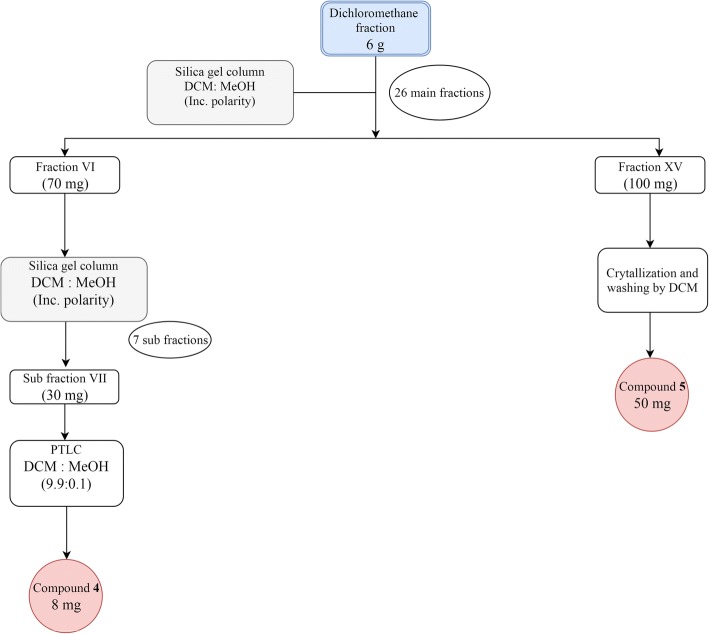
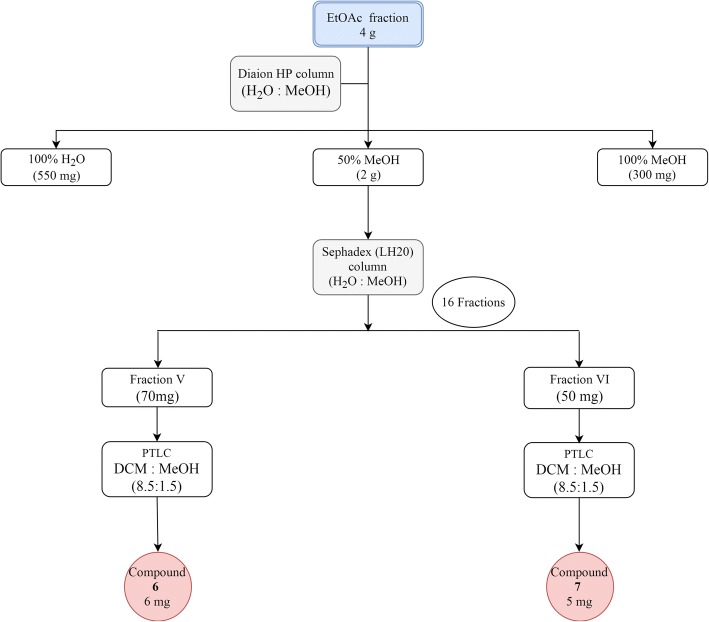
The tested samples showed no cytotoxicity towards the tested cell lines. The nonpolar fractions of both B. rupestris and B. discolor showed potent anti-allergic potency by inhibiting the release of β-hexosaminidase. The dichloromethane fraction of both species exhibited the highest anti-inflammatory activity by suppressing superoxide anion generation and elastase release with IC values of 2.99 and 1.98 μg/mL, respectively for B. rupestris, and 0.78 and 1.57 μg/mL, respectively for B. discolor. Phytochemical investigation of various fractions of B. rupestris resulted in the isolation of β-amyrin acetate (1), β-sitosterol (2) and stigmasterol (3) from the n-hexane fraction. Scopoletin (4) and β-sitosterol-3-O-β-D-glucoside (5) were obtained from the dichloromethane fraction. Dihydrodehydrodiconiferyl alcohol 4-O-β-D-glucoside (6) and dihydrodehydrodiconiferyl alcohol 9-O-β-D-glucoside (7) were separated from the ethyl acetate fraction. Scopoletin (4) showed anti-allergic and anti-inflammatory activity.
It was concluded that the nonpolar fractions of both Brachychiton species exhibited anti-allergic and anti-inflammatory activities.
金叶蒲桃(Brachychiton rupestris)和变色蒲桃(Brachychiton discolor)(锦葵科)是原产于澳大利亚的观赏树木。一些蒲桃属及其高度相关的柿树属植物被用于传统医学,用于治疗瘙痒、皮炎和其他皮肤病。然而,关于这两个属的科学研究很少。为了揭示这些植物在民间医学中的应用的科学基础,评估了金叶蒲桃和变色蒲桃叶提取物和馏分的细胞毒性、抗炎和抗过敏活性。此外,还对金叶蒲桃进行了植物化学研究,以鉴定发挥生物作用的化合物。
对金叶蒲桃和变色蒲桃的提取物以及馏分进行了测试,以评估它们对肝癌 HepG2、肺癌 A549 和乳腺癌 MDA-MB-231 癌细胞系的细胞毒性。通过 RBL-2H3 肥大细胞脱颗粒试验评估抗过敏活性。通过测量 fMLF/CB 诱导的人嗜中性粒细胞中超氧阴离子产生和弹性蛋白酶释放的抑制作用来测试抗炎作用。使用不同的色谱和光谱技术对金叶蒲桃的正己烷、二氯甲烷和乙酸乙酯馏分进行了植物化学研究。
测试样品对测试细胞系没有细胞毒性。两种金叶蒲桃和变色蒲桃的非极性馏分通过抑制β-己糖胺酶的释放显示出强大的抗过敏作用。两种物种的二氯甲烷馏分通过抑制超氧阴离子生成和弹性蛋白酶释放表现出最高的抗炎活性,金叶蒲桃的 IC 值分别为 2.99 和 1.98μg/mL,变色蒲桃的 IC 值分别为 0.78 和 1.57μg/mL。对金叶蒲桃各馏分的植物化学研究结果从正己烷馏分中分离得到乙酸β-香树脂醇(1)、β-谷甾醇(2)和豆甾醇(3)。从二氯甲烷馏分中得到东莨菪内酯(4)和β-谷甾醇-3-O-β-D-葡萄糖苷(5)。从乙酸乙酯馏分中分离得到二氢去氢二桂皮酰基醇 4-O-β-D-葡萄糖苷(6)和二氢去氢二桂皮酰基醇 9-O-β-D-葡萄糖苷(7)。东莨菪内酯(4)表现出抗过敏和抗炎活性。
综上所述,两种蒲桃属植物的非极性馏分均表现出抗过敏和抗炎活性。