Kang Kyowon, Cho Younguk, Yu Ki Jun
School of Electrical Engineering, Yonsei University, Seoul 03722, Korea.
Micromachines (Basel). 2018 May 28;9(6):263. doi: 10.3390/mi9060263.
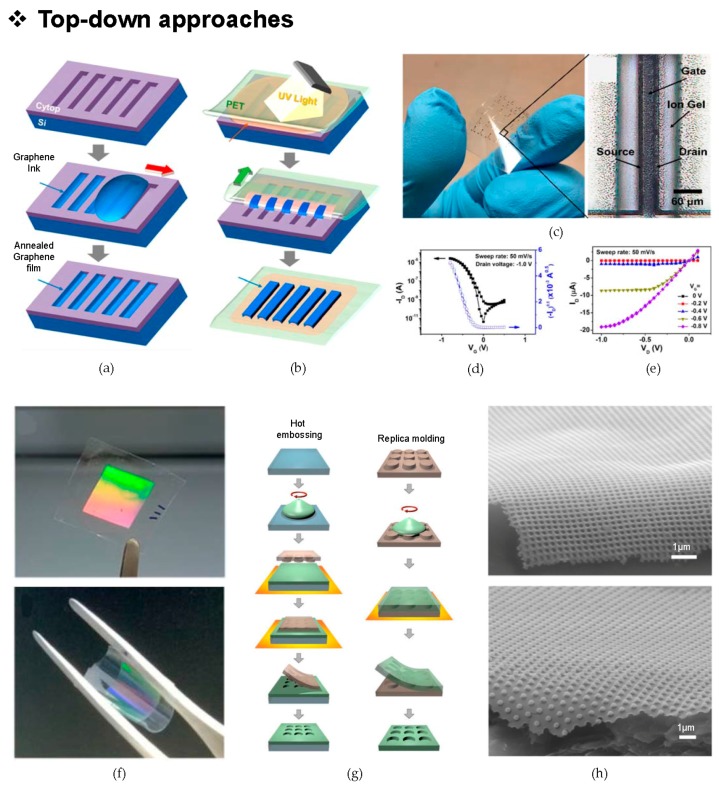
Recent progress in fabricating flexible electronics has been significantly developed because of the increased interest in flexible electronics, which can be applied to enormous fields, not only conventional in electronic devices, but also in bio/eco-electronic devices. Flexible electronics can be applied to a wide range of fields, such as flexible displays, flexible power storages, flexible solar cells, wearable electronics, and healthcare monitoring devices. Recently, flexible electronics have been attached to the skin and have even been implanted into the human body for monitoring biosignals and for treatment purposes. To improve the electrical and mechanical properties of flexible electronics, nanoscale fabrications using novel nanomaterials are required. Advancements in nanoscale fabrication methods allow the construction of active materials that can be combined with ultrathin soft substrates to form flexible electronics with high performances and reliability. In this review, a wide range of flexible electronic applications via nanoscale fabrication methods, classified as either top-down or bottom-up approaches, including conventional photolithography, soft lithography, nanoimprint lithography, growth, assembly, and chemical vapor deposition (CVD), are introduced, with specific fabrication processes and results. Here, our aim is to introduce recent progress on the various fabrication methods for flexible electronics, based on novel nanomaterials, using application examples of fundamental device components for electronics and applications in healthcare systems.
由于对柔性电子学的兴趣日益浓厚,柔性电子学制造方面的最新进展得到了显著发展。柔性电子学可应用于众多领域,不仅包括传统电子设备,还包括生物/生态电子设备。柔性电子学可应用于广泛的领域,如柔性显示器、柔性储能装置、柔性太阳能电池、可穿戴电子设备和医疗监测设备。最近,柔性电子学已被附着在皮肤上,甚至被植入人体以监测生物信号和用于治疗目的。为了提高柔性电子学的电学和力学性能,需要使用新型纳米材料进行纳米尺度制造。纳米尺度制造方法的进步使得能够构建活性材料,这些材料可以与超薄软基板结合,形成具有高性能和可靠性的柔性电子学。在这篇综述中,将介绍通过纳米尺度制造方法实现的广泛柔性电子应用,这些方法分为自上而下或自下而上的方法,包括传统光刻、软光刻、纳米压印光刻、生长、组装和化学气相沉积(CVD),并给出具体的制造工艺和结果。在这里,我们的目的是基于新型纳米材料,通过电子学基本器件组件的应用实例以及在医疗系统中的应用,介绍柔性电子学各种制造方法的最新进展。