Godwin Jessica, Raftery Adrian E
Department of Statistics, University of Washington, Seattle, USA.
Demogr Res. 2017 Jul-Dec;37:1549-1610. doi: 10.4054/DemRes.2017.37.48. Epub 2017 Nov 23.
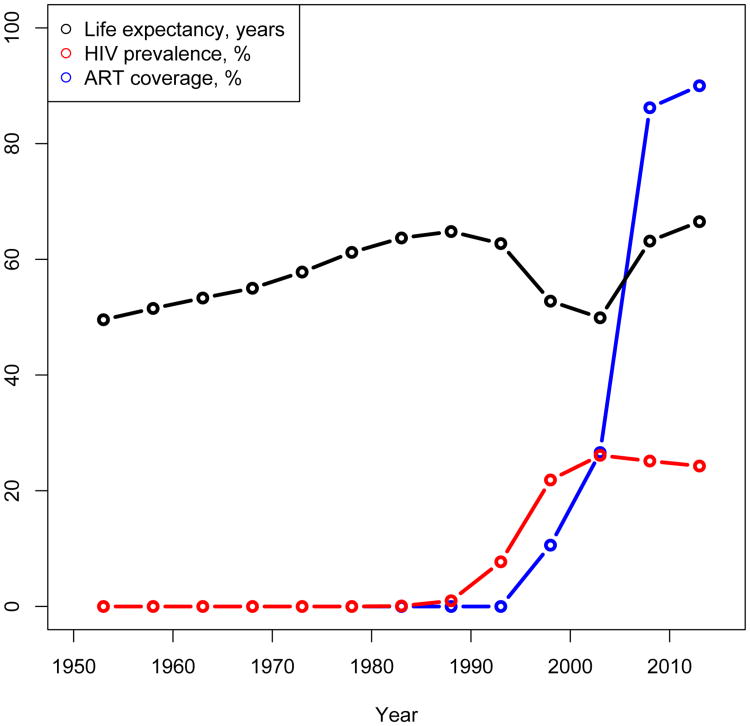
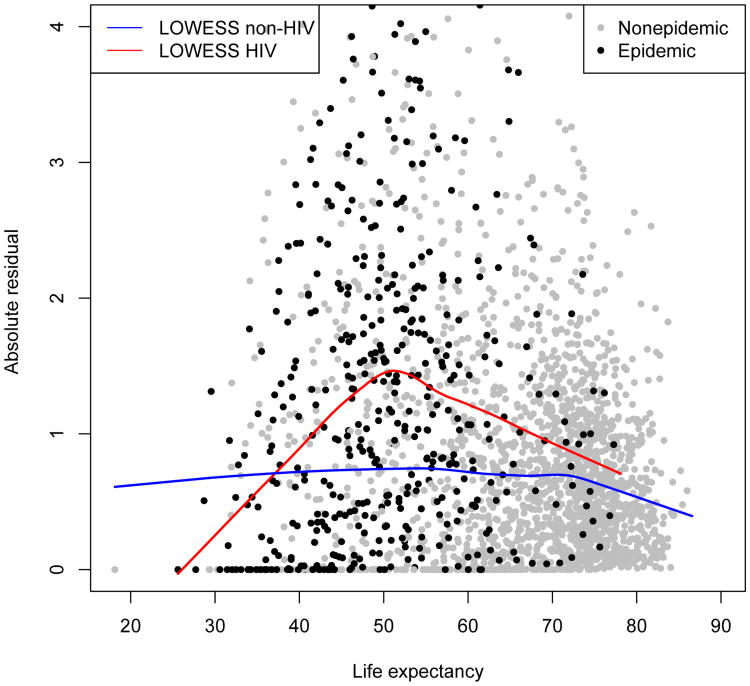
While probabilistic projection methods for projecting life expectancy exist, few account for covariates related to life expectancy. Generalized HIV/AIDS epidemics have a large, immediate negative impact on the life expectancy in a country, but this impact can be mitigated by widespread use of antiretroviral therapy (ART). Thus, projection methods for countries with generalized HIV/AIDS epidemics could be improved by accounting for HIV prevalence, the future course of the epidemic, and ART coverage.
We extend the current Bayesian probabilistic life expectancy projection methods of Raftery et al. (2013) to account for HIV prevalence and adult ART coverage in countries with generalized HIV/AIDS epidemics.
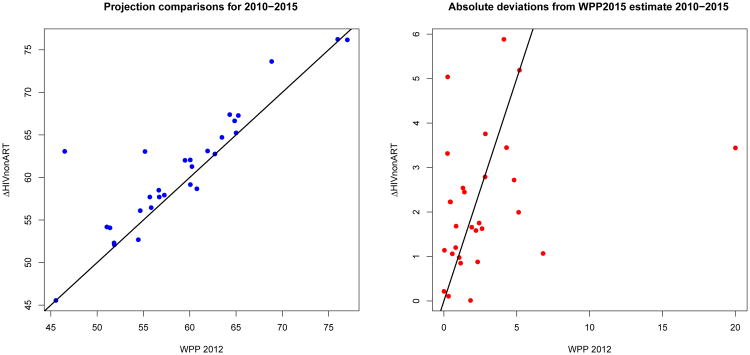
We evaluate our method using out-of-sample validation. We find that the proposed method performs better than the method that does not account for HIV prevalence or ART coverage for projections of life expectancy in countries with a generalized epidemic, while projections for countries without an epidemic remain essentially unchanged.
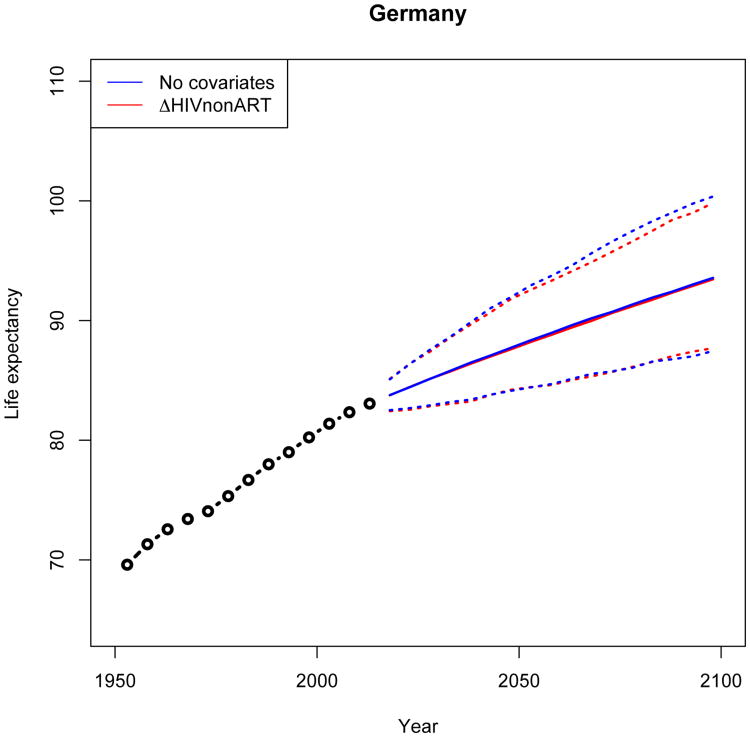
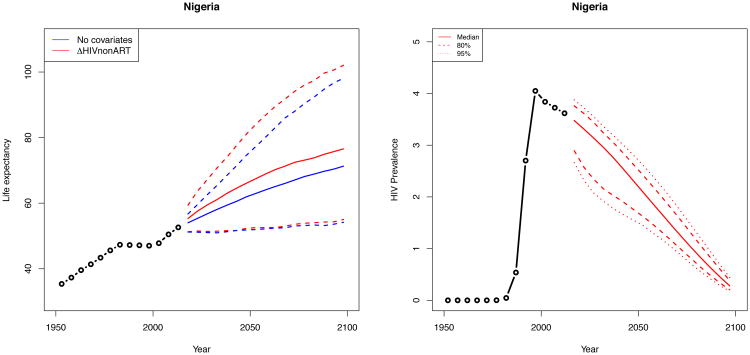
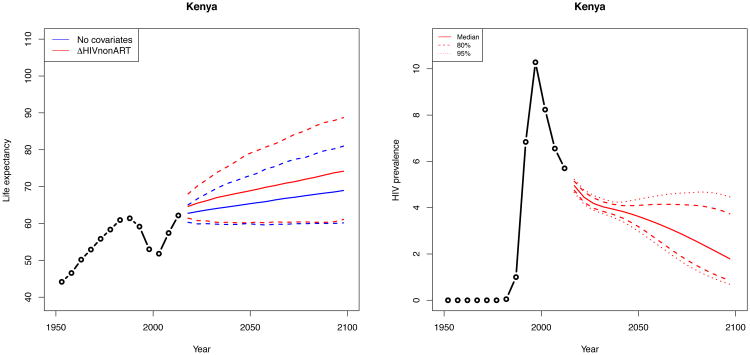
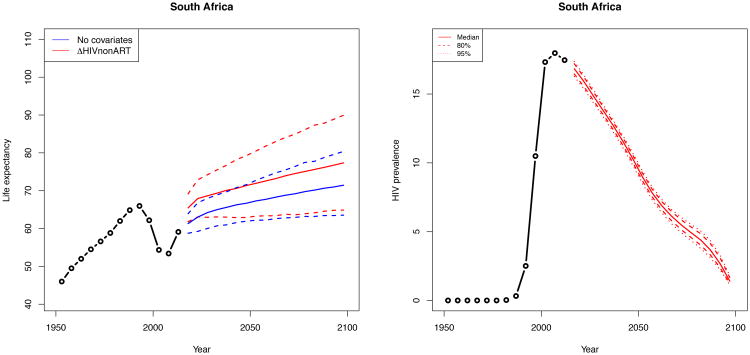
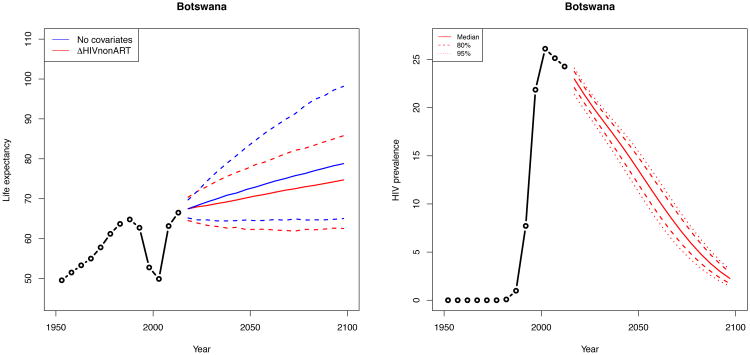
In general, our projections show rapid recovery to pre-epidemic life expectancy levels in the presence of widespread ART coverage. After the initial life expectancy recovery, we project a steady rise in life expectancy until the end of the century.
We develop a simple Bayesian hierarchical model for long-term projections of life expectancy while accounting for HIV/AIDS prevalence and coverage of ART. The method produces well-calibrated projections for countries with generalized HIV/AIDS epidemics up to 2100 while having limited data demands.
虽然存在用于预测预期寿命的概率预测方法,但很少有方法考虑与预期寿命相关的协变量。广泛流行的艾滋病毒/艾滋病对一个国家的预期寿命有巨大且直接的负面影响,但这种影响可以通过广泛使用抗逆转录病毒疗法(ART)来减轻。因此,通过考虑艾滋病毒流行率、疫情的未来发展轨迹以及抗逆转录病毒疗法的覆盖范围,可以改进针对存在广泛艾滋病毒/艾滋病疫情国家的预测方法。
我们扩展了拉夫蒂等人(2013年)当前的贝叶斯概率预期寿命预测方法,以考虑存在广泛艾滋病毒/艾滋病疫情国家的艾滋病毒流行率和成人抗逆转录病毒疗法覆盖情况。
我们使用样本外验证来评估我们的方法。我们发现,对于存在广泛疫情国家的预期寿命预测,所提出的方法比不考虑艾滋病毒流行率或抗逆转录病毒疗法覆盖情况的方法表现更好,而对于没有疫情国家的预测基本保持不变。
总体而言,我们的预测表明,在广泛覆盖抗逆转录病毒疗法的情况下,预期寿命会迅速恢复到疫情前的水平。在预期寿命最初恢复之后,我们预测预期寿命将稳步上升直至本世纪末。
我们开发了一个简单的贝叶斯分层模型,用于在考虑艾滋病毒/艾滋病流行率和抗逆转录病毒疗法覆盖情况的同时对预期寿命进行长期预测。该方法在数据需求有限的情况下,能对到2100年存在广泛艾滋病毒/艾滋病疫情的国家做出校准良好的预测。