Department of Epidemiology, Johns Hopkins University, Baltimore, Maryland.
Center on Aging and Health, Johns Hopkins University, Baltimore, Maryland.
J Am Geriatr Soc. 2019 Feb;67(2):261-268. doi: 10.1111/jgs.15631. Epub 2018 Nov 19.
To evaluate the effect of hospitalizations on patterns of sedentary and physical activity time in mobility-limited older adults randomized to structured physical activity or health education.
Secondary analysis of investigator-blinded, parallel-group, randomized trial conducted at 8 U.S. centers between February 2010 and December 2013.
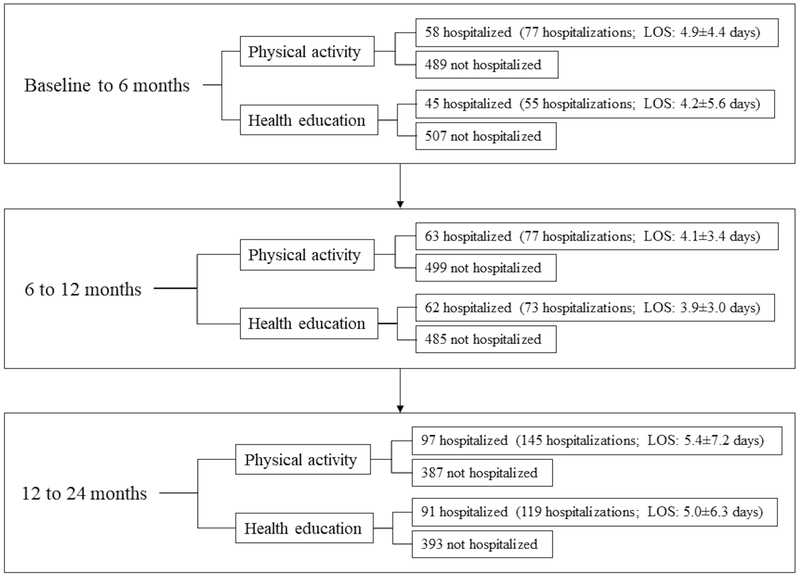
Sedentary men and women aged 70 to 89 at baseline who wore a hip-fitted accelerometer 7 consecutive days at baseline and 6, 12, and 24 months after randomization (N=1,341).
Participants were randomized to a physical activity (PA; n = 669) intervention that included aerobic, resistance, and flexibility training or to a health education (HE; n = 672) intervention that consisted of workshops on older adult health and light upper-extremity stretching. Accelerometer patterns were characterized as bouts of sedentary (<100 counts/min; ≥1, ≥10, ≥30, ≥60 minute lengths) and activity (≥100 counts/min; ≥1, ≥2, ≥5, ≥10 minute lengths) time. Each participant was categorized as having 0, 1 to 3, or 4 or more cumulative hospital days before each accelerometer assessment.
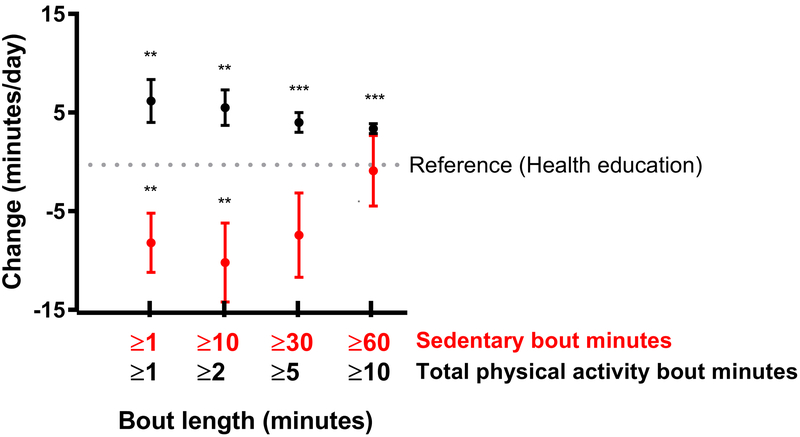
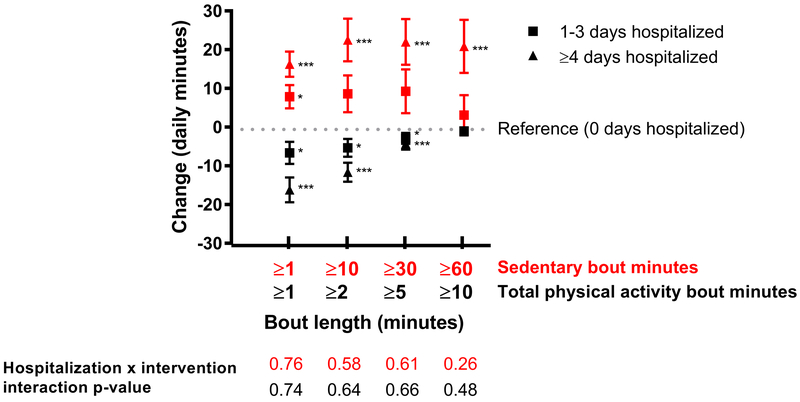
Hospitalization increased sedentary time similarly in both intervention groups (8 min/d for 1-3 cumulative hospital days and 16 min/d for ≥4 cumulative hospital days). Hospitalization was also associated with less physical activity time across all bouts of less than 10 minutes (≥1: -7 min/d for 1-3 cumulative hospital days, -16 min/d for ≥4 cumulative hospital days; ≥2: -5 min/d for 1-3 cumulative hospital days, -11 min/d for ≥4 cumulative hospital days; ≥5: -3 min/d for 1-3 cumulative hospital days, -4 min/d for ≥4 cumulative hospital days). There was no evidence of recovery to prehospitalization levels (time effect p >.41). PA participants had less sedentary time in bouts of less than 30 minutes than HE participants (-8 to -10 min/d) and more total activity (+3 to +6 min/d), although hospital-related changes were similar between the intervention groups (interaction effect p >.26).
Participating in a PA intervention before hospitalization had expected benefits, but participants remained susceptible to hospitalization's detrimental effects on their daily activity levels. There was no evidence of better activity recovery after hospitalization. J Am Geriatr Soc 67:261-268, 2019.
评估住院对身体活动受限的老年人进行结构化身体活动或健康教育后的久坐和身体活动时间模式的影响。
2010 年 2 月至 2013 年 12 月在美国 8 个中心进行的研究者盲法、平行组、随机试验的二次分析。
基线时年龄为 70 至 89 岁、佩戴腰部佩戴式加速度计连续 7 天、随机分组后 6、12 和 24 个月(N=1,341)的久坐男性和女性。
参与者被随机分配到身体活动(PA;n=669)干预组,该干预组包括有氧运动、阻力运动和柔韧性训练,或健康教育(HE;n=672)干预组,该干预组包括关于老年健康和轻度上肢伸展的研讨会。加速度计模式的特征是久坐(<100 计数/分钟;≥1、≥10、≥30、≥60 分钟长度)和活动(≥100 计数/分钟;≥1、≥2、≥5、≥10 分钟长度)时间。每个参与者在每次加速度计评估前被归类为有 0、1 至 3 或 4 或更多累积住院天数。
住院使两组干预组的久坐时间都增加了相似的时间(1-3 个累积住院天数为 8 分钟/天,≥4 个累积住院天数为 16 分钟/天)。住院也与所有小于 10 分钟的活动时间减少有关(≥1:1-3 个累积住院天数减少 7 分钟/天,≥4 个累积住院天数减少 16 分钟/天;≥2:1-3 个累积住院天数减少 5 分钟/天,≥4 个累积住院天数减少 11 分钟/天;≥5:1-3 个累积住院天数减少 3 分钟/天,≥4 个累积住院天数减少 4 分钟/天)。没有证据表明恢复到住院前的水平(时间效应 p>.41)。与 HE 参与者相比,PA 参与者在小于 30 分钟的时间内的久坐时间较少(-8 至-10 分钟/天),而总活动量较多(+3 至+6 分钟/天),尽管干预组之间的住院相关变化相似(交互作用效应 p>.26)。
在住院前参加 PA 干预有预期的益处,但参与者仍然容易受到住院对其日常活动水平的不利影响。没有证据表明住院后活动恢复更好。J Am Geriatr Soc 67:261-268, 2019.