Department of Nutritional Research, Umeå University, Umeå, Sweden.
Department of Odontology, Umeå University, Umeå, Sweden.
Nutr J. 2018 Nov 22;17(1):110. doi: 10.1186/s12937-018-0418-y.
The association between milk and dairy intake and the incidence of cardiometabolic diseases, cancer and mortality has been evaluated in many studies, but these studies have had conflicting results with no clear conclusion on causal or confounding associations. The present study aims to further address this association by cross-sectional and longitudinal evaluation of the associations between exposure to various types of dairy products and metabolic risk markers among inhabitants in northern Sweden while taking other lifestyle factors into account.
Respondents in the Västerbotten Intervention Programme with complete and plausible diet data between 1991 and 2016 were included, yielding 124,934 observations from 90,512 unique subjects. For longitudinal analysis, 27,682 participants with a visit 8-12 years after the first visit were identified. All participants completed a validated Food Frequency Questionnaire. Metabolic risk markers, including body mass index (BMI), blood pressure, serum (S) cholesterol and triglycerides, and blood glucose, were measured. Participants were categorized into quintiles by intake of dairy products, and risk (odds ratios, OR) of undesirable levels of metabolic risk markers was assessed in multivariable logistic regression analyses. In longitudinal analyses, intake quintiles were related to desirable levels of metabolic risk markers at both visits or deterioration at follow-up using Cox regression analyses.
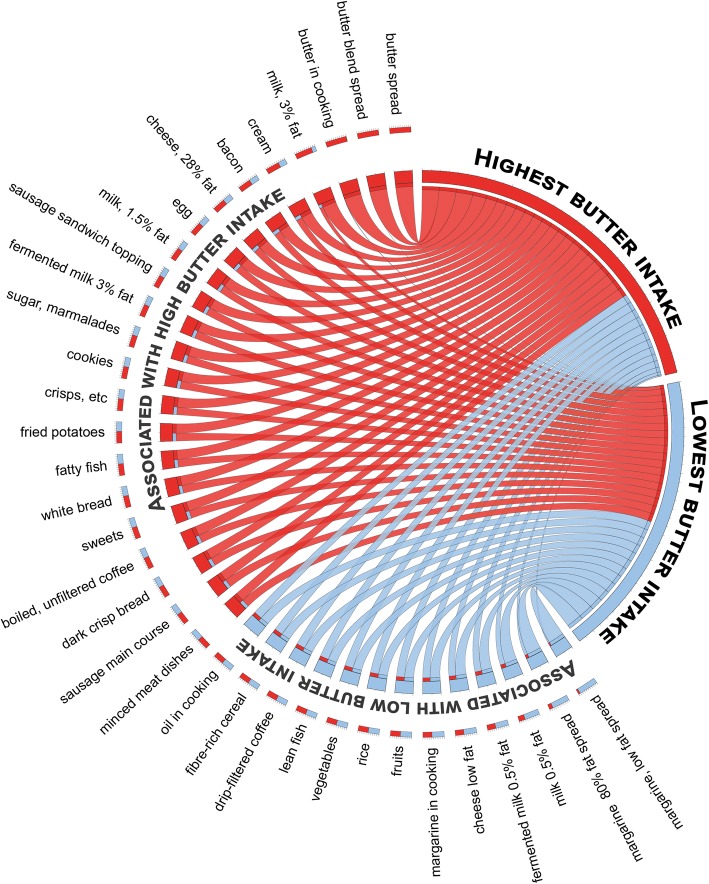
The OR of being classified with an undesirable BMI decreased with increasing quintiles of total dairy, cheese and butter intake but increased with increasing non-fermented milk intake. The OR of being classified with an undesirable S-cholesterol level increased with increasing intake of total dairy, butter and high fat (3%) non-fermented milk, whereas an undesirable S-triglyceride level was inversely associated with cheese and butter intake in women. In longitudinal analyses, increasing butter intake was associated with deterioration of S-cholesterol and blood glucose levels, whereas increasing cheese intake was associated with a lower risk of deterioration of S-triglycerides.
Confounding factors likely contribute to the demonstrated association between dairy intake and mortality, and other medical conditions and analyses should be stratified by dairy type.
许多研究评估了牛奶和乳制品摄入与心血管代谢疾病、癌症和死亡率的关系,但这些研究的结果相互矛盾,对于因果或混杂关联没有明确的结论。本研究旨在通过横断面和纵向评估瑞典北部居民暴露于各种乳制品与代谢风险标志物之间的关系,同时考虑其他生活方式因素,进一步解决这一关联。
纳入了 1991 年至 2016 年间饮食数据完整且合理的 Västerbotten 干预计划的参与者,从 90512 名参与者中获得了 124934 次观察结果。对于纵向分析,确定了 27682 名在第一次就诊后 8-12 年内进行访问的参与者。所有参与者均完成了经过验证的食物频率问卷。代谢风险标志物包括体重指数(BMI)、血压、血清(S)胆固醇和甘油三酯以及血糖。参与者根据乳制品摄入量分为五组,并在多变量逻辑回归分析中评估了不良代谢风险标志物水平的风险(比值比,OR)。在纵向分析中,使用 Cox 回归分析评估了在两次就诊时或随访时不良代谢风险标志物水平的五分位数与不良代谢风险标志物水平的相关性。
随着总乳制品、奶酪和黄油摄入量的增加,被归类为 BMI 不良的 OR 降低,但随着非发酵乳摄入量的增加而增加。随着总乳制品、黄油和高脂肪(3%)非发酵乳摄入量的增加,被归类为 S-胆固醇水平不良的 OR 增加,而女性 S-甘油三酯水平与奶酪和黄油摄入量呈负相关。在纵向分析中,黄油摄入量的增加与 S-胆固醇和血糖水平的恶化相关,而奶酪摄入量的增加与 S-甘油三酯恶化风险降低相关。
可能存在混杂因素导致乳制品摄入与死亡率和其他医疗状况之间存在关联,并且应该按乳制品类型进行分层分析。