Dumas Sabrina N, Ntambi James M
Department of Nutritional Sciences, University of Wisconsin-Madison, Madison, Wisconsin, United States of America.
Department of Biochemistry, University of Wisconsin-Madison, Madison, Wisconsin, United States of America.
J Cell Signal (Los Angel). 2018;3(3). doi: 10.4172/2576-1471.1000189. Epub 2018 Oct 10.
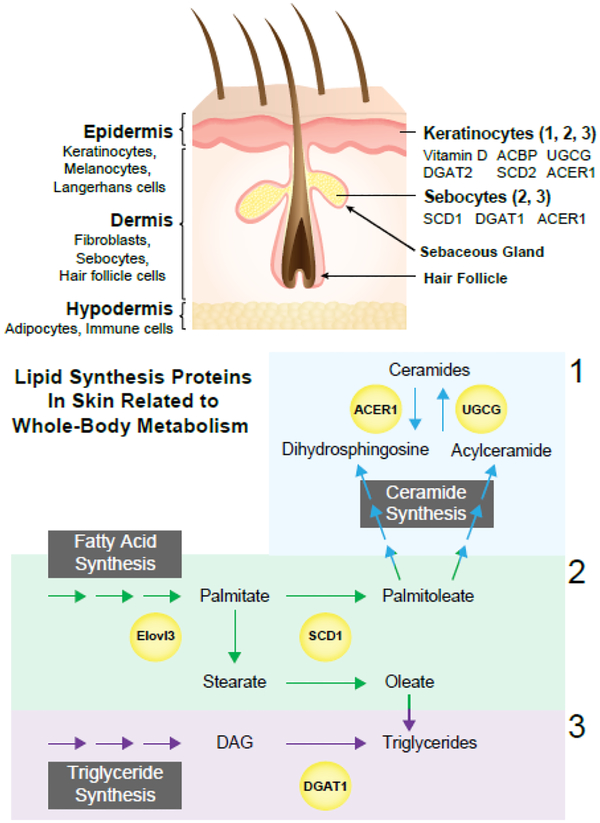
The obesity epidemic is a costly public health crisis that is not improving. In addition to the stigma and discomfort associated with carrying extra weight (at the expense of range of movement), obesity also goes hand-in-hand with co-morbidities like fatty liver disease, diabetes, cardiovascular disease, and increased risk of some forms of cancer. Currently there are no long-lasting treatments for obesity other than diet and exercise, which are not feasible for many populations that may not be equipped with the resources and/or support needed to lead a healthy lifestyle. Although there have been some pharmacological breakthroughs for treating obesity, each FDA-approved drug comes with unpleasant side-effects that make adherence unlikely. As a result, alternate approaches are necessary. In this review, we outline the relationship between skin lipid metabolism and whole-body glucose and lipid metabolism. Specifically, by summarizing studies that employed mice that were genetically modified to interrupt lipid metabolism in the skin. As a result, we propose that skin might be an overlooked, but viable target for combating obesity.
肥胖流行是一场代价高昂且未见改善的公共卫生危机。除了与超重相关的耻辱感和不适(以活动范围受限为代价)外,肥胖还与诸如脂肪肝疾病、糖尿病、心血管疾病以及某些癌症风险增加等合并症密切相关。目前,除了饮食和运动外,尚无针对肥胖的长效治疗方法,而对于许多可能不具备健康生活方式所需资源和/或支持的人群来说,饮食和运动并不可行。尽管在治疗肥胖方面取得了一些药理学突破,但每种获得美国食品药品监督管理局(FDA)批准的药物都伴有令人不适的副作用,这使得患者不太可能坚持用药。因此,需要采取其他方法。在本综述中,我们概述了皮肤脂质代谢与全身葡萄糖和脂质代谢之间的关系。具体而言,通过总结利用基因改造小鼠来阻断皮肤脂质代谢的研究。因此,我们提出皮肤可能是对抗肥胖的一个被忽视但可行的靶点。