Florian Baron Camilo, Mimidis Alexandros, Puerto Daniel, Skoulas Evangelos, Stratakis Emmanuel, Solis Javier, Siegel Jan
Laser Processing Group, Instituto de Óptica, IO-CSIC, Serrano 121, 28006 Madrid, Spain.
Institute of Electronic Structure and Laser (IESL), Foundation for Research and Technology (FORTH), N. Plastira 100, Vassilika Vouton, 70013, Heraklion, Crete, Greece.
Beilstein J Nanotechnol. 2018 Nov 5;9:2802-2812. doi: 10.3762/bjnano.9.262. eCollection 2018.
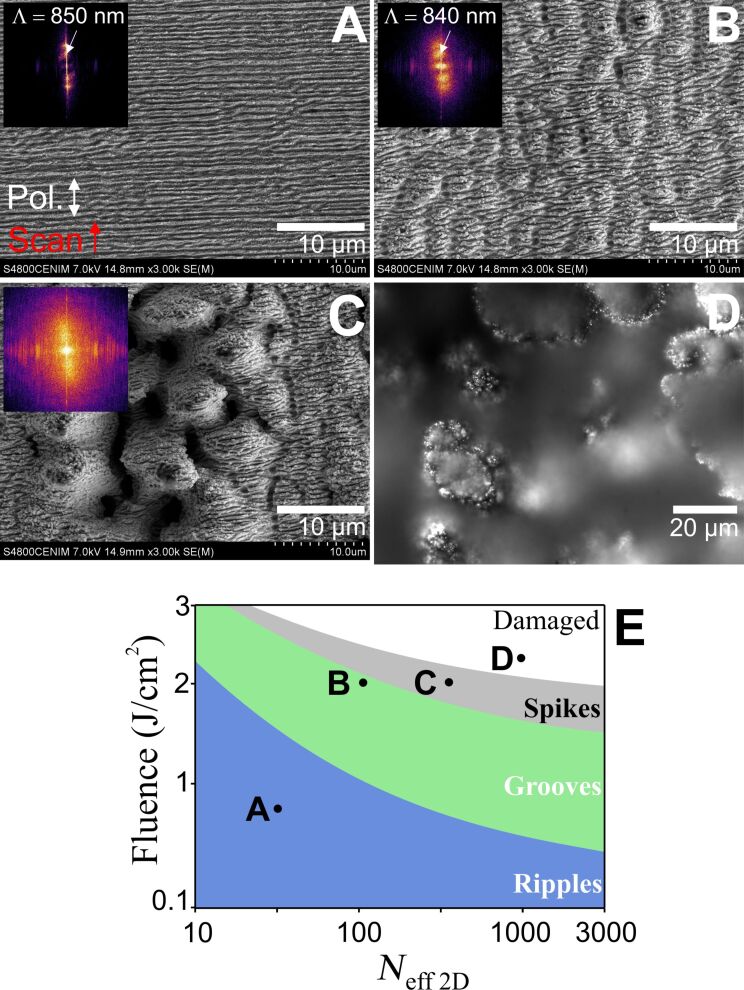
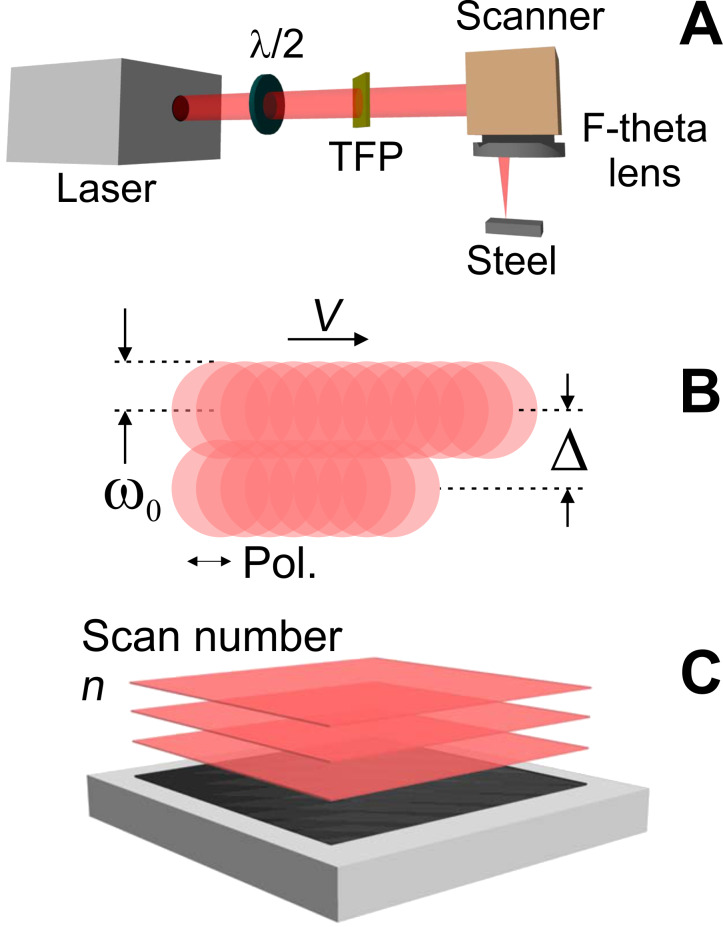
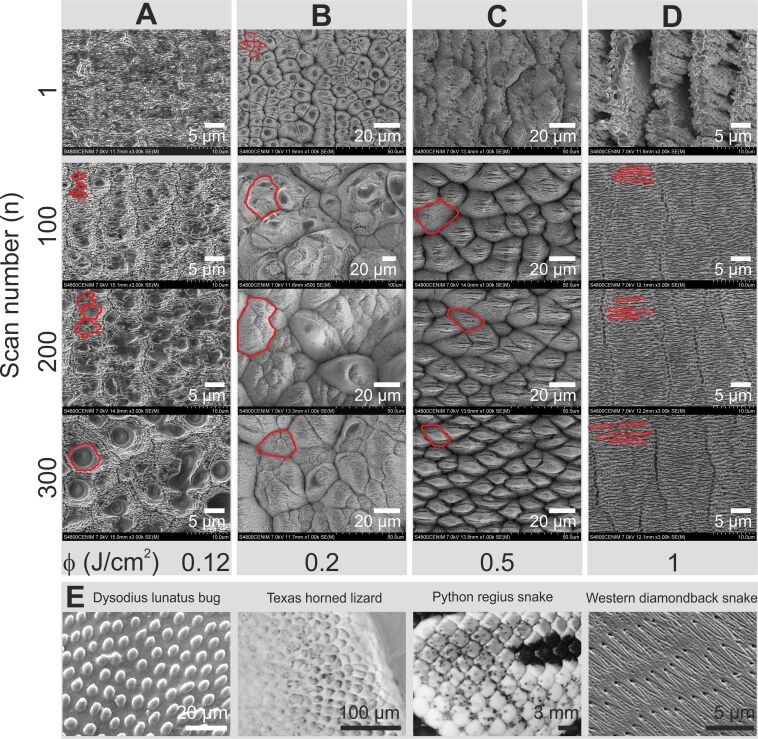
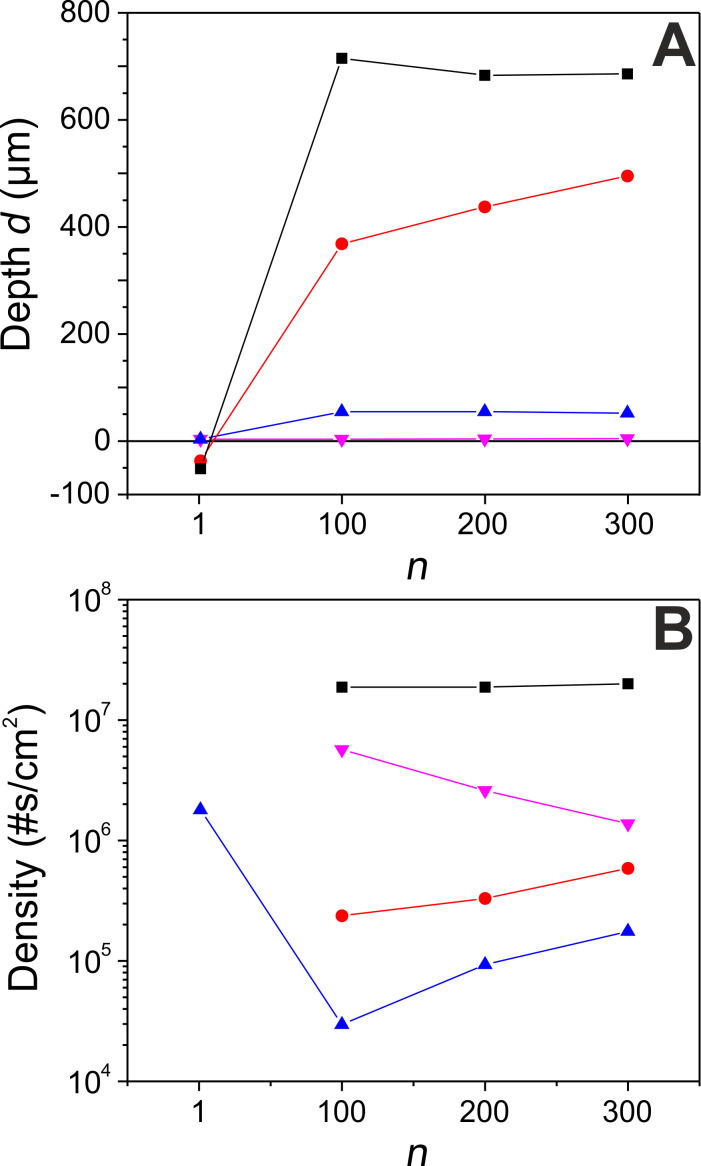
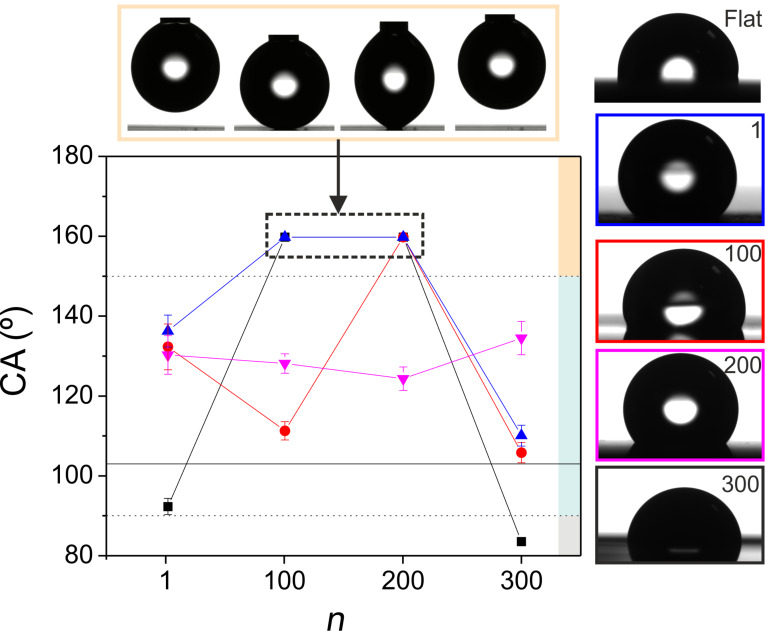
The replication of complex structures found in nature represents an enormous challenge even for advanced fabrication techniques, such as laser processing. For certain applications, not only the surface topography needs to be mimicked, but often also a specific function of the structure. An alternative approach to laser direct writing of complex structures is the generation of laser-induced periodic surface structures (LIPSS), which is based on directed self-organization of the material and allows fabrication of specific micro- and nanostructures over extended areas. In this work, we exploit this approach to fabricate complex biomimetic structures on the surface of steel 1.7131 formed upon irradiation with high repetition rate femtosecond laser pulses. In particular, the fabricated structures show similarities to the skin of certain reptiles and integument of insects. Different irradiation parameters are investigated to produce the desired structures, including laser repetition rate and laser fluence, paying special attention to the influence of the number of times the same area is rescanned with the laser. The latter parameter is identified to be crucial for controlling the morphology and size of specific structures. As an example for the functionality of the structures, we have chosen the surface wettability and studied its dependence on the laser processing parameters. Contact angle measurements of water drops placed on the surface reveal that a wide range of angles can be accessed by selecting the appropriate irradiation parameters, highlighting also here the prominent role of the number of scans.
即使对于先进的制造技术,如激光加工,复制自然界中发现的复杂结构也是一项巨大的挑战。对于某些应用,不仅需要模仿表面形貌,还常常需要模仿结构的特定功能。激光直接写入复杂结构的一种替代方法是生成激光诱导的周期性表面结构(LIPSS),它基于材料的定向自组织,能够在大面积上制造特定的微纳结构。在这项工作中,我们利用这种方法在1.7131钢表面上制造复杂的仿生结构,该表面是在高重复率飞秒激光脉冲照射下形成的。特别是,制造的结构与某些爬行动物的皮肤和昆虫的外皮有相似之处。研究了不同的辐照参数以产生所需的结构,包括激光重复率和激光能量密度,特别关注同一区域被激光重新扫描的次数的影响。后一个参数被确定为控制特定结构的形态和尺寸的关键。作为结构功能的一个例子,我们选择了表面润湿性,并研究了其对激光加工参数的依赖性。对放置在表面上的水滴进行接触角测量表明,通过选择合适的辐照参数可以获得广泛的角度范围,这也突出了扫描次数在这里的重要作用。