Toufanian Reyhaneh, Piryatinski Andrei, Mahler Andrew H, Iyer Radhika, Hollingsworth Jennifer A, Dennis Allison M
Division of Materials Science and Engineering, Boston University, Boston, MA, United States.
Theoretical Division, Los Alamos National Laboratory, Los Alamos, NM, United States.
Front Chem. 2018 Nov 20;6:567. doi: 10.3389/fchem.2018.00567. eCollection 2018.
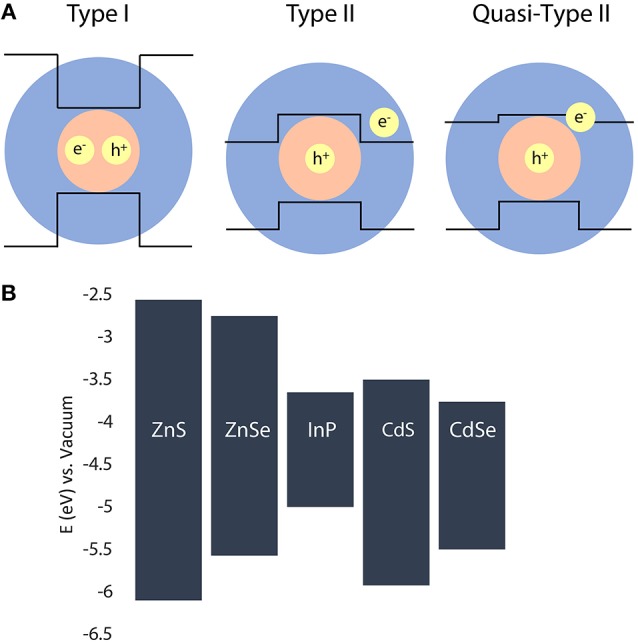
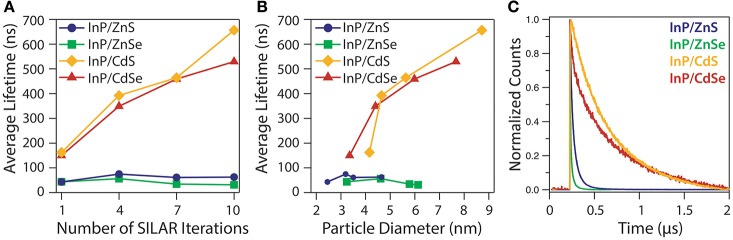
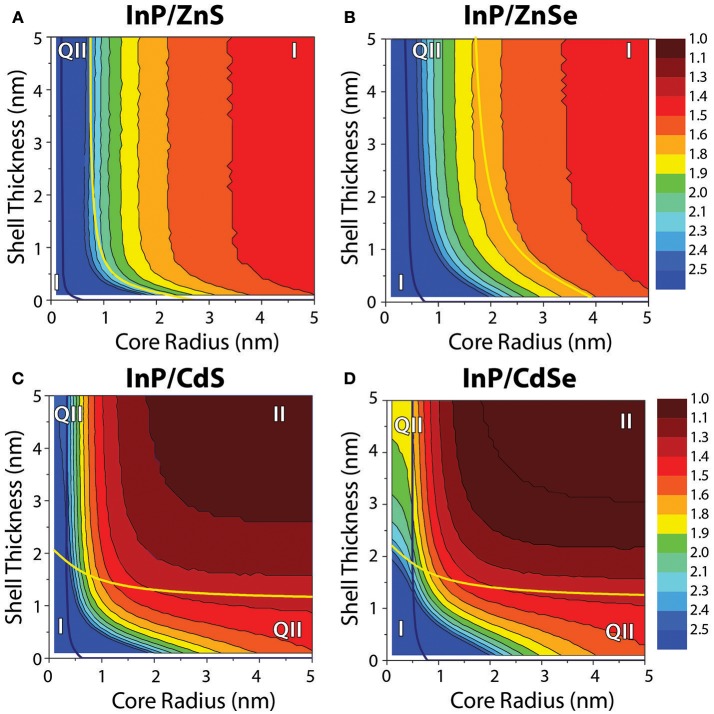
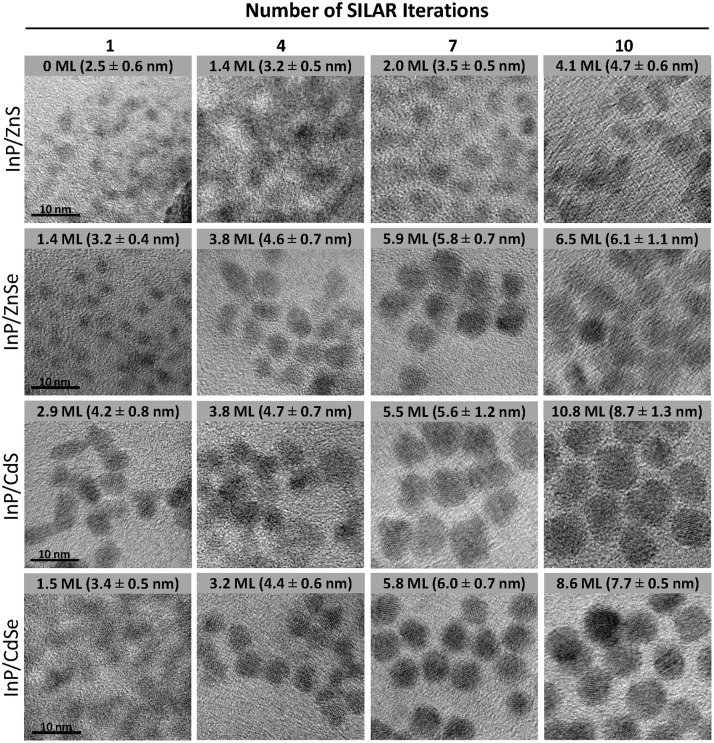
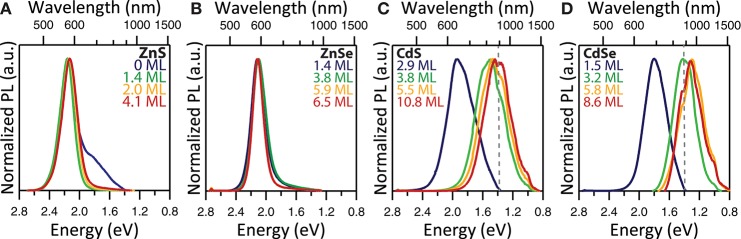
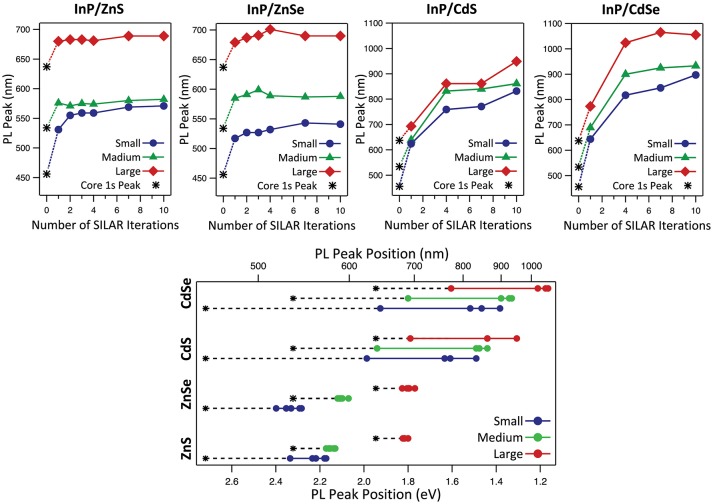
The large bulk bandgap (1.35 eV) and Bohr radius (~10 nm) of InP semiconductor nanocrystals provides bandgap tunability over a wide spectral range, providing superior color tuning compared to that of CdSe quantum dots. In this paper, the dependence of the bandgap, photoluminescence emission, and exciton radiative lifetime of core/shell quantum dot heterostructures has been investigated using colloidal InP core nanocrystals with multiple diameters (1.5, 2.5, and 3.7 nm). The shell thickness and composition dependence of the bandgap for type-I and type-II heterostructures was observed by coating the InP core with ZnS, ZnSe, CdS, or CdSe through one to ten iterations of a successive ion layer adsorption and reaction (SILAR)-based shell deposition. The empirical results are compared to bandgap energy predictions made with effective mass modeling. Photoluminescence emission colors have been successfully tuned throughout the visible and into the near infrared (NIR) wavelength ranges for type-I and type-II heterostructures, respectively. Based on sizing data from transmission electron microscopy (TEM), it is observed that at the same particle diameter, average radiative lifetimes can differ as much as 20-fold across different shell compositions due to the relative positions of valence and conduction bands. In this direct comparison of InP/ZnS, InP/ZnSe, InP/CdS, and InP/CdSe core/shell heterostructures, we clearly delineate the impact of core size, shell composition, and shell thickness on the resulting optical properties. Specifically, Zn-based shells yield type-I structures that are color tuned through core size, while the Cd-based shells yield type-II particles that emit in the NIR regardless of the starting core size if several layers of CdS(e) have been successfully deposited. Particles with thicker CdS(e) shells exhibit longer photoluminescence lifetimes, while little shell-thickness dependence is observed for the Zn-based shells. Taken together, these InP-based heterostructures demonstrate the extent to which we are able to precisely tailor the material properties of core/shell particles using core/shell dimensions and composition as variables.
磷化铟(InP)半导体纳米晶体具有较大的体带隙(1.35电子伏特)和玻尔半径(约10纳米),可在很宽的光谱范围内实现带隙可调谐,与硒化镉(CdSe)量子点相比,能提供更优异的颜色调谐。在本文中,我们使用了多种直径(1.5、2.5和3.7纳米)的胶体InP核纳米晶体,研究了核/壳量子点异质结构的带隙、光致发光发射以及激子辐射寿命的依赖性。通过基于连续离子层吸附和反应(SILAR)的壳层沉积,对InP核进行一到十次迭代的硫化锌(ZnS)、硒化锌(ZnSe)、硫化镉(CdS)或硒化镉(CdSe)包覆,观察了I型和II型异质结构的带隙对壳层厚度和组成的依赖性。将实验结果与有效质量模型预测的带隙能量进行了比较。对于I型和II型异质结构,分别在整个可见光和近红外(NIR)波长范围内成功实现了光致发光发射颜色的调谐。基于透射电子显微镜(TEM)的尺寸数据,观察到在相同粒径下,由于价带和导带的相对位置,不同壳层组成的平均辐射寿命差异可达20倍。在InP/ZnS、InP/ZnSe、InP/CdS和InP/CdSe核/壳异质结构的直接比较中,我们清楚地描绘了核尺寸、壳层组成和壳层厚度对所得光学性质的影响。具体而言,基于锌的壳层产生通过核尺寸进行颜色调谐的I型结构,而基于镉的壳层产生II型粒子,只要成功沉积了几层CdS(e),无论起始核尺寸如何,都会在近红外区域发射。具有较厚CdS(e)壳层的粒子表现出更长的光致发光寿命,而基于锌的壳层对壳层厚度的依赖性较小。综上所述,这些基于InP的异质结构展示了我们能够利用核/壳尺寸和组成作为变量精确调整核/壳粒子材料性质的程度。