Department of Medical Oncology, Erasmus MC Cancer Institute, University Medical Center Rotterdam, The Netherlands.
Workgroup Cancer Genomics Netherlands, Erasmus MC Cancer Institute, University Medical Center Rotterdam, The Netherlands.
Mol Oncol. 2019 Feb;13(2):392-402. doi: 10.1002/1878-0261.12415. Epub 2018 Dec 22.
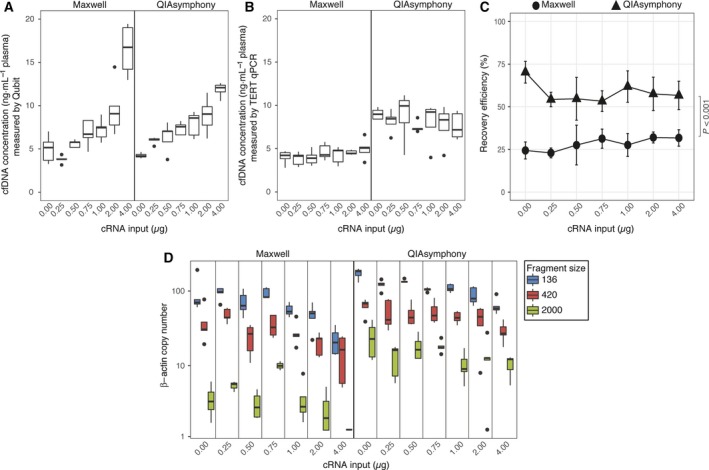
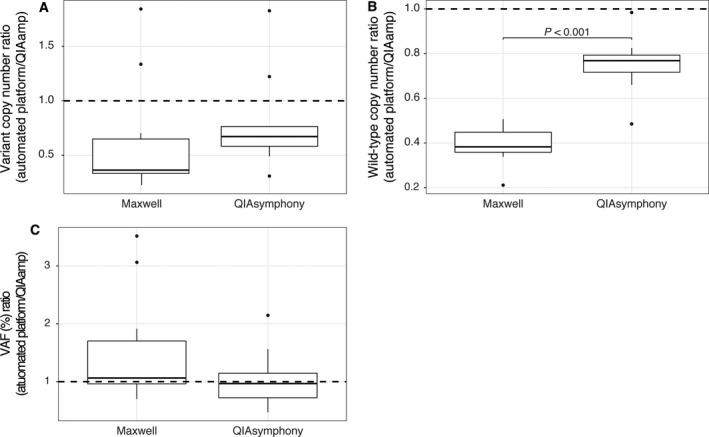
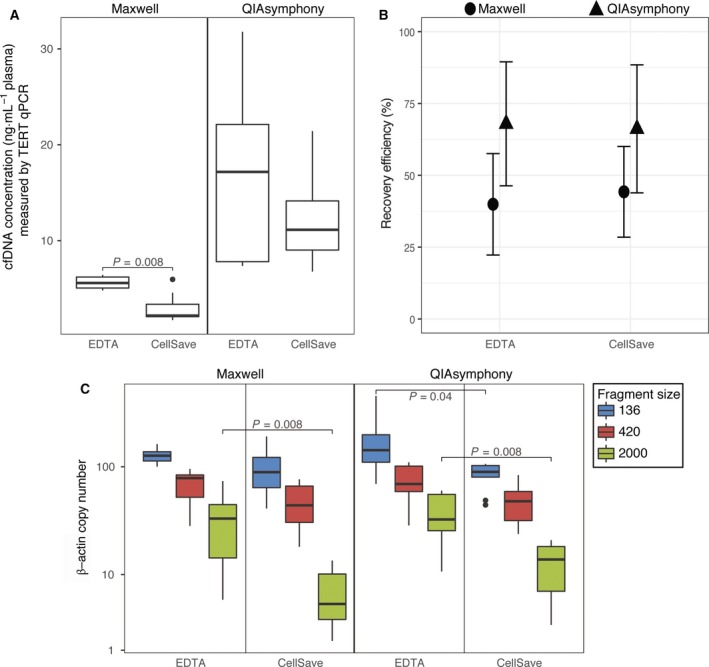
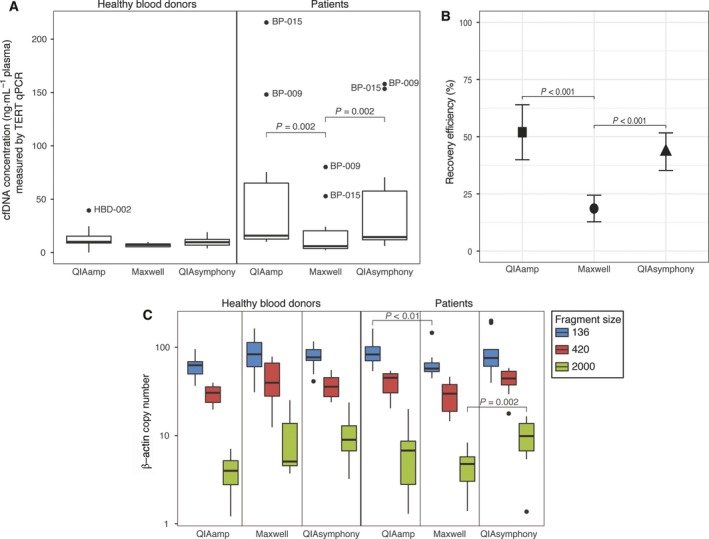
The emerging interest in circulating tumor DNA (ctDNA) analyses for clinical trials has necessitated the development of a high-throughput method for fast, reproducible, and efficient isolation of ctDNA. Currently, the majority of ctDNA studies use the manual QIAamp (QA) platform to isolate DNA from blood. The purpose of this study was to compare two competing automated DNA isolation platforms [Maxwell (MX) and QIAsymphony (QS)] to the current 'gold standard' QA to facilitate high-throughput processing of samples in prospective trials. We obtained blood samples from healthy blood donors and metastatic cancer patients for plasma isolation. Total cell-free DNA (cfDNA) quantity was assessed by TERT quantitative PCR. Recovery efficiency was investigated by quantitative PCR analysis of spiked-in synthetic plant DNA. In addition, a β-actin fragmentation assay was performed to determine the amount of contamination by genomic DNA from lysed leukocytes. ctDNA quality was assessed by digital PCR for somatic variant detection. cfDNA quantity and recovery efficiency were lowest using the MX platform, whereas QA and QS showed a comparable performance. All platforms preferentially isolated small (136 bp) DNA fragments over large (420 and 2000 bp) DNA fragments. Detection of the number variant and wild-type molecules was most comparable between QA and QS. However, there was no significant difference in variant allele frequency comparing QS and MX to QA. In summary, we show that the QS platform has comparable performance to QA, the 'gold standard', and outperformed the MX platform depending on the readout used. We conclude that the QS can replace the more laborious QA platform, especially when high-throughput cfDNA isolation is needed.
新兴的循环肿瘤 DNA(ctDNA)分析在临床试验中的应用,需要开发一种高通量的方法来快速、可重复、高效地分离 ctDNA。目前,大多数 ctDNA 研究使用手动 QIAamp(QA)平台从血液中分离 DNA。本研究旨在比较两种竞争的自动化 DNA 分离平台[Maxwell(MX)和 QIAsymphony(QS)]与当前的“金标准”QA,以促进前瞻性试验中样品的高通量处理。我们从健康献血者和转移性癌症患者获得血液样本进行血浆分离。通过 TERT 定量 PCR 评估总无细胞游离 DNA(cfDNA)量。通过定量 PCR 分析掺入的合成植物 DNA 来研究回收效率。此外,还进行了 β-肌动蛋白片段化测定,以确定从裂解白细胞中污染的基因组 DNA 量。通过数字 PCR 评估 ctDNA 质量以检测体细胞变异。使用 MX 平台时,cfDNA 量和回收率最低,而 QA 和 QS 表现出相当的性能。所有平台都优先分离小(136 bp)DNA 片段,而不是大(420 和 2000 bp)DNA 片段。QA 和 QS 之间最可比的是数量变异和野生型分子的检测。然而,与 QA 相比,QS 和 MX 对变体等位基因频率没有显著差异。总之,我们表明 QS 平台的性能与 QA 相当,“金标准”,并且根据使用的读出值优于 MX 平台。我们得出结论,QS 可以取代更繁琐的 QA 平台,尤其是在需要高通量 cfDNA 分离时。