School of Agriculture and Food Science, Institute of Food and Health, University College Dublin, Belfield, Dublin 4, Ireland.
Department of Nutrition, Exercise and Sports, Faculty of Science, University of Copenhagen, 1958 Frederiksberg C, Denmark.
Nutrients. 2018 Dec 4;10(12):1911. doi: 10.3390/nu10121911.
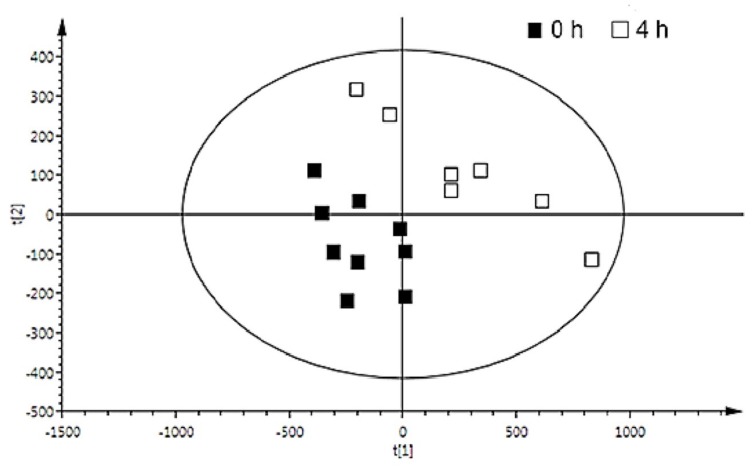
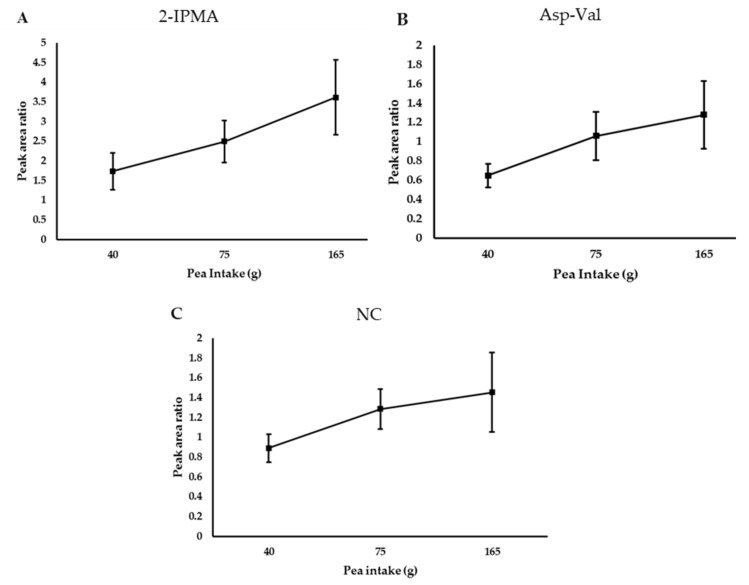
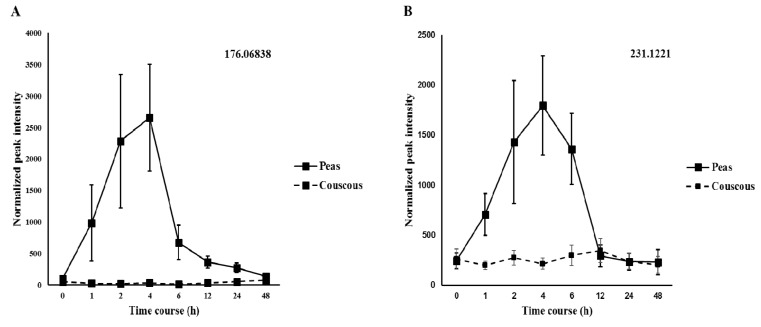
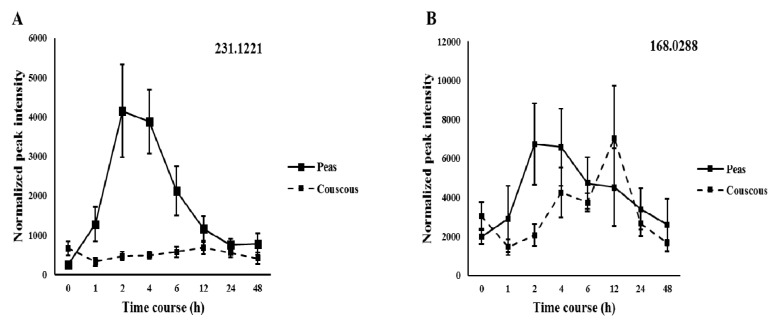
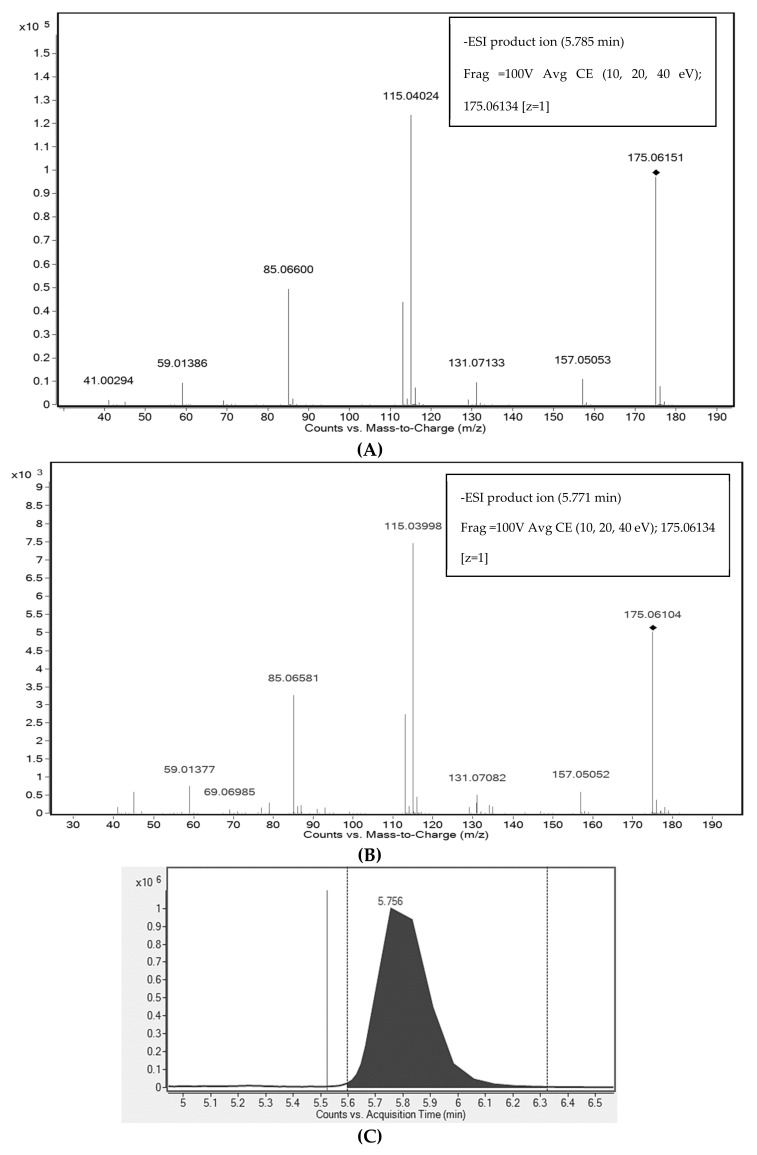
A significant body of evidence demonstrates that isoflavone metabolites are good markers of soy intake, while research is lacking on specific markers of other leguminous sources such as peas. In this context, the objective of our current study was to identify biomarkers of pea intake using an untargeted metabolomics approach. A randomized cross-over acute intervention study was conducted on eleven participants who consumed peas and couscous (control food) in random order. The urine samples were collected in fasting state and postprandially at regular intervals and were further analysed by ultra-performance liquid chromatography coupled to quadrupole time of flight mass spectrometry (UPLC-QTOF-MS). Multivariate statistical analysis resulted in robust Partial least squares Discriminant Analysis (PLS-DA) models obtained for comparison of fasting against the postprandial time points (0 h vs. 4 h, (R²X = 0.41, Q² = 0.4); 0 h vs. 6 h, ((R²X = 0.517, Q² = 0.495)). Variables with variable importance of projection (VIP) scores ≥1.5 obtained from the PLS-DA plot were considered discriminant between the two time points. Repeated measures analysis of variance (ANOVA) was performed to identify features with a significant time effect. Assessment of the time course profile revealed that ten features displayed a differential time course following peas consumption compared to the control food. The interesting features were tentatively identified using accurate mass data and confirmed by tandem mass spectrometry (MS using commercial spectral databases and authentic standards. 2-Isopropylmalic acid, asparaginyl valine and N-carbamoyl-2-amino-2-(4-hydroxyphenyl) acetic acid were identified as markers reflecting pea intake. The three markers also increased in a dose-dependent manner in a randomized intervention study and were further confirmed in an independent intervention study. Overall, key validation criteria were met for the successfully identified pea biomarkers. Future work will examine their use in nutritional epidemiology studies.
大量证据表明,异黄酮代谢物是大豆摄入量的良好标志物,而关于豌豆等其他豆类来源的特定标志物的研究则较少。在这种情况下,我们当前研究的目的是使用非靶向代谢组学方法来确定豌豆摄入量的生物标志物。在一项随机交叉急性干预研究中,11 名参与者随机摄入豌豆和蒸粗麦粉(对照食物)。在空腹和餐后定期收集尿液样本,并通过超高效液相色谱-四极杆飞行时间质谱联用(UPLC-QTOF-MS)进行进一步分析。多元统计分析得到了稳健的偏最小二乘判别分析(PLS-DA)模型,用于比较空腹与餐后时间点(0 h 与 4 h,(R²X = 0.41,Q² = 0.4);0 h 与 6 h,(R²X = 0.517,Q² = 0.495))。从 PLS-DA 图中获得的变量重要性投影(VIP)得分≥1.5 的变量被认为是两个时间点之间的判别变量。进行重复测量方差分析(ANOVA)以确定具有显著时间效应的特征。评估时间过程曲线发现,与对照食物相比,有 10 个特征在豌豆摄入后呈现出不同的时间过程。使用准确质量数据对有趣的特征进行了初步鉴定,并通过串联质谱(MS)进行了确认,使用商业光谱数据库和真实标准。鉴定出 2-异丙基马来酸、天冬酰胺缬氨酸和 N-碳酰-2-氨基-2-(4-羟基苯基)乙酸作为反映豌豆摄入量的标志物。在一项随机干预研究中,这三个标志物也呈剂量依赖性增加,并在一项独立的干预研究中得到进一步证实。总体而言,成功鉴定的豌豆生物标志物满足了关键验证标准。未来的工作将研究它们在营养流行病学研究中的应用。