Kang Wei-Bo, Chen Yong-Jie, Lu Du-Yi, Yan Jia-Zhi
Department of Orthopedic Surgery, Beijing Tiantan Hospital, Capital Medical University, Beijing, China.
Neural Regen Res. 2019 Jan;14(1):132-139. doi: 10.4103/1673-5374.243718.
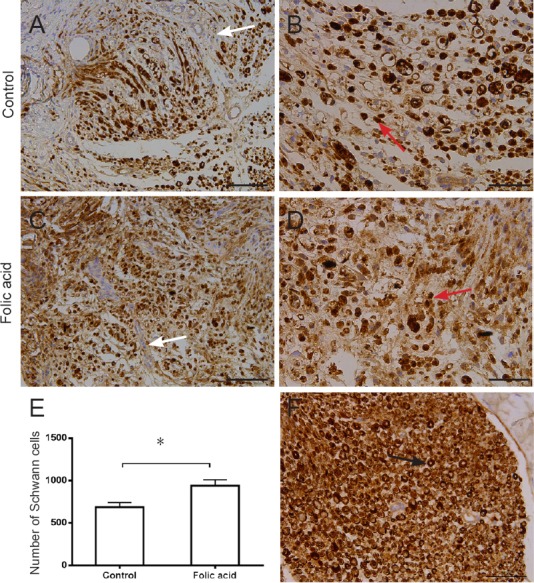
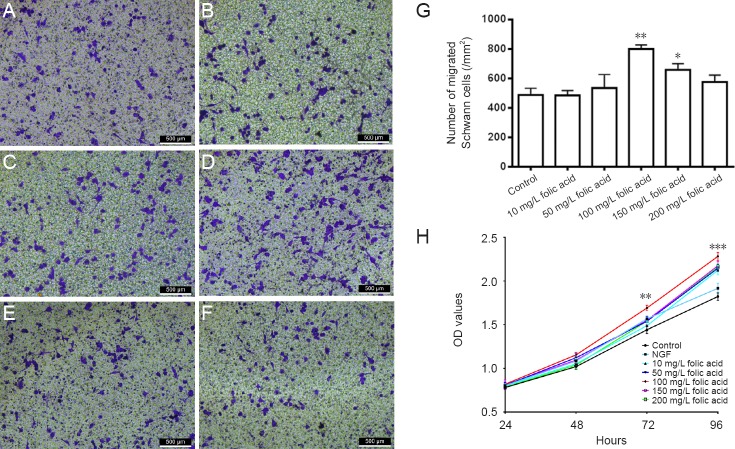
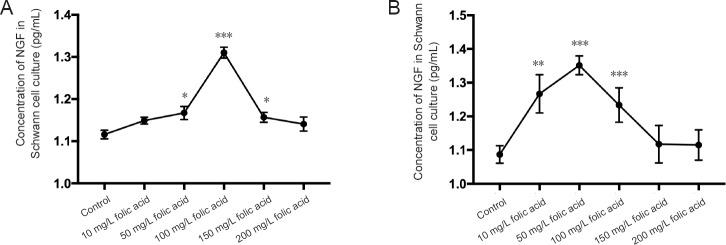
After peripheral nerve injury, intraperitoneal injection of folic acid improves axon quantity, increases axon density and improves electromyography results. However, the mechanisms for this remain unclear. This study explored whether folic acid promotes peripheral nerve injury repair by affecting Schwann cell function. Primary Schwann cells were obtained from rats by in vitro separation and culture. Cell proliferation, assayed using the Cell Counting Kit-8 assay, was higher in cells cultured for 72 hours with 100 mg/L folic acid compared with the control group. Cell proliferation was also higher in the 50, 100, 150, and 200 mg/L folic acid groups compared with the control group after culture for 96 hours. Proliferation was markedly higher in the 100 mg/L folic acid group compared with the 50 mg/L folic acid group and the 40 ng/L nerve growth factor group. In Transwell assays, the number of migrated Schwann cells dramatically increased after culture with 100 and 150 mg/L folic acid compared with the control group. In nerve growth factor enzyme-linked immunosorbent assays, treatment of Schwann cell cultures with 50, 100, and 150 mg/L folic acid increased levels of nerve growth factor in the culture medium compared with the control group at 3 days. The nerve growth factor concentration of Schwann cell cultures treated with 100 mg/L folic acid group was remarkably higher than that in the 50 and 150 mg/L folic acid groups at 3 days. Nerve growth factor concentration in the 10, 50, and 100 mg/L folic acid groups was higher than that in the control group at 7 days. The nerve growth factor concentration in the 50 mg/L folic acid group was remarkably higher than that in the 10 and 100 mg/L folic acid groups at 7 days. In vivo, 80 μg/kg folic acid was intraperitoneally administrated for 7 consecutive days after sciatic nerve injury. Immunohistochemical staining showed that the number of Schwann cells in the folic acid group was greater than that in the control group. We suggest that folic acid may play a role in improving the repair of peripheral nerve injury by promoting the proliferation and migration of Schwann cells and the secretion of nerve growth factors.
周围神经损伤后,腹腔注射叶酸可改善轴突数量、增加轴突密度并改善肌电图结果。然而,其机制尚不清楚。本研究探讨叶酸是否通过影响雪旺细胞功能促进周围神经损伤修复。通过体外分离和培养从大鼠获得原代雪旺细胞。使用细胞计数试剂盒-8检测法测定细胞增殖,与对照组相比,用100 mg/L叶酸培养72小时的细胞增殖更高。培养96小时后,50、100、150和200 mg/L叶酸组的细胞增殖也高于对照组。与50 mg/L叶酸组和40 ng/L神经生长因子组相比,100 mg/L叶酸组的增殖明显更高。在Transwell实验中,与对照组相比,用100和150 mg/L叶酸培养后,迁移的雪旺细胞数量显著增加。在神经生长因子酶联免疫吸附测定中,与对照组相比,用50、100和150 mg/L叶酸处理雪旺细胞培养物3天时,培养基中神经生长因子水平升高。用100 mg/L叶酸组处理的雪旺细胞培养物在3天时的神经生长因子浓度明显高于50和150 mg/L叶酸组。在7天时,10、50和100 mg/L叶酸组的神经生长因子浓度高于对照组。在7天时,50 mg/L叶酸组的神经生长因子浓度明显高于10和100 mg/L叶酸组。在体内,坐骨神经损伤后连续7天腹腔注射80 μg/kg叶酸。免疫组织化学染色显示,叶酸组的雪旺细胞数量多于对照组。我们认为叶酸可能通过促进雪旺细胞的增殖和迁移以及神经生长因子的分泌,在改善周围神经损伤修复中发挥作用。