Nanfang Hospital, Southern Medical University, Guangzhou 510515, China,
Guizhou Provincial People's Hospital, Guiyang 550002, China.
Int J Nanomedicine. 2018 Dec 11;13:8487-8506. doi: 10.2147/IJN.S170723. eCollection 2018.
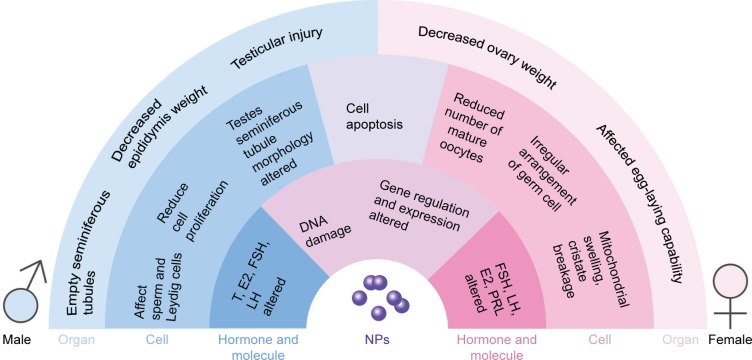
With the vigorous development of nanometer-sized materials, nanoproducts are becoming widely used in all aspects of life. In medicine, nanoparticles (NPs) can be used as nanoscopic drug carriers and for nanoimaging technologies. Thus, substantial attention has been paid to the potential risks of NPs. Previous studies have shown that numerous types of NPs are able to pass certain biological barriers and exert toxic effects on crucial organs, such as the brain, liver, and kidney. Only recently, attention has been directed toward the reproductive toxicity of nanomaterials. NPs can pass through the blood-testis barrier, placental barrier, and epithelial barrier, which protect reproductive tissues, and then accumulate in reproductive organs. NP accumulation damages organs (testis, epididymis, ovary, and uterus) by destroying Sertoli cells, Leydig cells, and germ cells, causing reproductive organ dysfunction that adversely affects sperm quality, quantity, morphology, and motility or reduces the number of mature oocytes and disrupts primary and secondary follicular development. In addition, NPs can disrupt the levels of secreted hormones, causing changes in sexual behavior. However, the current review primarily examines toxicological phenomena. The molecular mechanisms involved in NP toxicity to the reproductive system are not fully understood, but possible mechanisms include oxidative stress, apoptosis, inflammation, and genotoxicity. Previous studies have shown that NPs can increase inflammation, oxidative stress, and apoptosis and induce ROS, causing damage at the molecular and genetic levels which results in cytotoxicity. This review provides an understanding of the applications and toxicological effects of NPs on the reproductive system.
随着纳米材料的蓬勃发展,纳米产品在生活的各个方面得到了广泛的应用。在医学领域,纳米颗粒(NPs)可作为纳米级药物载体和纳米成像技术使用。因此,人们对 NPs 的潜在风险给予了极大的关注。先前的研究表明,许多类型的 NPs 能够穿透某些生物屏障,并对大脑、肝脏和肾脏等关键器官产生毒性作用。直到最近,人们才开始关注纳米材料的生殖毒性。NPs 可以穿透血睾屏障、胎盘屏障和上皮屏障,这些屏障保护生殖组织,然后在生殖器官中积累。NP 积累通过破坏支持细胞、间质细胞和生殖细胞来损害器官(睾丸、附睾、卵巢和子宫),导致生殖器官功能障碍,从而对精子质量、数量、形态和活力产生不利影响,或减少成熟卵母细胞的数量,并破坏初级和次级卵泡的发育。此外,NPs 还可以破坏分泌激素的水平,导致性行为的改变。然而,目前的综述主要研究了毒理学现象。NP 对生殖系统毒性的分子机制尚不完全清楚,但可能的机制包括氧化应激、细胞凋亡、炎症和遗传毒性。先前的研究表明,NPs 可以增加炎症、氧化应激和细胞凋亡,并诱导 ROS,导致分子和遗传水平的损伤,从而产生细胞毒性。本综述提供了对 NPs 对生殖系统的应用和毒理学效应的理解。