UMR BIPAR, INRA, ANSES, Ecole Nationale Vétérinaire d'Alfort, Université Paris-Est, 94700, Maisons-Alfort, France.
Department of Veterinary Biosciences, Faculty of Veterinary and Agricultural Sciences, The University of Melbourne, Werribee, Victoria, 3030, Australia.
Parasit Vectors. 2019 Jan 7;12(1):12. doi: 10.1186/s13071-018-3194-9.
Rhipicephalus sanguineus sensu lato (s.l.) is the most widely distributed ixodid tick and is a vector of major canine and human pathogens. High-throughput technologies have revealed that individual ticks carry a high diversity of pathogens, including bacteria, protozoa and viruses. Currently, it is accepted that co-infections (multiple pathogen species within an individual) are very common in ticks and influence pathogen acquisition and transmission as well as host infection risk. However, little is known on the impact of the genetic diversity of pathogens on the incidence of co-infections. Herein, we studied the frequency of co-infections in R. sanguineus (s.l.) and their association with the genetic diversity of Ehrlichia canis.
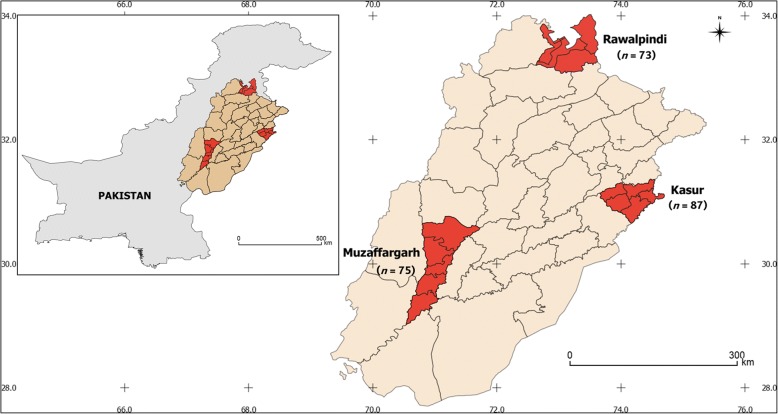
Rhipicephalus sanguineus (s.l.) female ticks (n = 235) were collected from healthy farm dogs in three districts of Pakistan. Microfluidic real-time PCR, a powerful nanotechnology for high-throughput molecular detection of pathogens, was used to test the presence of 25 bacterial and seven parasitic species in individual ticks. The genetic diversity of E. canis was evaluated by characterizing the trp36 gene.
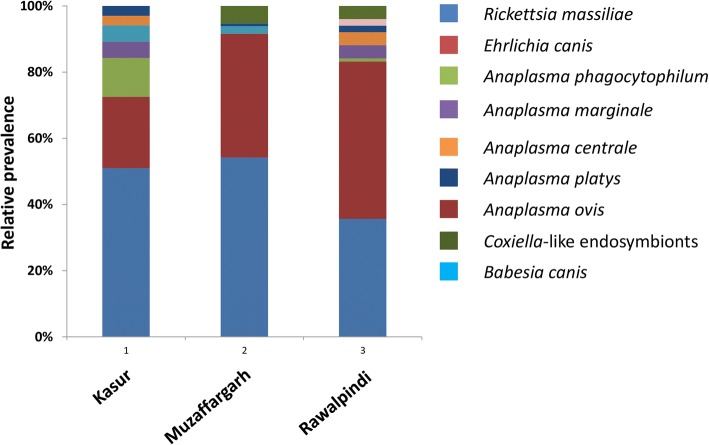
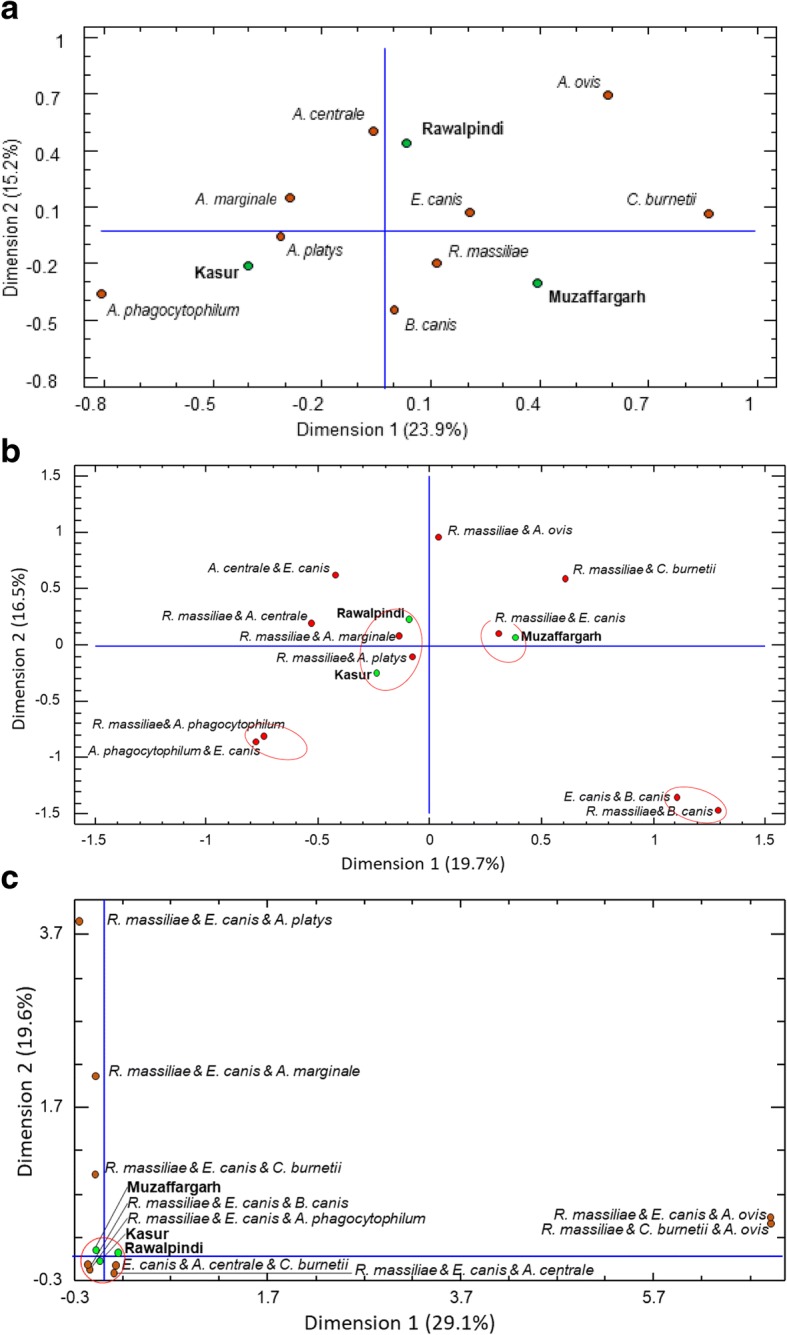
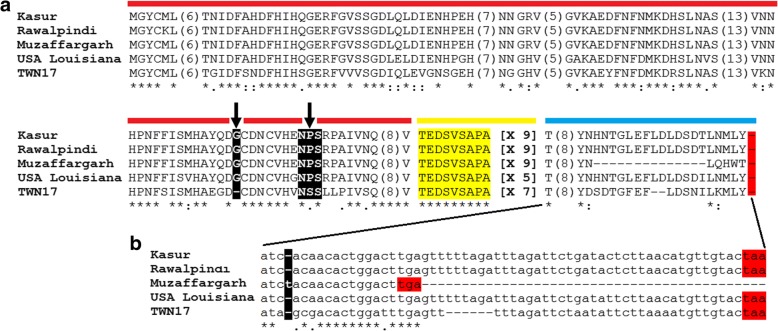
A total of 204 ticks were infected with at least one pathogen and 109 co-infected with two (80%) or three (20%) pathogens. Rickettsia massiliae (human pathogen) and E. canis (zoonotic dog pathogen) were the most common pathogens co-infecting (30.4%) ticks. Furthermore, all identified co-infections included R. massiliae and/or E. canis. Multiple correspondence analysis (MCA) revealed that single infections did not show clear regional association whereas some co-infections were restricted to certain geographical regions. The sequence analysis of trp36 in representative samples allowed the identification of three E. canis strains with low genetic diversity, and the strain found in Muzaffargarh district appeared to be more adapted to co-infection with R. massiliae.
Rhipicephalus sanguineus (s.l.) harbors multiple co-infections with human and dog pathogens of zoonotic potential. Findings of this study suggest that genetic diversity of E. canis may favor co-infections with different pathogens.
传播犬埃立克体病的血红扇头蜱(Rhipicephalus sanguineus sensu lato,s.l.)分布广泛,是犬和人类的重要病原体的传播媒介。高通量技术表明,单个蜱虫携带高度多样化的病原体,包括细菌、原生动物和病毒。目前,蜱虫中普遍存在(单个个体中多种病原体)合并感染的情况已被广泛接受,并且这种情况会影响病原体的获取和传播以及宿主的感染风险。然而,对于病原体遗传多样性对合并感染发生率的影响知之甚少。在此,我们研究了血红扇头蜱(s.l.)中的合并感染频率及其与犬埃立克体遗传多样性的关系。
从巴基斯坦三个地区的健康农场犬中收集了 235 只雌性血红扇头蜱(Rhipicephalus sanguineus sensu lato,s.l.)。微流控实时 PCR 是一种强大的纳米技术,用于高通量分子检测病原体,用于检测单个蜱虫中 25 种细菌和 7 种寄生虫的存在。通过对 trp36 基因进行特征分析来评估犬埃立克体的遗传多样性。
共有 204 只蜱虫感染了至少一种病原体,109 只蜱虫感染了两种(80%)或三种(20%)病原体。人病原体里氏曼氏杆菌(Rickettsia massiliae)和犬病原体犬埃立克体(Ehrlichia canis)是最常见的共同感染蜱虫的病原体(30.4%)。此外,所有确定的合并感染均包括里氏曼氏杆菌和/或犬埃立克体。多重对应分析(MCA)表明,单一感染没有明显的区域关联,而某些合并感染则局限于特定的地理区域。代表样本的 trp36 序列分析允许鉴定出三种遗传多样性低的犬埃立克体菌株,并且在穆扎法尔加尔地区发现的菌株似乎更适应与里氏曼氏杆菌的合并感染。
血红扇头蜱(s.l.)携带多种潜在人畜共患的人类和犬病原体的合并感染。本研究结果表明,犬埃立克体的遗传多样性可能有利于与不同病原体的合并感染。