Groennebaek Thomas, Jespersen Nichlas R, Jakobsgaard Jesper Emil, Sieljacks Peter, Wang Jakob, Rindom Emil, Musci Robert V, Bøtker Hans Erik, Hamilton Karyn L, Miller Benjamin F, de Paoli Frank V, Vissing Kristian
Section for Sports Science, Department of Public Health, Aarhus University, Aarhus, Denmark.
Department of Cardiology, Aarhus University Hospital, Aarhus, Denmark.
Front Physiol. 2018 Dec 17;9:1796. doi: 10.3389/fphys.2018.01796. eCollection 2018.
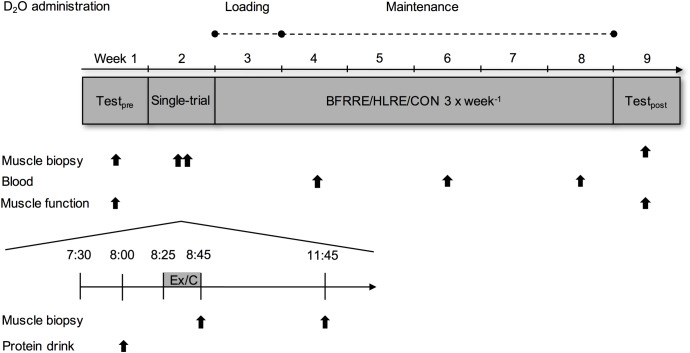
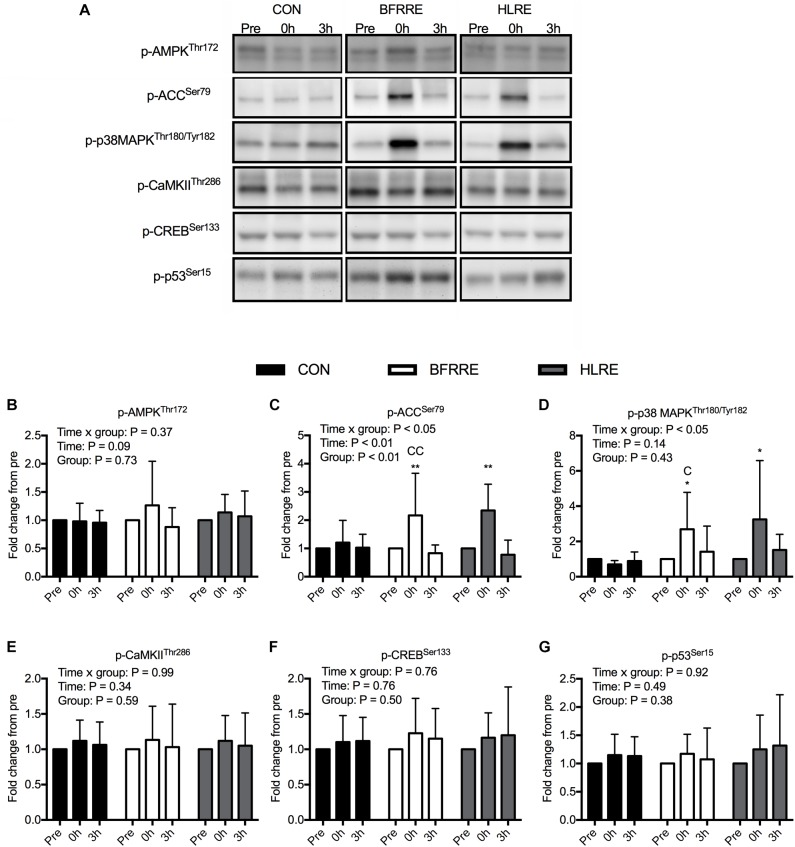
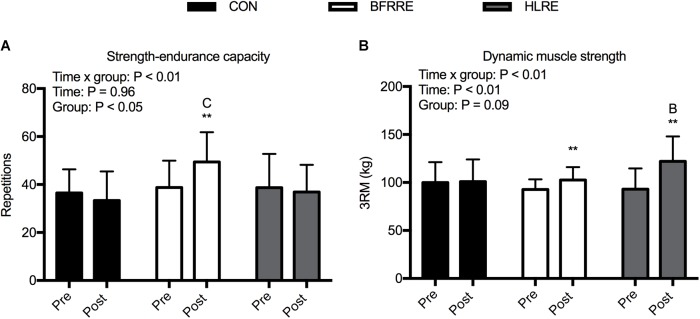
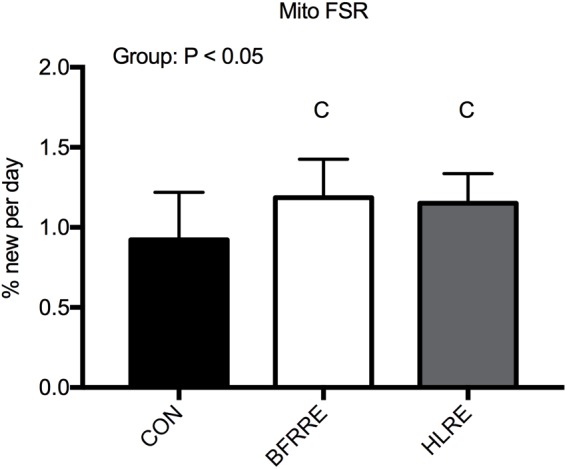
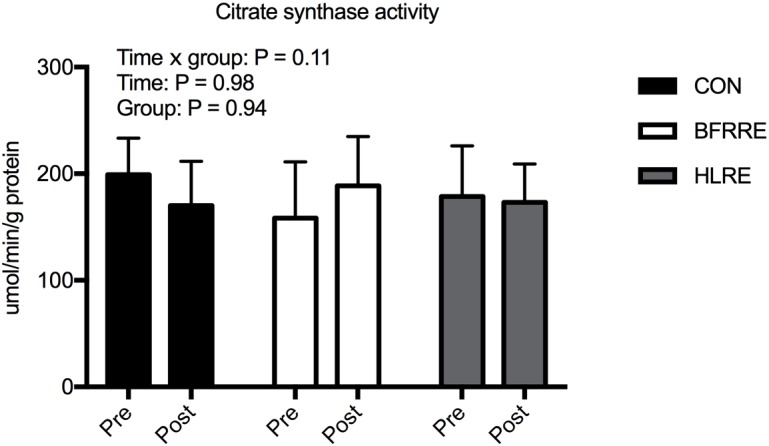
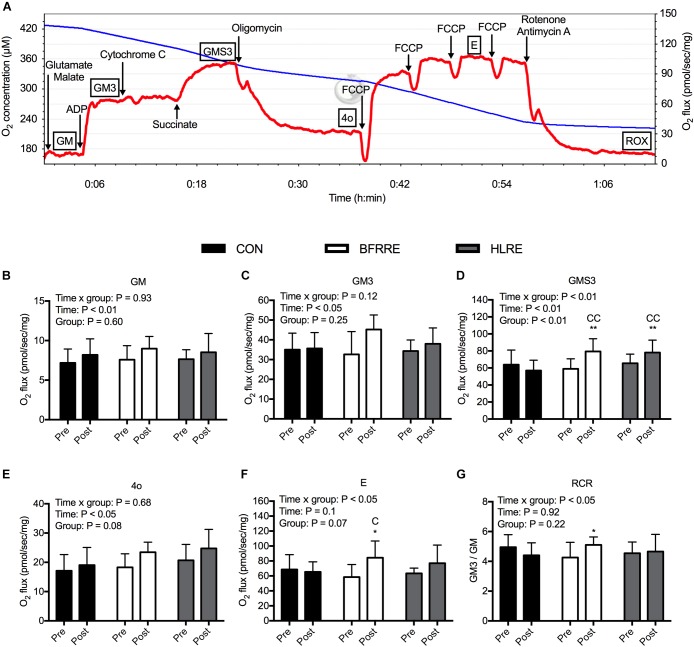
It is well established that high-load resistance exercise (HLRE) can stimulate myofibrillar accretion. Additionally, recent studies suggest that HLRE can also stimulate mitochondrial biogenesis and respiratory function. However, in several clinical situations, the use of resistance exercise with high loading may not constitute a viable approach. Low-load blood flow restricted resistance exercise (BFRRE) has emerged as a time-effective low-load alternative to stimulate myofibrillar accretion. It is unknown if BFRRE can also stimulate mitochondrial biogenesis and respiratory function. If so, BFRRE could provide a feasible strategy to stimulate muscle metabolic health. To study this, 34 healthy previously untrained individuals (24 ± 3 years) participated in BFRRE, HLRE, or non-exercise control intervention (CON) 3 times per week for 6 weeks. Skeletal muscle biopsies were collected; (1) before and after the 6-week intervention period to assess mitochondrial biogenesis and respiratory function and; (2) during recovery from single-bout exercise to assess myocellular signaling events involved in transcriptional regulation of mitochondrial biogenesis. During the 6-week intervention period, deuterium oxide (DO) was continuously administered to the participants to label newly synthesized skeletal muscle mitochondrial proteins. Mitochondrial respiratory function was assessed in permeabilized muscle fibers with high-resolution respirometry. Mitochondrial content was assessed with a citrate synthase activity assay. Myocellular signaling was assessed with immunoblotting. Mitochondrial protein synthesis rate was higher with BFRRE (1.19%/day) and HLRE (1.15%/day) compared to CON (0.92%/day) ( < 0.05) but similar between exercise groups. Mitochondrial respiratory function increased to similar degree with both exercise regimens and did not change with CON. For instance, coupled respiration supported by convergent electron flow from complex I and II increased 38% with BFRRE and 24% with HLRE ( < 0.01). Training did not alter citrate synthase activity compared to CON. BFRRE and HLRE elicited similar myocellular signaling responses. These results support recent findings that resistance exercise can stimulate mitochondrial biogenesis and respiratory function to support healthy skeletal muscle and whole-body metabolism. Intriquingly, BFRRE produces similar mitochondrial adaptations at a markedly lower load, which entail great clinical perspective for populations in whom exercise with high loading is untenable.
众所周知,高负荷抗阻运动(HLRE)可刺激肌原纤维增生。此外,最近的研究表明,HLRE还可刺激线粒体生物合成及呼吸功能。然而,在一些临床情况下,采用高负荷抗阻运动可能并非可行的方法。低负荷血流限制抗阻运动(BFRRE)已成为一种省时的低负荷替代方法,可刺激肌原纤维增生。目前尚不清楚BFRRE是否也能刺激线粒体生物合成及呼吸功能。如果可以,BFRRE可能提供一种可行的策略来促进肌肉代谢健康。为了研究这一点,34名健康的未经训练的个体(24±3岁)每周参加3次BFRRE、HLRE或非运动对照干预(CON)干预,持续6周。采集骨骼肌活检样本;(1)在6周干预期前后,以评估线粒体生物合成及呼吸功能;(2)在单次运动恢复期间,以评估参与线粒体生物合成转录调控的肌细胞信号事件。在6周干预期内,持续向参与者施用氧化氘(DO),以标记新合成的骨骼肌线粒体蛋白。采用高分辨率呼吸测定法评估通透化肌纤维中的线粒体呼吸功能。采用柠檬酸合酶活性测定法评估线粒体含量。采用免疫印迹法评估肌细胞信号。与CON组(0.92%/天)相比,BFRRE组(1.19%/天)和HLRE组(1.15%/天)的线粒体蛋白合成率更高(P<0.05),但运动组之间相似。两种运动方案的线粒体呼吸功能均有相似程度的增加,而CON组则无变化。例如,由复合体I和II的汇聚电子流支持的偶联呼吸,BFRRE组增加了38%,HLRE组增加了24%(P<0.01)。与CON组相比,训练未改变柠檬酸合酶活性。BFRRE和HLRE引发了相似的肌细胞信号反应。这些结果支持了最近的研究发现,即抗阻运动可刺激线粒体生物合成及呼吸功能,以支持健康的骨骼肌和全身代谢。有趣的是,BFRRE在显著更低的负荷下产生相似的线粒体适应性变化,这对于无法进行高负荷运动的人群具有重要的临床意义。