Berges Mareike, Michel Annika-Marisa, Lassek Christian, Nuss Aaron M, Beckstette Michael, Dersch Petra, Riedel Katharina, Sievers Susanne, Becher Dörte, Otto Andreas, Maaß Sandra, Rohde Manfred, Eckweiler Denitsa, Borrero-de Acuña Jose M, Jahn Martina, Neumann-Schaal Meina, Jahn Dieter
Braunschweig Integrated Centre of Systems Biology (BRICS), Technische Universität Braunschweig, Braunschweig, Germany.
Center for Functional Genomics of Microbes (CFGM), Institute of Microbiology, University of Greifswald, Greifswald, Germany.
Front Microbiol. 2018 Dec 24;9:3183. doi: 10.3389/fmicb.2018.03183. eCollection 2018.
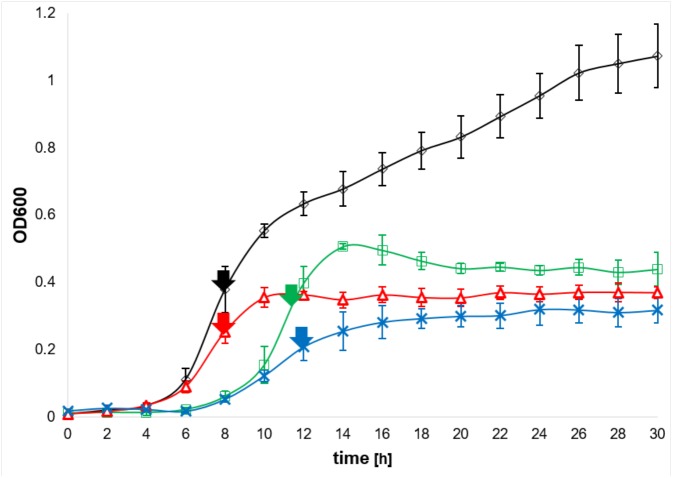
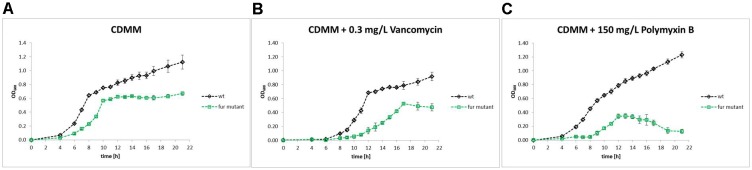
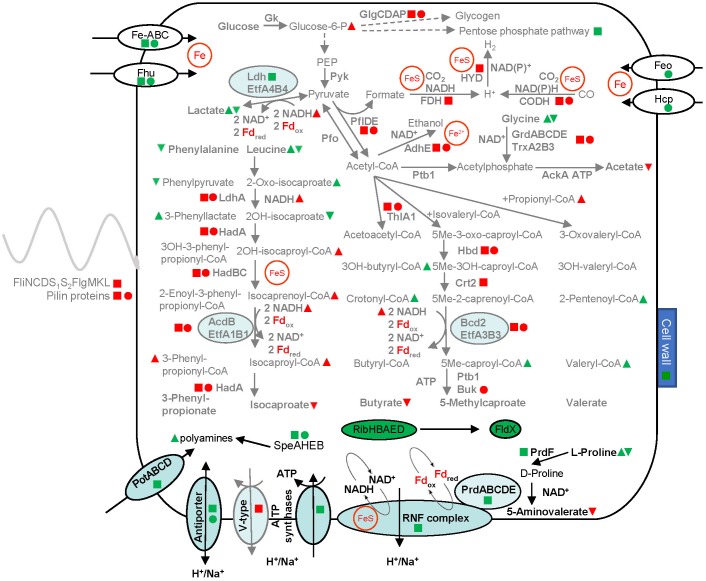
The response to iron limitation of several bacteria is regulated by the ferric uptake regulator (Fur). The Fur-regulated transcriptional, translational and metabolic networks of the Gram-positive, pathogen were investigated by a combined RNA sequencing, proteomic, metabolomic and electron microscopy approach. At high iron conditions (15 μM) the mutant displayed a growth deficiency compared to wild type cells. Several iron and siderophore transporter genes were induced by Fur during low iron (0.2 μM) conditions. The major adaptation to low iron conditions was observed for the central energy metabolism. Most ferredoxin-dependent amino acid fermentations were significantly down regulated (). The substrates of these pathways phenylalanine, leucine, glycine and some intermediates (phenylpyruvate, 2-oxo-isocaproate, 3-hydroxy-butyryl-CoA, crotonyl-CoA) accumulated, while end products like isocaproate and butyrate were found reduced. Flavodoxin () formation and riboflavin biosynthesis () were enhanced, most likely to replace the missing ferredoxins. Proline reductase (), the corresponding ion pumping RNF complex () and the reaction product 5-aminovalerate were significantly enhanced. An ATP forming ATPase () of the FF-type was induced while the formation of a ATP-consuming, proton-pumping V-type ATPase () was decreased. The [Fe-S] enzyme-dependent pyruvate formate lyase (), formate dehydrogenase () and hydrogenase () branch of glucose utilization and glycogen biosynthesis (glg) were significantly reduced, leading to an accumulation of glucose and pyruvate. The formation of [Fe-S] enzyme carbon monoxide dehydrogenase () was inhibited. The mutant showed an increased sensitivity to vancomycin and polymyxin B. An intensive remodeling of the cell wall was observed, Polyamine biosynthesis () was induced leading to an accumulation of spermine, spermidine, and putrescine. The mutant lost most of its flagella and motility. Finally, the CRISPR/Cas and a prophage encoding operon were downregulated. Fur binding sites were found upstream of around 20 of the regulated genes. Overall, adaptation to low iron conditions in focused on an increase of iron import, a significant replacement of iron requiring metabolic pathways and the restructuring of the cell surface for protection during the complex adaptation phase and was only partly directly regulated by Fur.
几种细菌对铁限制的反应受铁摄取调节因子(Fur)调控。采用RNA测序、蛋白质组学、代谢组学和电子显微镜相结合的方法,对革兰氏阳性病原体的Fur调控转录、翻译和代谢网络进行了研究。在高铁条件(15μM)下,与野生型细胞相比,该突变体表现出生长缺陷。在低铁(0.2μM)条件下,Fur诱导了几个铁和铁载体转运蛋白基因。在中心能量代谢方面观察到了对低铁条件的主要适应性变化。大多数依赖铁氧化还原蛋白的氨基酸发酵显著下调()。这些途径的底物苯丙氨酸、亮氨酸、甘氨酸和一些中间产物(苯丙酮酸、2-氧代异己酸、3-羟基丁酰辅酶A、巴豆酰辅酶A)积累,而异己酸和丁酸等终产物减少。黄素氧化还原蛋白()的形成和核黄素生物合成()增强,最有可能是为了替代缺失的铁氧化还原蛋白。脯氨酸还原酶()、相应的离子泵RNF复合物()和反应产物5-氨基戊酸显著增强。诱导了FF型的ATP合成ATP酶(),而消耗ATP的质子泵V型ATP酶()的形成减少。葡萄糖利用和糖原生物合成(glg)中依赖[Fe-S]酶的丙酮酸甲酸裂解酶()、甲酸脱氢酶()和氢化酶()分支显著减少,导致葡萄糖和丙酮酸积累。[Fe-S]酶一氧化碳脱氢酶()的形成受到抑制。该突变体对万古霉素和多粘菌素B的敏感性增加。观察到细胞壁发生了强烈重塑,多胺生物合成()被诱导,导致精胺、亚精胺和腐胺积累。该突变体失去了大部分鞭毛和运动能力。最后,CRISPR/Cas和一个编码原噬菌体的操纵子被下调。在约20个受调控基因的上游发现了Fur结合位点。总体而言,该菌对低铁条件的适应集中在增加铁的摄取、大量替代需要铁的代谢途径以及在复杂适应阶段对细胞表面进行重组以提供保护,并且仅部分直接受Fur调控。