Developmental Neuroscience, Munroe Meyer Institute for Genetics and Rehabilitation, University of Nebraska Medical Center, Omaha, NE 68106-5915, USA.
Mouse Genome Engineering Core Facility, Vice Chancellor for Research Office, University of Nebraska Medical Center, Omaha, NE 68106-5915, USA.
Dis Model Mech. 2019 Jan 8;12(1):dmm029462. doi: 10.1242/dmm.029462.
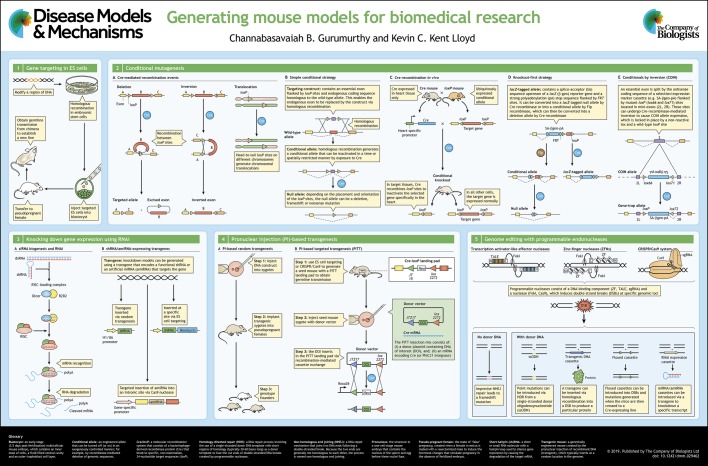
Over the past decade, new methods and procedures have been developed to generate genetically engineered mouse models of human disease. This At a Glance article highlights several recent technical advances in mouse genome manipulation that have transformed our ability to manipulate and study gene expression in the mouse. We discuss how conventional gene targeting by homologous recombination in embryonic stem cells has given way to more refined methods that enable allele-specific manipulation in zygotes. We also highlight advances in the use of programmable endonucleases that have greatly increased the feasibility and ease of editing the mouse genome. Together, these and other technologies provide researchers with the molecular tools to functionally annotate the mouse genome with greater fidelity and specificity, as well as to generate new mouse models using faster, simpler and less costly techniques.
在过去的十年中,已经开发出了新的方法和程序来生成人类疾病的基因工程小鼠模型。这篇概览文章重点介绍了小鼠基因组操作的几项最新技术进展,这些进展改变了我们在小鼠中操纵和研究基因表达的能力。我们讨论了传统的胚胎干细胞同源重组基因靶向技术如何让位于更精细的方法,使我们能够在受精卵中进行等位基因特异性操作。我们还强调了可编程内切酶的使用方面的进展,这些进展极大地提高了编辑小鼠基因组的可行性和简易性。总之,这些技术和其他技术为研究人员提供了分子工具,使他们能够更准确、更特异的对小鼠基因组进行功能注释,并使用更快、更简单、更廉价的技术来生成新的小鼠模型。