From the Program in Trauma, Department of Surgery (B.C.D., D.M.S.), R Adams Cowley Shock Trauma Center, University of Maryland School of Medicine, Baltimore, Maryland; Department of Surgery (L.J.M.), University of Texas Health Sciences Center at Houston, McGovern Medical School, Houston, Texas; Department of Surgery, Department of Critical Care Medicine (S.B.R.), St. Michael's Hospital, University of Toronto, Toronto, Ontario, Canada; and Department of Surgery (M.J.C.), Denver Health Medical Center, University of Colorado, Boulder, Colorado.
J Trauma Acute Care Surg. 2019 Apr;86(4):710-721. doi: 10.1097/TA.0000000000002206.
Viscoelastic tests (VETs), specifically thromboelastography (TEG) and rotational thromboelastometry (ROTEM), are gaining popularity in the management of critically ill surgical patients with hemorrhage or thrombosis due to their comprehensive characterization of the coagulation process and point-of-care availability in comparison to conventional coagulation tests (CCTs). We review current evidence for VET use in patients in the surgical intensive care unit (SICU).
We searched PUBMED, EMBASE and the Cochrane Library through May 30, 2018 for articles that evaluated the use of VETs in patient populations and clinical scenarios germane to the surgical intensivist. Individual articles were critically evaluated for relevance and appropriate methodology using a structured technique. Information on patient characteristics, timing and methods of CCTs/VETs, and outcomes was collected and summarized in narrative form.
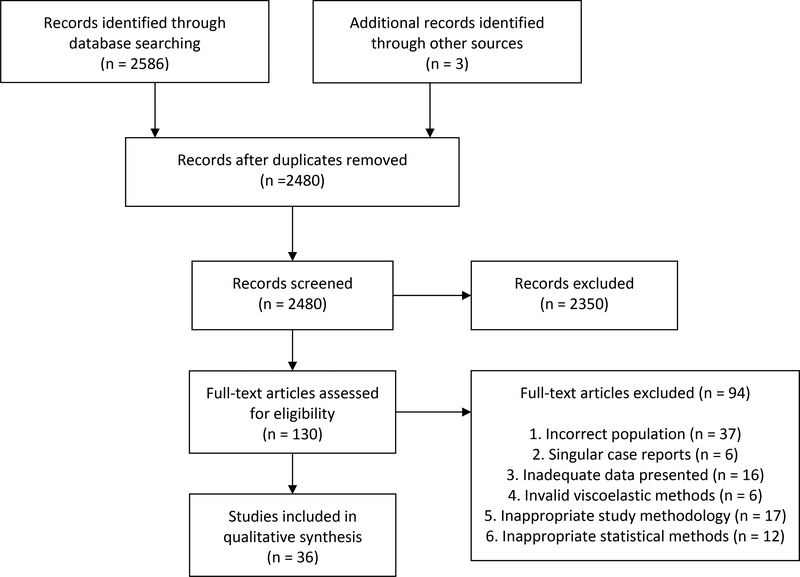
Of 2,589 identified articles, 36 were included. Five (14%) were interventional studies and 31 (86%) were observational. Twenty-five (69%) evaluated TEG, 11 (31%) ROTEM and 18 (50%) CCTs. Investigated outcomes included quantitative blood loss (13 (36%)), blood product transfusion (9 (25%)), thromboembolic events (9 (25%)) and mortality (6 (17%)). We identified 12 clinical scenarios with sufficient available evidence, much of which was of limited quantity and poor methodological quality. Nonetheless, research supports the use of VETs for guiding early blood product administration in severe traumatic hemorrhage and for the prediction of abstract excess bleeding following routine cardiac surgery. In contrast, evidence suggests VET-based heparin dosing strategies for venous thromboembolism prophylaxis are not superior to standard dosing in SICU patients.
While VETs have the potential to impact the care of critically ill surgical patients in many ways, current evidence for their use is limited, mainly because of poor methodological quality of most available studies. Further high-quality research, including several ongoing randomized controlled trials, is needed to elucidate the role of TEG/ROTEM in the SICU population.
Systematic review, level IV.
粘弹性测试(VETs),特别是血栓弹力图(TEG)和旋转血栓弹性图(ROTEM),由于其对凝血过程的全面描述以及与传统凝血测试(CCTs)相比在即时护理中的可用性,在伴有出血或血栓形成的危重症手术患者的管理中越来越受欢迎。我们回顾了 VET 在外科重症监护病房(SICU)患者中的使用的现有证据。
我们通过 2018 年 5 月 30 日检索 PUBMED、EMBASE 和 Cochrane 图书馆,以评估 VET 在与外科重症医生相关的患者人群和临床情况下的使用情况。使用结构化技术对个别文章进行了相关性和适当方法的严格评估。收集并以叙述形式总结患者特征、CCTs/VETs 的时间和方法以及结局的信息。
在 2589 篇确定的文章中,有 36 篇被纳入。其中 5 篇(14%)为干预性研究,31 篇(86%)为观察性研究。25 篇(69%)评估了 TEG,11 篇(31%)ROTEM 和 18 篇(50%)CCTs。调查结果包括定量失血(13 篇(36%))、输血(9 篇(25%))、血栓栓塞事件(9 篇(25%))和死亡率(6 篇(17%))。我们确定了 12 个具有足够可用证据的临床情况,其中大部分的数量和方法质量都较差。尽管如此,研究支持 VET 用于指导严重创伤性出血患者的早期血制品管理,并预测常规心脏手术后的过度出血。相比之下,证据表明 VET 指导的肝素预防静脉血栓栓塞症的剂量策略并不优于 SICU 患者的标准剂量。
虽然 VET 有可能以多种方式影响危重症手术患者的护理,但目前关于其使用的证据有限,主要是因为大多数可用研究的方法质量较差。需要进一步进行高质量的研究,包括几项正在进行的随机对照试验,以阐明 TEG/ROTEM 在 SICU 人群中的作用。
系统评价,IV 级。