Center for Tobacco Studies, Rutgers School of Public Health, New Brunswick, NJ 08901, USA.
School of Public Health and Health Systems, University of Waterloo, Waterloo, ON N2L 3G1, Canada.
Int J Environ Res Public Health. 2019 Jan 10;16(2):184. doi: 10.3390/ijerph16020184.
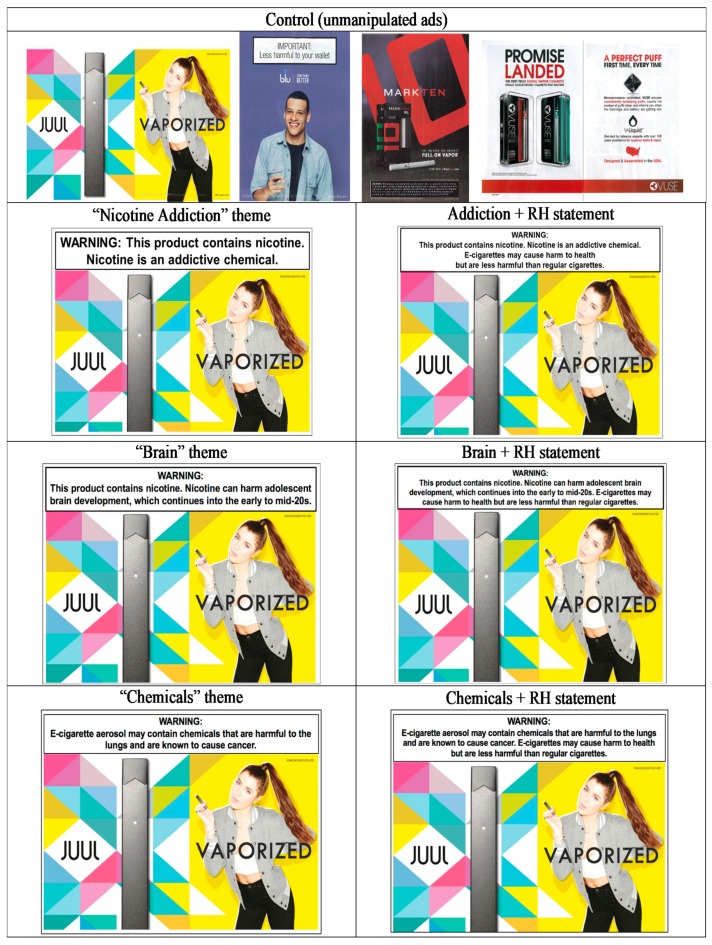
Although e-cigarettes in the United States are required to carry one nicotine addiction warning, little is known about the impact of other potential e-cigarette warning themes, nor about pairing warnings with messages that communicate e-cigarettes' reduced-harm potential relative to cigarettes. We randomly assigned 876 young adults (ages 18⁻29) to view e-cigarette ads in a 3 × 2 plus control online experiment that varied by warning theme (i.e., nicotine addiction; nicotine's impact on adolescent brain development; presence of harmful chemicals) and warning type-i.e., the presence ("relative harm warning") or absence ("standard warning") of a relative harm (RH) statement in the warning label ("e-cigarettes may cause harm to health but are less harmful than cigarettes"). Warning believability, informativeness, understandability and support were high across conditions and there were no significant differences by warning theme on e-cigarette harm perceptions or use intentions nor on nicotine (mis)perceptions. Perceived warning effectiveness for discouraging youth initiation was higher for the "brain" and "chemicals" warnings compared to the addiction warning. Warnings with the included RH statement were perceived as less believable and credible and were less frequently correctly recalled. Research should continue to investigate the impact of different e-cigarette warning themes and formats with priority audiences.
尽管美国的电子烟需要携带一个尼古丁成瘾警告,但对于其他潜在的电子烟警告主题的影响,以及将警告与传达电子烟相对于香烟的降低危害潜力的信息结合起来的效果,人们知之甚少。我们在一项 3×2 加对照的在线实验中随机分配了 876 名年轻成年人(18-29 岁),让他们观看电子烟广告,实验条件因警告主题(即尼古丁成瘾、尼古丁对青少年大脑发育的影响、有害化学物质的存在)和警告类型(即警告标签中是否存在相对危害 (RH) 声明“电子烟可能对健康造成危害,但比香烟危害小”)而异。在各种条件下,警告的可信度、信息量、可理解性和支持度都很高,而且警告主题对电子烟危害认知或使用意向以及尼古丁(误解)认知没有显著差异。与成瘾警告相比,“大脑”和“化学物质”警告在劝阻年轻人开始使用电子烟方面的效果更高。带有包含 RH 声明的警告被认为不太可信和可靠,并且不太容易被正确回忆。应该继续研究不同的电子烟警告主题和格式对优先受众的影响。