Department of Psychiatry, Columbia University Irving Medical Center, New York, New York.
Department of Psychiatry, New York State Psychiatric Institute, New York, New York.
Int J Eat Disord. 2019 Mar;52(3):255-260. doi: 10.1002/eat.23014. Epub 2019 Jan 14.
Dietary restraint refers to an individual's intention to restrict food intake, measured via self-report questionnaires, whereas dietary restriction refers to actual reduction in caloric intake. The aim of this research was to investigate the association between dietary restraint scales and actual caloric restriction.
Data were collected from six previously published or two ongoing eating behavior studies in which participants (n = 183) completed the Three Factor Eating Questionnaire (TFEQ) and Eating Disorders Examination Questionnaire (EDE-Q) and participated in a laboratory-based research lunch meal. Participants were individuals with anorexia nervosa (AN), bulimia nervosa (BN), and healthy controls (HC). The primary analysis was the association between TFEQ Restraint subscale and caloric intake in the meal.
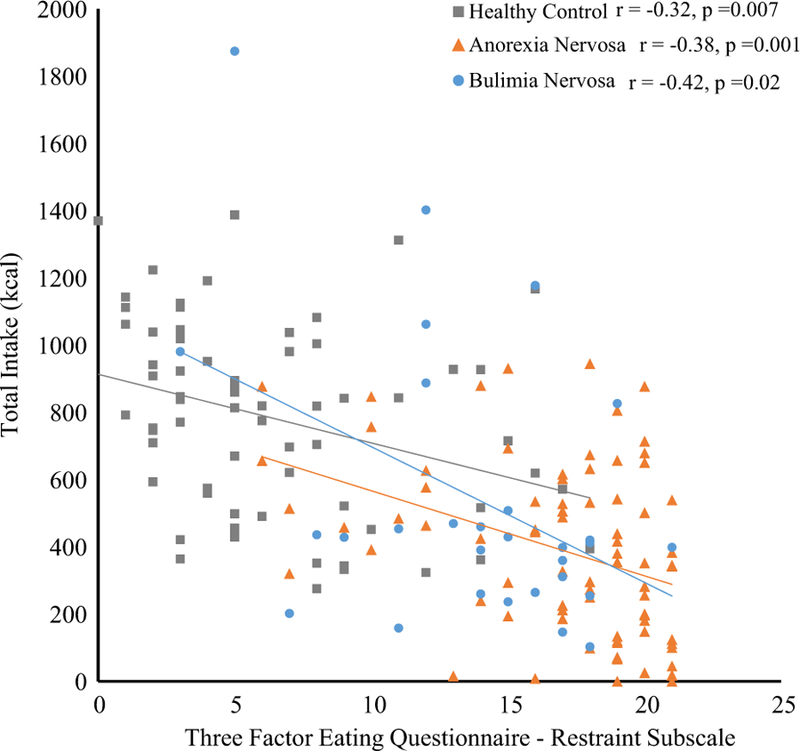
There was a significant negative correlation between total caloric intake and TFEQ Restraint scores (r = -.60, p < .001) and EDE-Q Restraint scores (r = -.54, p < .001). For TFEQ Restraint score, this relationship was significant within each diagnostic group (HC: r = -.32, p = .007; AN: r = -.38, p < .001; BN: r = -.43, p = .02).
These results suggest that the TFEQ Restraint scale is a useful measure of dietary restriction, especially among individuals with eating disorders.
饮食克制是指个体通过自我报告问卷来限制食物摄入的意图,而饮食限制则是指实际减少卡路里的摄入。本研究旨在调查饮食克制量表与实际卡路里限制之间的关系。
本研究的数据来自六项已发表的或两项正在进行的饮食行为研究,共有 183 名参与者完成了三因素饮食问卷(TFEQ)和饮食障碍检查问卷(EDE-Q),并参加了一项基于实验室的研究性午餐。参与者包括神经性厌食症(AN)、神经性贪食症(BN)和健康对照组(HC)患者。主要分析是 TFEQ 克制分量表与餐中卡路里摄入量之间的关系。
总卡路里摄入量与 TFEQ 克制分量表得分(r = -0.60,p <.001)和 EDE-Q 克制分量表得分(r = -0.54,p <.001)呈显著负相关。对于 TFEQ 克制分量表得分,这种关系在每个诊断组中都是显著的(HC:r = -0.32,p =.007;AN:r = -0.38,p <.001;BN:r = -0.43,p =.02)。
这些结果表明,TFEQ 克制分量表是衡量饮食限制的有用工具,尤其是在患有饮食障碍的个体中。