Zeng Guan-Sheng, Chen Li-Chang, Fan Hui-Zhen, Wu Ling-Ling, Wu Xi-Ping, Fang Ze-Kui, He Xi, Yu Hua-Peng
Department of Pulmonary and Critical Care Medicine, Zhujiang Hospital, Southern Medical University, Guangzhou, China,
Int J Chron Obstruct Pulmon Dis. 2018 Dec 28;14:141-148. doi: 10.2147/COPD.S188994. eCollection 2019.
The distance of 6-minute walk test (D6MWT) has been widely used in the assessment of functional status in patients with COPD, while very little attention has been paid to the role of steps of 6-minute walk test (S6MWT). The purpose of this study was to investigate the relationship between S6MWT and other physiologic parameters of COPD.
Seventy patients with stable COPD were enrolled consecutively in this cross-sectional study. Pulmonary function tests, including spirometry, impulse oscillometry (IOS) and the single-breath diffusing capacity of the lungs for carbon monoxide (DL), were carried out at rest. Quality of life was assessed by health-related quality of life (HRQoL) questionnaires, including modified Medical Research Council dyspnea scale (mMRC), St George's Respiratory Questionnaire, Chronic Obstructive Pulmonary Disease Assessment Test (CAT) and Clinical Chronic Obstructive Pulmonary Questionnaire. Both steps and distance were measured in the following 6-minute walk test (6MWT).
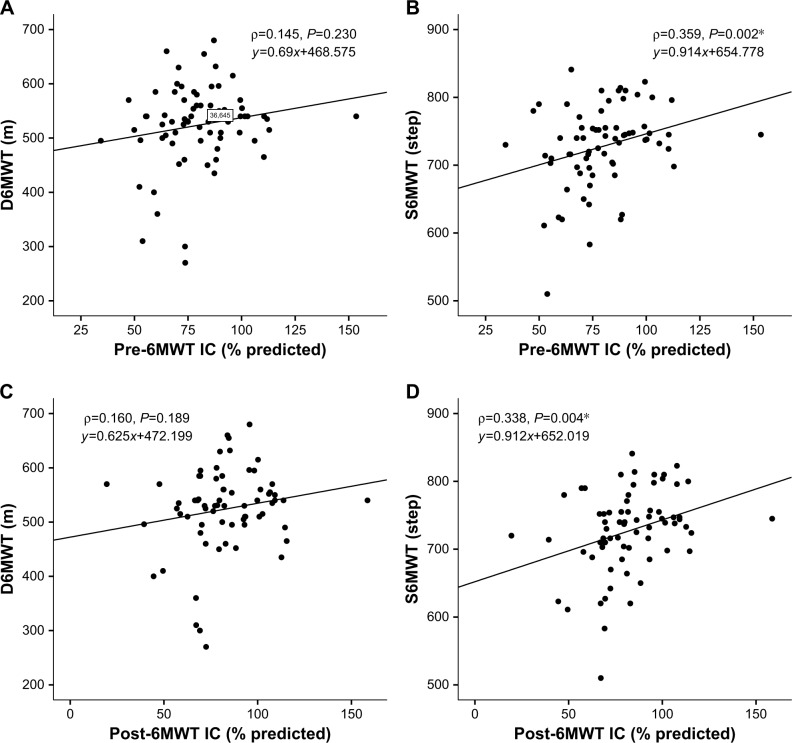
Both S6MWT and D6MWT showed significant correlation with spirometry, IOS, DL parameters and HRQoL questionnaires score. Both pre- and post-6MWT inspiratory capacity showed significant correlation with S6MWT (ρ=0.338, =0.004; ρ=0.359, =0.002, respectively), whereas did not correlate with D6MWT (ρ=0.145, =0.230; ρ=0.160, =0.189, respectively). In stepwise multiple regression analysis, mMRC grade, age and CAT score remained as significant predictors in the final model for D6MWT (adjusted =0.445, <0.01). DL and CAT score remained as significant predictors in the final model for S6MWT (adjusted =0.417, <0.01).
S6MWT is efficient in the evaluation of functional status and quality of life in COPD and has significant correlation with various parameters indicating disease severity. Additionally, S6MWT might be better in predicting lung hyperinflation in COPD compared with D6MWT.
6分钟步行试验距离(D6MWT)已广泛应用于慢性阻塞性肺疾病(COPD)患者功能状态的评估,而6分钟步行试验步数(S6MWT)的作用却很少受到关注。本研究旨在探讨S6MWT与COPD其他生理参数之间的关系。
本横断面研究连续纳入70例稳定期COPD患者。在静息状态下进行肺功能测试,包括肺活量测定、脉冲振荡法(IOS)和肺一氧化碳单次呼吸弥散量(DL)。采用与健康相关的生活质量(HRQoL)问卷评估生活质量,包括改良的医学研究委员会呼吸困难量表(mMRC)、圣乔治呼吸问卷、慢性阻塞性肺疾病评估测试(CAT)和临床慢性阻塞性肺疾病问卷。在接下来的6分钟步行试验(6MWT)中测量步数和距离。
S6MWT和D6MWT均与肺活量测定、IOS、DL参数及HRQoL问卷评分显著相关。6MWT前后的吸气量均与S6MWT显著相关(分别为ρ=0.338,P=0.004;ρ=0.359,P=0.002),而与D6MWT无相关性(分别为ρ=0.145,P=0.230;ρ=0.160,P=0.189)。在逐步多元回归分析中,mMRC分级、年龄和CAT评分在D6MWT的最终模型中仍为显著预测因素(调整R²=0.445,P<0.01)。DL和CAT评分在S6MWT的最终模型中仍为显著预测因素(调整R²=0.417,P<0.01)。
S6MWT在评估COPD患者的功能状态和生活质量方面有效,且与表明疾病严重程度的各种参数显著相关。此外,与D6MWT相比,S6MWT在预测COPD患者肺过度充气方面可能更好。