Tierklinik Luesche GmbH, Luesche, Germany.
Department of Equine Sciences, Faculty of Veterinary Medicine, Utrecht University, Utrecht, the Netherlands.
Equine Vet J. 2019 Nov;51(6):831-839. doi: 10.1111/evj.13075. Epub 2019 Feb 12.
Objective lameness assessment is gaining more importance in a clinical setting, necessitating availability of reference values.
To investigate the between -path, -trial and -day variation, between and within horses, in the locomotion symmetry of horses in regular use that are perceived sound.
Observational study with replicated measurement sessions.
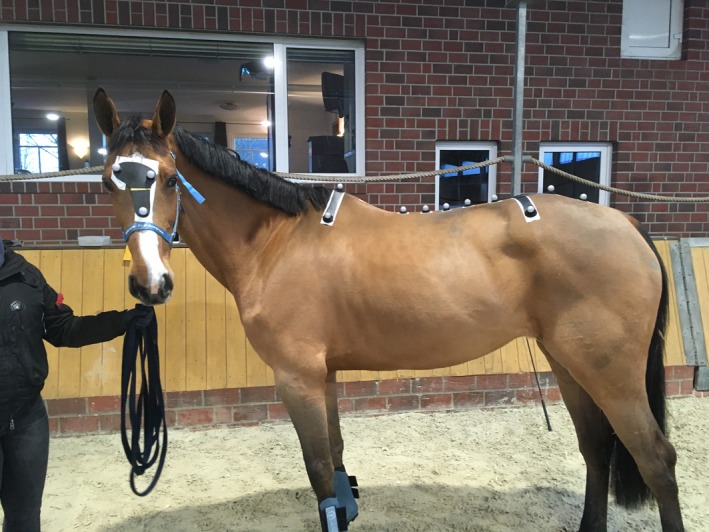
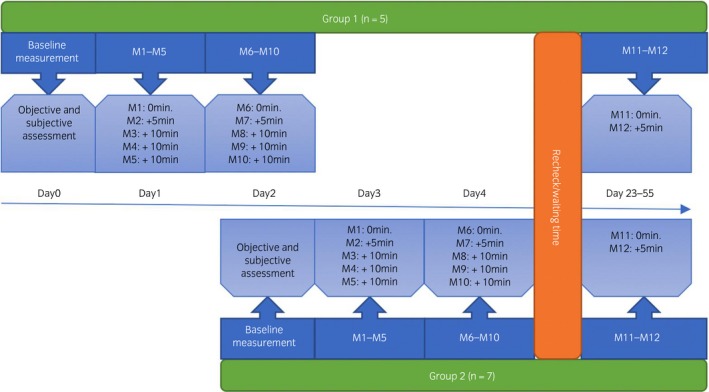
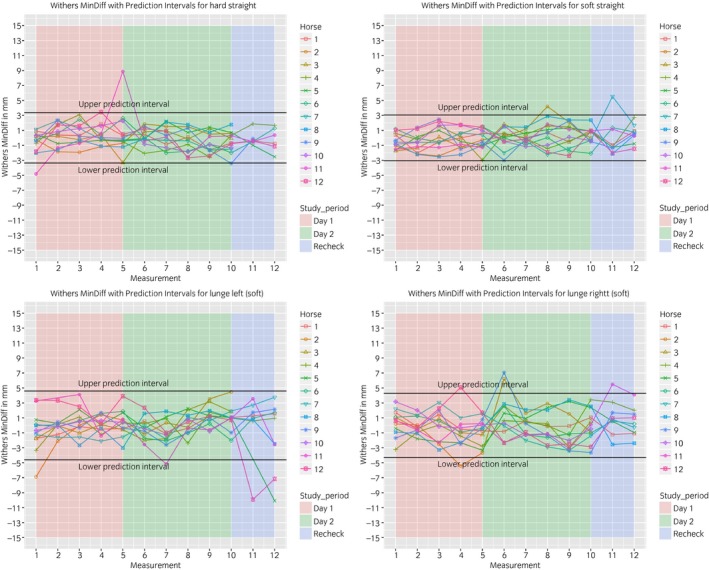
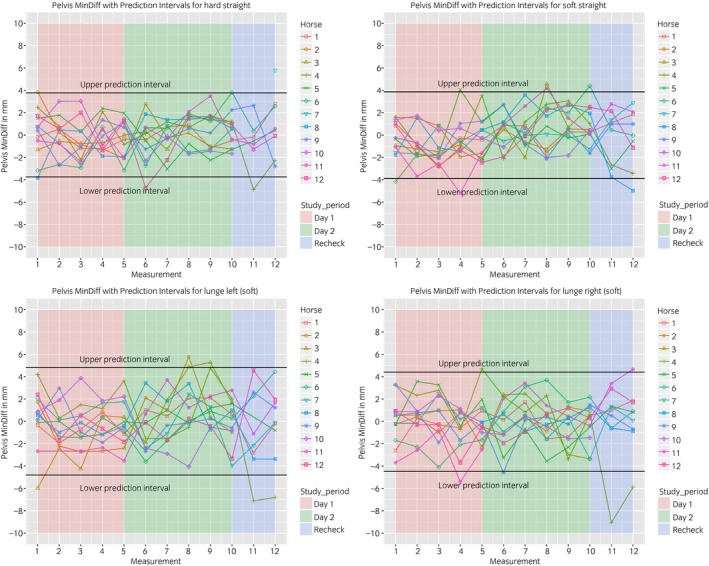
Twelve owner-sound horses were trotted on the straight line and on the lunge. Kinematic data were collected from these horses using 3D optical motion capture. Examinations were repeated on 12 occasions over the study which lasted 42 days in total. For each horse, measurements were grouped as five replicates on the first and second measurement days and two replicates on the third measurement day. Between measurement days 2 and 3, every horse had a break from examination of at least 28 days. Previously described symmetry parameters were calculated: RUD and RDD (Range Up/Down Difference; difference in upward/downward movement between right and left halves of a stride); MinDiff and MaxDiff (difference between the two minima/maxima of the movement); HHDswing and HHDstance (Hip Hike Difference-swing/-stance; difference between the upward movement of the tuber coxae during swingphase/stancephase). Data are described by the between-measurement variation for each parameter. A linear mixed model was used to test for the effect of time, surface and path. Intraclass correlation coefficients (ICC) were calculated to access repeatability.
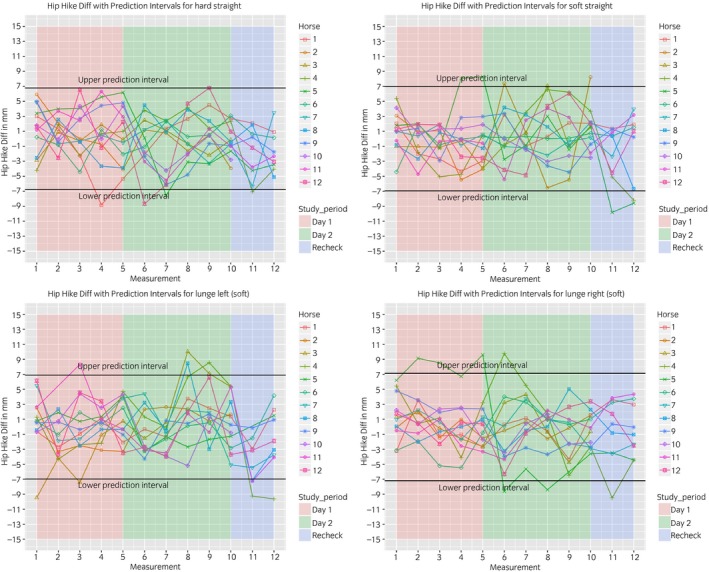
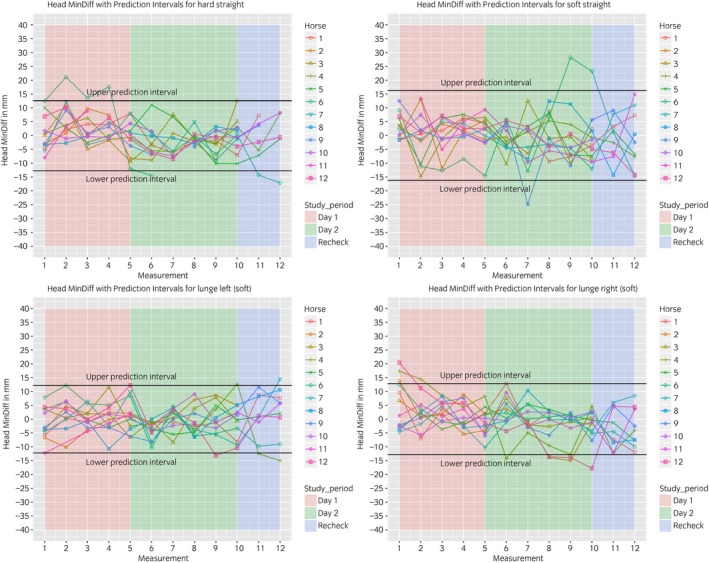
Mean between-measurement variation was (MinDiff, MaxDiff, RUD, RDD): 13, 12, 20, 16 mm (head); 4, 3, 6, 4 mm (withers) and 5, 4, 6, 6 mm (pelvis); (HHDswing, HHDstance): 7 and 7 mm. More between-measurement variation is seen on the first measurement day compared to the second and third measurement days. In general, less variation is seen with increasing number of repetitions. Less between-measurement variation is seen on hard surface compared to soft surface. More between-measurement variation is seen on the circle compared to the straight line. Between-horse variation was clearly larger than within-horse variation. ICC values for the head, withers and pelvis symmetry parameters were 0.68 (head), 0.76 (withers), 0.85 (pelvis).
Lunge measurements on a hard surface were not performed.
Between-measurement variation may be substantial, especially in head motion. This should be considered when interpreting clinical data after repeated measurements, as in routine lameness assessments.
在临床环境中,对跛行的客观评估变得越来越重要,这就需要有参考值。
研究在正常使用且被认为健康的马匹中,个体间、试验间和试验日内的运动对称性的差异,以及个体内的差异。
具有重复测量的观察性研究。
使用三维光学运动捕捉技术,对 12 匹由马主认为健康的马匹进行直线和侧方的慢步运动测试。对每匹马,在整个研究持续 42 天的过程中,在第一和第二天的测量中,每匹马重复测量 5 次,在第三天的测量中重复测量 2 次。在测量日 2 和 3 之间,每匹马至少有 28 天的休息时间,不进行检查。计算了之前描述的对称性参数:RUD 和 RDD(跨步中左右两侧的上下运动差异;左右半侧步的差异);MinDiff 和 MaxDiff(运动中两个最小值/最大值之间的差异);HHDswing 和 HHDstance(髋关节提升差异-摆动/支撑;摆动阶段/支撑阶段时,股骨头向上运动的差异)。数据以每个参数的测量间变化来表示。使用线性混合模型来检验时间、表面和路径的影响。计算组内相关系数(ICC)以评估可重复性。
平均测量间的变化为(MinDiff、MaxDiff、RUD、RDD):头部为 13、12、20、16mm;肩部为 4、3、6、4mm;骨盆为 5、4、6、6mm;(HHDswing、HHDstance)为 7 和 7mm。与第二和第三天相比,在第一天的测量中,测量间的变化更大。一般来说,重复测量次数越多,变化越小。在硬表面上的测量间变化小于软表面。与直线相比,在圆形表面上的测量间变化更大。个体间的变化明显大于个体内的变化。头部、肩部和骨盆对称性参数的 ICC 值为 0.68(头部)、0.76(肩部)和 0.85(骨盆)。
未在硬表面上进行侧方的测功机测试。
测量间的差异可能很大,尤其是头部的运动。在重复测量后解释临床数据时,应考虑到这一点,如在常规跛行评估中。