Institute of Crop Science, Shandong Academy of Agricultural Sciences, Key Laboratory of Wheat Biology & Genetic Improvement on North Yellow & Huai River Valley, Ministry of Agriculture, National Engineering Laboratory for Wheat & Maize, Jinan 250100, China.
BGI Institute of Applied Agriculture, BGI-Agro, Shenzhen 518083, China.
Int J Mol Sci. 2019 Jan 15;20(2):335. doi: 10.3390/ijms20020335.
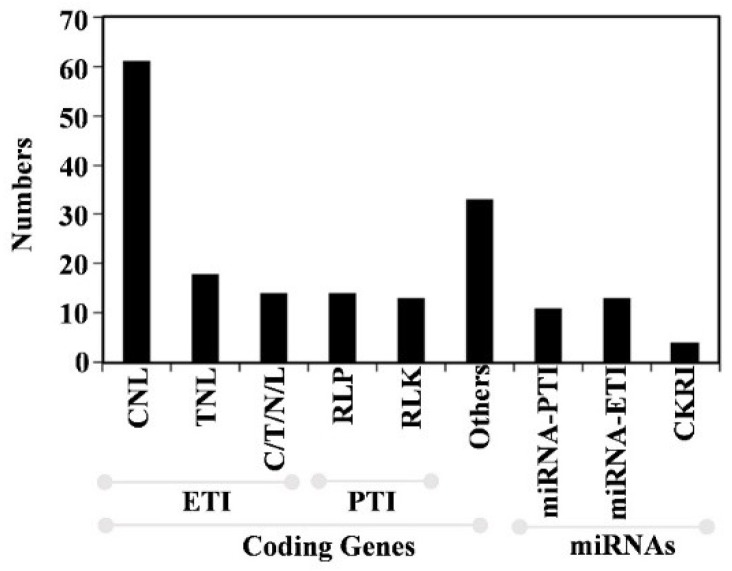
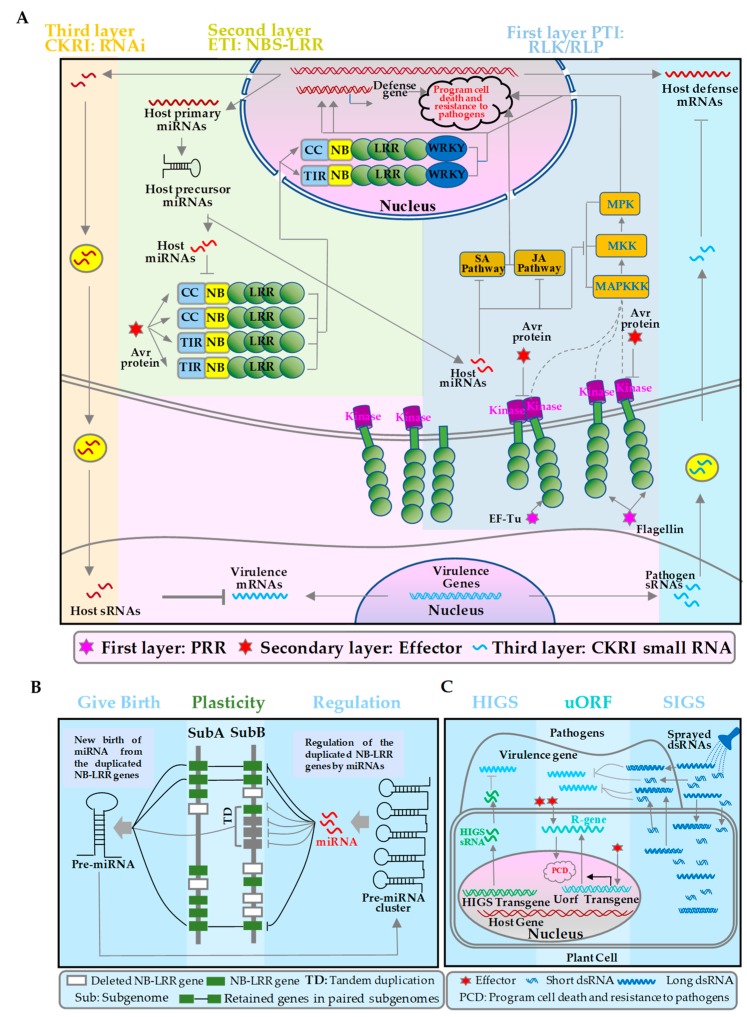
Biotic stresses do damage to the growth and development of plants, and yield losses for some crops. Confronted with microbial infections, plants have evolved multiple defense mechanisms, which play important roles in the never-ending molecular arms race of plant⁻pathogen interactions. The complicated defense systems include pathogen-associated molecular patterns (PAMP) triggered immunity (PTI), effector triggered immunity (ETI), and the exosome-mediated cross-kingdom RNA interference (CKRI) system. Furthermore, plants have evolved a classical regulation system mediated by miRNAs to regulate these defense genes. Most of the genes/small RNAs or their regulators that involve in the defense pathways can have very rapid evolutionary rates in the longitudinal and horizontal co-evolution with pathogens. According to these internal defense mechanisms, some strategies such as molecular switch for the disease resistance genes, host-induced gene silencing (HIGS), and the new generation of RNA-based fungicides, have been developed to control multiple plant diseases. These broadly applicable new strategies by transgene or spraying ds/sRNA may lead to reduced application of pesticides and improved crop yield.
生物胁迫会损害植物的生长和发育,并导致一些作物减产。面对微生物感染,植物已经进化出多种防御机制,这些机制在植物与病原体相互作用的永无止境的分子军备竞赛中发挥着重要作用。复杂的防御系统包括病原体相关分子模式(PAMP)触发的免疫(PTI)、效应物触发的免疫(ETI)和外体介导的跨物种 RNA 干扰(CKRI)系统。此外,植物还进化出了一种由 miRNAs 介导的经典调控系统来调控这些防御基因。在与病原体的纵向和横向共同进化过程中,大多数参与防御途径的基因/小 RNA 或其调控因子的进化速度非常快。根据这些内在的防御机制,已经开发出一些策略来控制多种植物病害,例如抗病基因的分子开关、寄主诱导基因沉默(HIGS)和新一代基于 RNA 的杀菌剂。通过转基因或喷洒 ds/sRNA 这些广泛适用的新策略可能会减少农药的使用并提高作物产量。