Centre for Advanced Sensory Science, School of Exercise and Nutrition Sciences, Deakin University, 1 Gheringhap Street, Geelong 3220, Australia.
Nutrients. 2019 Jan 16;11(1):182. doi: 10.3390/nu11010182.
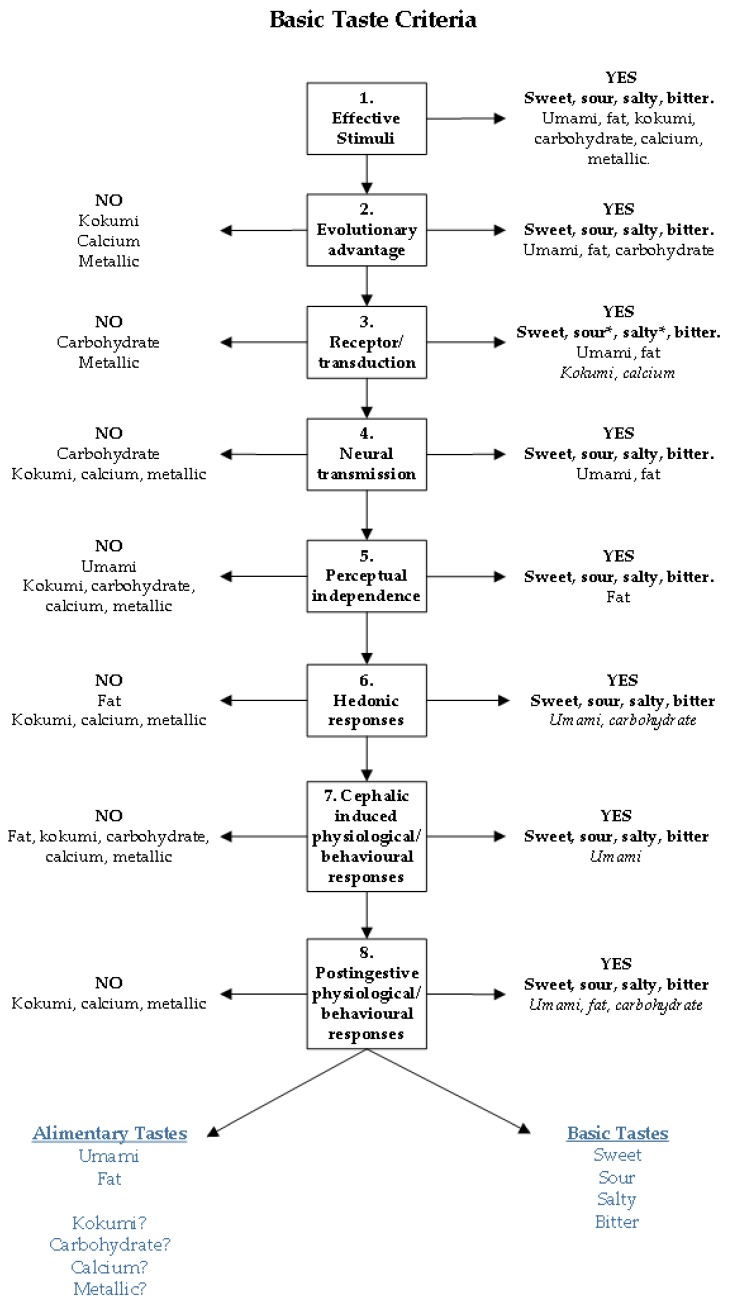
Applied taste research is increasingly focusing on the relationship with diet and health, and understanding the role the sense of taste plays in encouraging or discouraging consumption. The concept of basic tastes dates as far back 3000 years, where perception dominated classification with sweet, sour, salty, and bitter consistently featuring on basic taste lists throughout history. Advances in molecular biology and the recent discovery of taste receptors and ligands has increased the basic taste list to include umami and fat taste. There is potential for a plethora of other new basic tastes pending the discovery of taste receptors and ligands. Due to the possibility for an ever-growing list of basic tastes it is pertinent to critically evaluate whether new tastes, including umami, are suitably positioned with the four classic basic tastes (sweet, sour, salty, and bitter). The review critically examines the evidence that umami, and by inference other new tastes, fulfils the criteria for a basic taste, and proposes a subclass named 'alimentary' for tastes not meeting basic criteria.
应用味觉研究越来越关注味觉与饮食和健康的关系,以及理解味觉在鼓励或抑制消费方面所起的作用。基本味觉的概念可以追溯到 3000 年前,当时感知主导着分类,甜味、酸味、咸味和苦味在整个历史中一直是基本味觉列表的特色。分子生物学的进步和最近发现的味觉受体和配体,使基本味觉列表增加了鲜味和脂肪味。由于有待发现味觉受体和配体,可能会有大量其他新的基本味觉。由于基本味觉的列表可能会不断增加,因此有必要批判性地评估鲜味(包括鲜味)等新味觉是否与甜、酸、咸、苦四种经典基本味觉(sweet, sour, salty, and bitter)相适应。本综述批判性地审查了鲜味(以及其他新味觉)符合基本味觉标准的证据,并提出了一个名为“营养”的子类,用于不符合基本标准的味觉。