School of Physical Education, Shandong University, Jinan, Shandong, China.
School of Community Health Sciences, University of Nevada Reno, Reno, NV, USA.
BMC Public Health. 2019 Jan 17;19(1):81. doi: 10.1186/s12889-019-6420-2.
This study aimed to describe the most recent prevalence estimates of adolescent body mass index (BMI) and physical fitness from thirteen regions in Shandong Province, China and to examine differences by social-economic status (SES).
The participants were 27,955 adolescents (mean age = 14.4 ± 1.8 years; 13,791 girls) enrolled from 91 public middle and high schools randomly selected from 13 administrative regions in Shandong Province. The Chinese National Student Physical Fitness Standard was employed to assess participants' fitness once during the school semester. Fitness assessments included BMI, a 50-m sprint run, sit-and-reach, standing-broad jump, sit-ups, pull-ups, and a 1000 m/boy or 800 m/girl distance run. Participants' fitness performance was categorized as excellent, good, pass, or no pass.
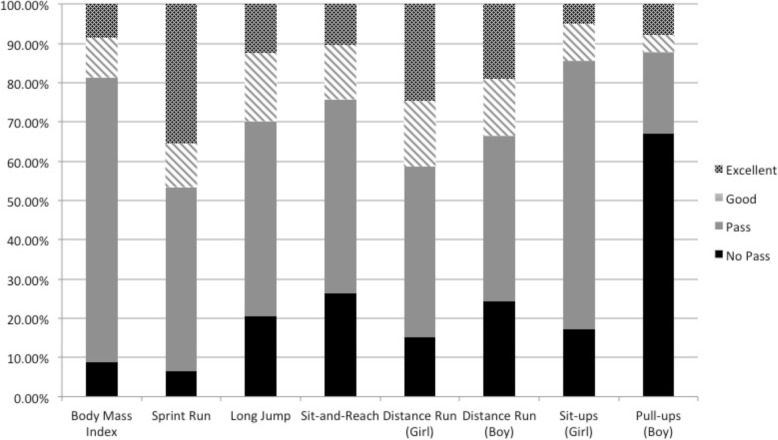
The percent of Chinese adolescents categorized as "no pass" ranged from just 8.9% for BMI to 67.1% for boy pull-ups. The percent of Chinese adolescents categorized as "excellent" ranged from 5.0% for the girl sit-ups to 35.4% for the 50-m sprint run. Approximately 8.4% of the sample was categorized as excellent for BMI. SES significantly predicted both girl and boy continuous distance run scores (p < 0.05). Adolescents in lower SES strata had lower odds of achieving "pass" or better on cardio-respiratory endurance tests, muscular fitness tests, and flexibility tests, but higher odds of achieving "pass" or better on BMI compared to adolescents who were high SES (p < 0.05).
The large sample of the adolescents in Shandong province, on average, had healthy weight status and achieved a high prevalence of "pass" or better on physical fitness tests. Adolescents who were low SES demonstrated poorer cardio-respiratory endurance, muscular fitness, and flexibility test achievement but better BMI achievement compared to high SES adolescents in Shandong Province, China.
本研究旨在描述中国山东省十三个地区青少年的体质量指数(BMI)和身体素质的最新流行率估计,并检查社会经济地位(SES)的差异。
研究对象为 27955 名青少年(平均年龄为 14.4 ± 1.8 岁,女生 13791 人),来自山东省十三个行政区域的 91 所公立中学和高中。采用中国国家学生体质健康标准,在学校学期内对参与者进行一次身体素质评估。身体素质评估包括 BMI、50 米短跑、坐位体前屈、立定跳远、仰卧起坐、引体向上和 1000 米跑(男生)或 800 米跑(女生)。将参与者的身体素质表现分为优秀、良好、及格和不及格。
BMI 不及格的中国青少年比例仅为 8.9%,而男生引体向上不及格的比例则高达 67.1%。仰卧起坐女生表现优秀的比例为 5.0%,50 米短跑男生表现优秀的比例为 35.4%。大约 8.4%的样本在 BMI 方面被评为优秀。SES 显著预测了男女连续长跑成绩(p<0.05)。SES 较低的青少年在心肺耐力测试、肌肉力量测试和柔韧性测试中达到及格或更好的可能性较低,但在 BMI 测试中达到及格或更好的可能性较高,而 SES 较高的青少年则相反(p<0.05)。
山东省的青少年样本数量较大,平均而言,体重健康状况良好,身体素质测试的及格率较高。与山东省 SES 较高的青少年相比,SES 较低的青少年心肺耐力、肌肉力量和柔韧性测试成绩较差,但 BMI 成绩较好。