MRC Integrative Epidemiology Unit, Department of Population Health Sciences, Bristol Medical School, University of Bristol, Bristol, BS8 2BN, UK.
Language and Genetics Department, Max Planck Institute for Psycholinguistics, 6525 XD, Nijmegen, The Netherlands.
Nat Commun. 2019 Jan 21;10(1):357. doi: 10.1038/s41467-018-07863-x.
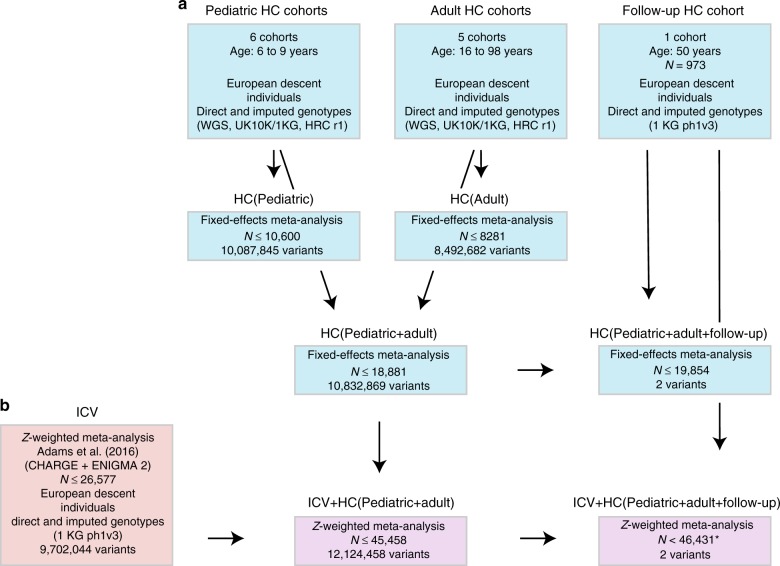
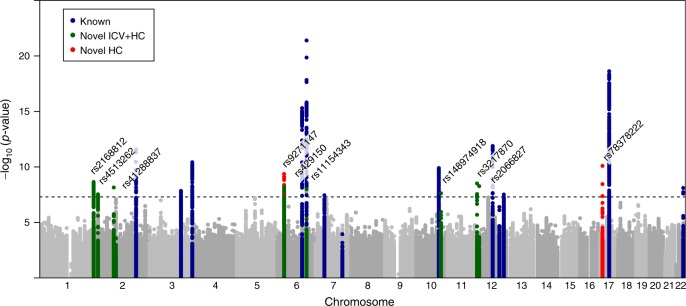
Cranial growth and development is a complex process which affects the closely related traits of head circumference (HC) and intracranial volume (ICV). The underlying genetic influences shaping these traits during the transition from childhood to adulthood are little understood, but might include both age-specific genetic factors and low-frequency genetic variation. Here, we model the developmental genetic architecture of HC, showing this is genetically stable and correlated with genetic determinants of ICV. Investigating up to 46,000 children and adults of European descent, we identify association with final HC and/or final ICV + HC at 9 novel common and low-frequency loci, illustrating that genetic variation from a wide allele frequency spectrum contributes to cranial growth. The largest effects are reported for low-frequency variants within TP53, with 0.5 cm wider heads in increaser-allele carriers versus non-carriers during mid-childhood, suggesting a previously unrecognized role of TP53 transcripts in human cranial development.
颅面生长和发育是一个复杂的过程,它影响头围(HC)和颅内体积(ICV)等密切相关的特征。从儿童期到成年期,塑造这些特征的潜在遗传影响还知之甚少,但可能包括特定年龄的遗传因素和低频遗传变异。在这里,我们对 HC 的发育遗传结构进行建模,结果表明其遗传结构稳定,并与 ICV 的遗传决定因素相关。通过对多达 46000 名欧洲血统的儿童和成人进行研究,我们在 9 个新的常见和低频基因座中发现了与最终 HC 和/或最终 ICV+HC 的关联,这表明来自广泛等位基因频率谱的遗传变异有助于颅面生长。TP53 内的低频变异体报告了最大的影响,与非携带者相比,携带者在儿童中期头围增加 0.5 厘米,这表明 TP53 转录本在人类颅面发育中具有以前未被认识到的作用。