Flink Maria, Brandberg Carina, Ekstedt Mirjam
Department of Learning, Informatics, Management and Ethics, Karolinska Institutet, Stockholm, Sweden.
Department of Social work, Karolinska University Hospital, Stockholm, Sweden.
Trials. 2019 Jan 25;20(1):82. doi: 10.1186/s13063-019-3187-9.
Despite worldwide interest in reducing re-hospitalization, there is limited knowledge regarding characteristics of patients who chose to decline participation in such efforts and why. The aim is to explore reasons to decline participation in an intervention using motivational interviewing to reduce re-hospitalization through patient activation for persons with chronic obstructive pulmonary disease or heart failure.
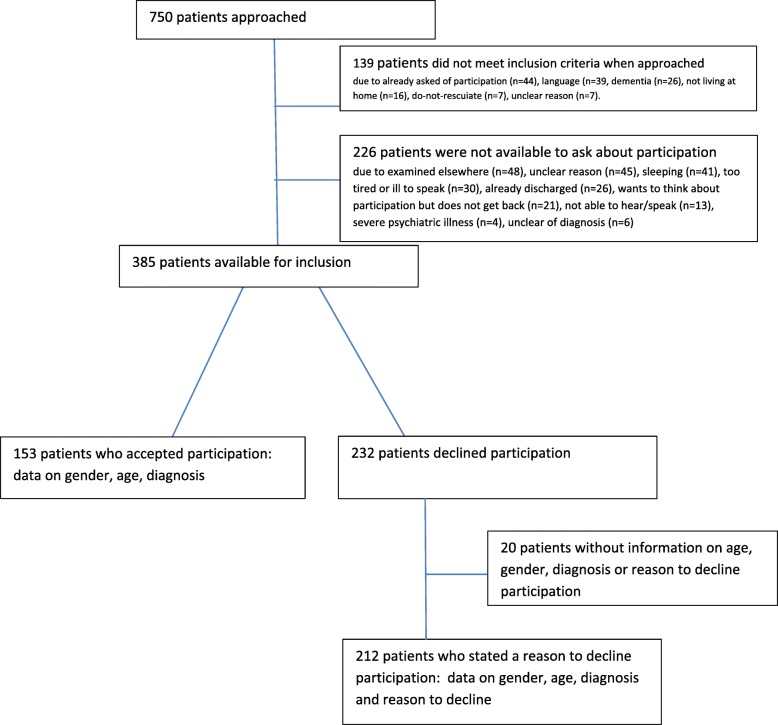
This study uses data from 385 patients who were asked about participating in a randomized controlled trial; of these, 232 declined participation. Data on age, gender, and diagnosis were collected for those who agreed to participate and those who declined. Reasons to decline participation were collected for those who were asked to participate but refused. The stated reasons to decline were analyzed using content analysis, and the categories identified were used for the statistical analysis.
The main reasons for declining participation were having sufficient support (17.5%), no need for support (16%), being too ill (14.6%), and lack of time for illness-related activities (14.2%). A statistically significant negative association between age and willingness to participate was found (odds ratio = - 0.03, 95% confidence interval 0.95-0.99).
Those who agreed to participate were younger than non-participants, and non-participants either lacked time for illness-related activities or did not have the energy needed to become involved in the intervention.
ClinicalTrials.gov, NCT02823795 . Registered on 1 July 2016.
尽管全球都对减少再次住院感兴趣,但对于那些选择拒绝参与此类工作的患者的特征以及原因,了解有限。目的是探讨慢性阻塞性肺疾病或心力衰竭患者拒绝参与一项使用动机性访谈通过患者激活来减少再次住院的干预措施的原因。
本研究使用了来自385名被询问是否参与一项随机对照试验患者的数据;其中,232人拒绝参与。收集了同意参与和拒绝参与患者的年龄、性别及诊断数据。收集了被邀请参与但拒绝患者拒绝参与的原因。使用内容分析法分析所陈述的拒绝原因,并将确定的类别用于统计分析。
拒绝参与的主要原因是有足够的支持(17.5%)、不需要支持(16%)、病情太重(14.6%)以及没有时间进行与疾病相关的活动(14.2%)。发现年龄与参与意愿之间存在统计学上显著的负相关(优势比=-0.03,95%置信区间0.95-0.99)。
同意参与的患者比未参与者更年轻,未参与者要么没有时间进行与疾病相关的活动,要么没有精力参与干预。
ClinicalTrials.gov,NCT02823795。于2016年7月1日注册。