Department of Biochemistry and Biophysics, Stockholm University, 106 91, Stockholm, Sweden.
Department of Cell and Molecular Biology, Uppsala University, 751 24, Uppsala, Sweden.
J Biol Inorg Chem. 2019 Mar;24(2):211-221. doi: 10.1007/s00775-019-01639-4. Epub 2019 Jan 28.
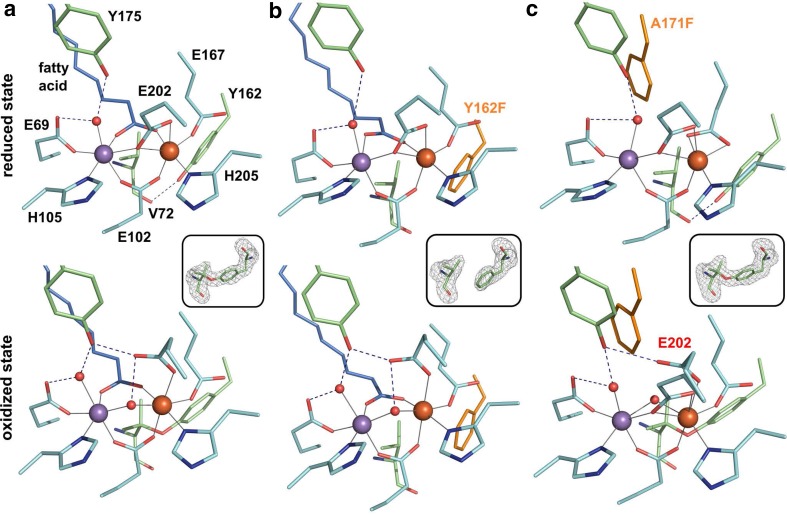
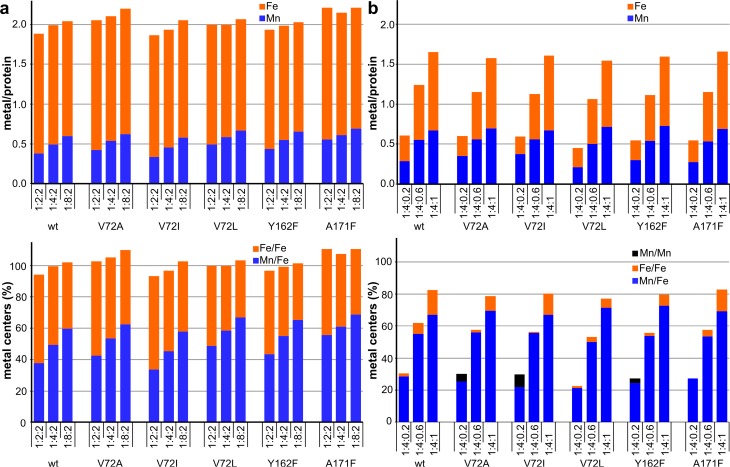
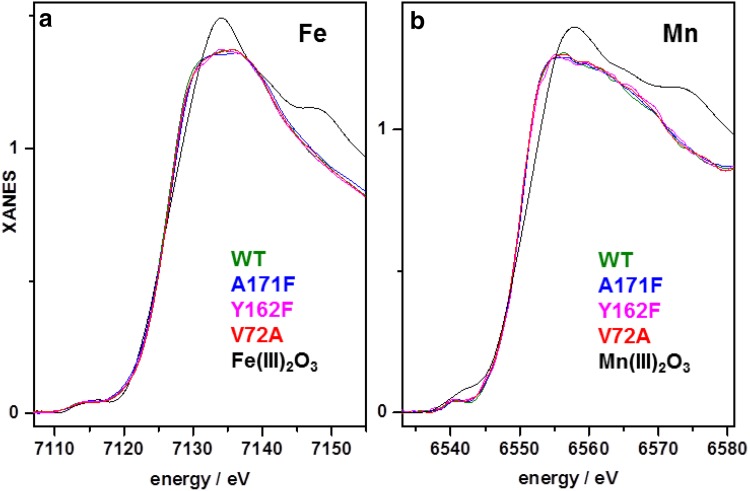
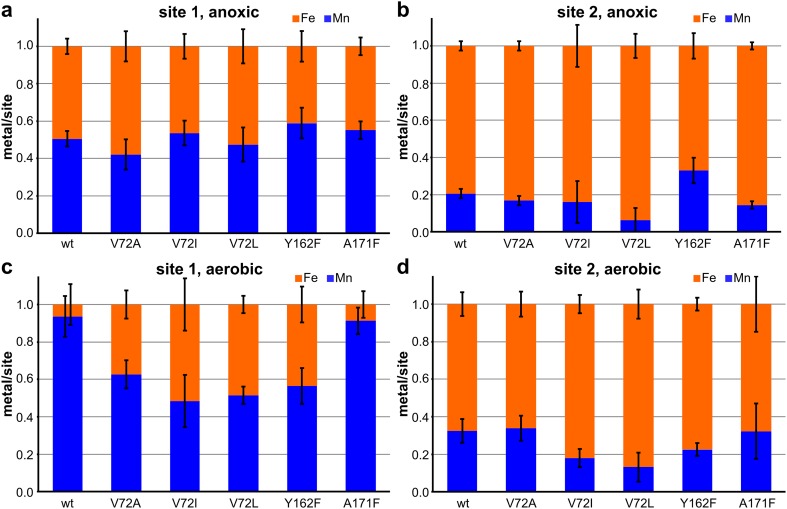
R2-like ligand-binding oxidases (R2lox) assemble a heterodinuclear Mn/Fe cofactor which performs reductive dioxygen (O) activation, catalyzes formation of a tyrosine-valine ether cross-link in the protein scaffold, and binds a fatty acid in a putative substrate channel. We have previously shown that the N-terminal metal binding site 1 is unspecific for manganese or iron in the absence of O, but prefers manganese in the presence of O, whereas the C-terminal site 2 is specific for iron. Here, we analyze the effects of amino acid exchanges in the cofactor environment on cofactor assembly and metalation specificity using X-ray crystallography, X-ray absorption spectroscopy, and metal quantification. We find that exchange of either the cross-linking tyrosine or the valine, regardless of whether the mutation still allows cross-link formation or not, results in unspecific manganese or iron binding at site 1 both in the absence or presence of O, while site 2 still prefers iron as in the wild-type. In contrast, a mutation that blocks binding of the fatty acid does not affect the metal specificity of either site under anoxic or aerobic conditions, and cross-link formation is still observed. All variants assemble a dinuclear trivalent metal cofactor in the aerobic resting state, independently of cross-link formation. These findings imply that the cross-link residues are required to achieve the preference for manganese in site 1 in the presence of O. The metalation specificity, therefore, appears to be established during the redox reactions leading to cross-link formation.
R2 样配体结合氧化酶 (R2lox) 组装一个异双核 Mn/Fe 辅因子,该辅因子执行还原型氧气 (O) 激活,催化蛋白质支架中酪氨酸-缬氨酸醚交联的形成,并在假定的底物通道中结合脂肪酸。我们之前已经表明,在没有 O 的情况下,N 端金属结合位点 1 对锰或铁没有特异性,但在有 O 的情况下更喜欢锰,而 C 端位点 2 对铁具有特异性。在这里,我们使用 X 射线晶体学、X 射线吸收光谱和金属定量分析来分析辅因子环境中的氨基酸交换对辅因子组装和金属化特异性的影响。我们发现,无论突变是否仍然允许交联形成,交联酪氨酸或缬氨酸的交换都会导致在没有或存在 O 的情况下,1 位点上的锰或铁非特异性结合,而 2 位点仍然像野生型一样优先结合铁。相比之下,阻止脂肪酸结合的突变在缺氧或有氧条件下都不会影响两个位点的金属特异性,并且仍然观察到交联形成。所有变体在有氧静止状态下组装双核三价金属辅因子,与交联形成无关。这些发现表明,交联残基对于在有 O 的情况下在 1 位点上实现对锰的偏好是必需的。因此,金属化特异性似乎是在导致交联形成的氧化还原反应过程中建立的。