State Key Laboratory of Rice Biology, China National Rice Research Institute, No.359 Tiyuchang Road, Hangzhou, 310006, People's Republic of China.
BMC Genomics. 2019 Jan 28;20(1):91. doi: 10.1186/s12864-019-5435-5.
Bakanae disease, caused by the fungus Fusarium fujikuroi, occurs widely throughout Asia and Europe and sporadically in other rice production areas. Recent changes in climate and cropping patterns have aggravated this disease. To gain a better understanding of the molecular mechanisms of rice bakanae disease resistance, we employed a 6-plex tandem mass tag approach for relative quantitative proteomic comparison of infected and uninfected rice seedlings 7 days post-inoculation with two genotypes: the resistant genotype 93-11 and the susceptible genotype Nipponbare.
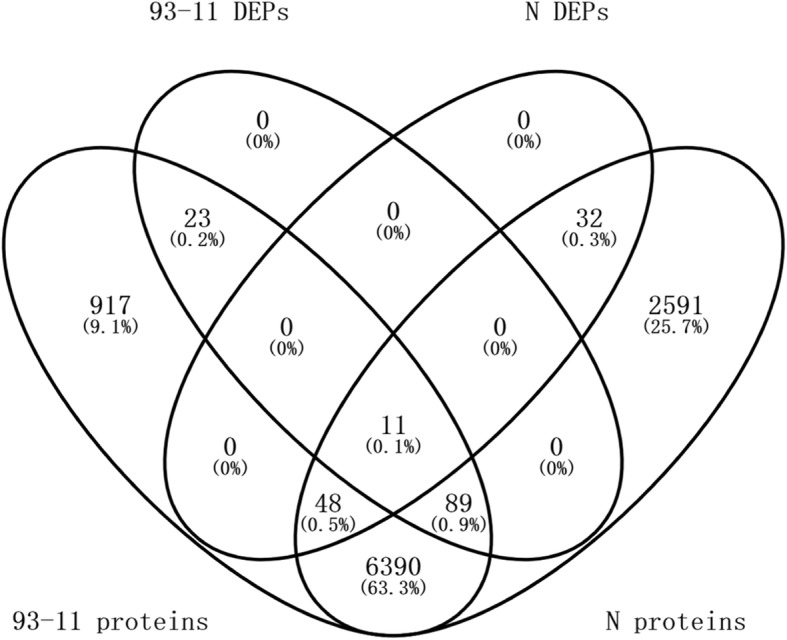
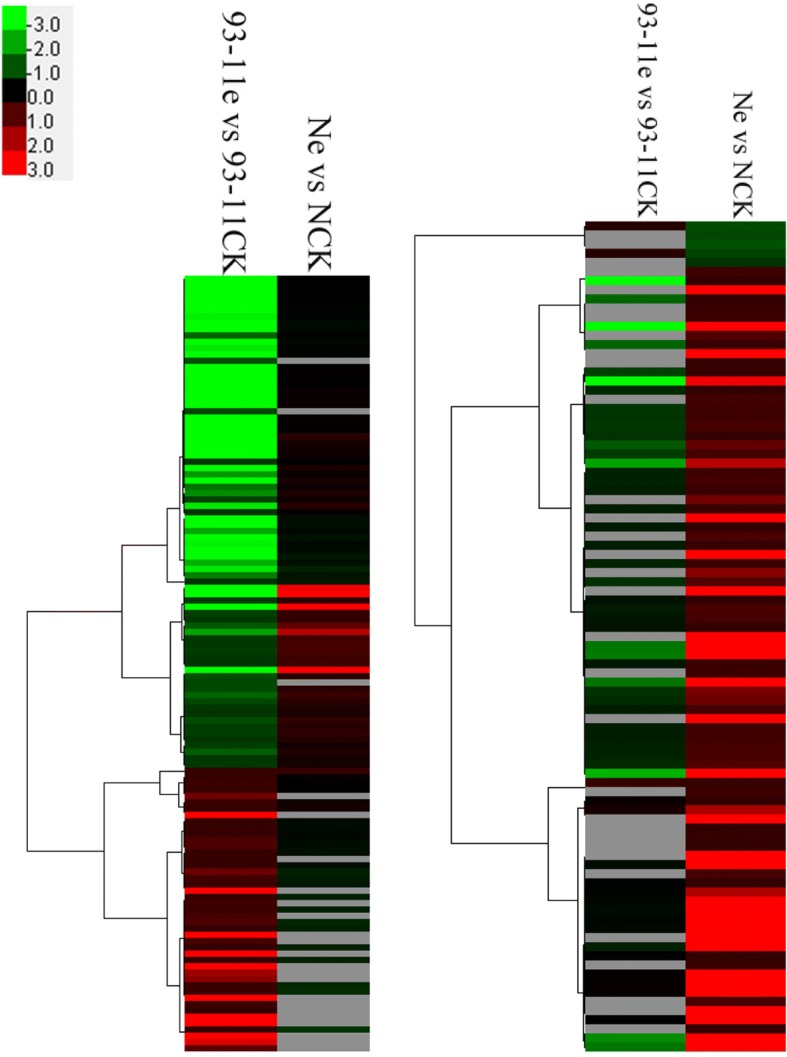
In total, 123 (77.2% up-regulated, 22.8% down-regulated) and 91 (94.5% up-regulated, 5.5% down-regulated) differentially expressed proteins (DEPs) accumulated in 93-11 and Nipponbare, respectively. Only 11 DEPs were both shared by the two genotypes. Clustering results showed that the protein regulation trends for the two genotypes were highly contrasting, which suggested obviously different interaction mechanisms of the host and the pathogen between 93 and 11 and Nipponbare. Further analysis showed that a noticeable aquaporin, PIP2-2, was sharply upregulated with a fold change (FC) of 109.2 in 93-11, which might be related to pathogen defense and the execution of bakanae disease resistance. Certain antifungal proteins were regulated in both 93-11 and Nipponbare with moderate FCs. These proteins might participate in protecting the cellular integrity required for basic growth of the susceptible genotype. Correlation analysis between the transcriptome and proteome revealed that Pearson correlation coefficients of R = 0.677 (P = 0.0005) and R = - 0.097 (P = 0.702) were obtained for 93-11 and Nipponbare, respectively. Our findings raised an intriguing result that a significant positive correlation only in the resistant genotype, while no correlation was found in the susceptible genotype. The differences in codon usage was hypothesized for the cause of the result.
Quantitative proteomic analysis of the rice genotypes 93-11and Nipponbare after F. fujikuroi infection revealed that the aquaporin protein PIP2-2 might execute bakanae disease resistance. The difference in the correlation between the transcriptome and proteome might be due to the differences in codon usage between 93-11and Nipponbare. Overall, the protein regulation trends observed under bakanae disease stress are highly contrasting, and the molecular mechanisms of disease defense are obviously different between 93 and 11 and Nipponbare. In summary, these findings deepen our understanding of the functions of proteins induced by bakanae disease and the mechanisms of rice bakanae disease resistance.
由镰刀菌(Fusarium fujikuroi)引起的生芽鞘病广泛发生在亚洲和欧洲,偶尔也发生在其他水稻产区。最近气候和种植方式的变化加剧了这种疾病。为了更好地了解水稻生芽鞘病抗性的分子机制,我们采用了 6 重串联质量标签方法,对感染和未感染两种基因型(抗性基因型 93-11 和感病基因型 Nipponbare)水稻幼苗接种后 7 天的相对定量蛋白质组进行比较。
在 93-11 中,共鉴定到 123 个(77.2%上调,22.8%下调)和 91 个(94.5%上调,5.5%下调)差异表达蛋白(DEPs),在 Nipponbare 中分别为 123 个和 91 个。两个基因型共有 11 个 DEP。聚类结果表明,两个基因型的蛋白质调控趋势高度相反,这表明 93-11 和 Nipponbare 之间宿主与病原体的相互作用机制明显不同。进一步分析表明,一种明显的水通道蛋白 PIP2-2 显著上调,在 93-11 中 Fold change(FC)为 109.2,这可能与病原体防御和生芽鞘病抗性的执行有关。某些抗真菌蛋白在 93-11 和 Nipponbare 中均有中等 FC 调节。这些蛋白质可能参与保护易感基因型基本生长所需的细胞完整性。转录组和蛋白质组之间的相关性分析显示,93-11 和 Nipponbare 的 Pearson 相关系数分别为 R=0.677(P=0.0005)和 R=-0.097(P=0.702)。我们的研究结果提出了一个有趣的结果,即在抗性基因型中存在显著的正相关,而在易感基因型中则没有相关性。推测这是由于 93-11 和 Nipponbare 之间密码子使用的差异所致。
对感染镰刀菌的水稻基因型 93-11 和 Nipponbare 进行定量蛋白质组分析表明,水通道蛋白 PIP2-2 可能执行生芽鞘病抗性。转录组和蛋白质组之间的相关性差异可能是由于 93-11 和 Nipponbare 之间密码子使用的差异所致。总体而言,在生芽鞘病胁迫下观察到的蛋白质调控趋势高度相反,93-11 和 Nipponbare 之间的疾病防御分子机制明显不同。综上所述,这些发现加深了我们对生芽鞘病诱导蛋白功能和水稻生芽鞘病抗性机制的理解。