Arslan Hakan, Nojoomi Amirali, Jeon Junha, Yum Kyungsuk
Department of Materials Science and Engineering University of Texas at Arlington Arlington TX 76019 USA.
Department of Mechanical and Aerospace Engineering University of Texas at Arlington Arlington TX 76019 USA.
Adv Sci (Weinh). 2018 Nov 22;6(2):1800703. doi: 10.1002/advs.201800703. eCollection 2019 Jan 23.
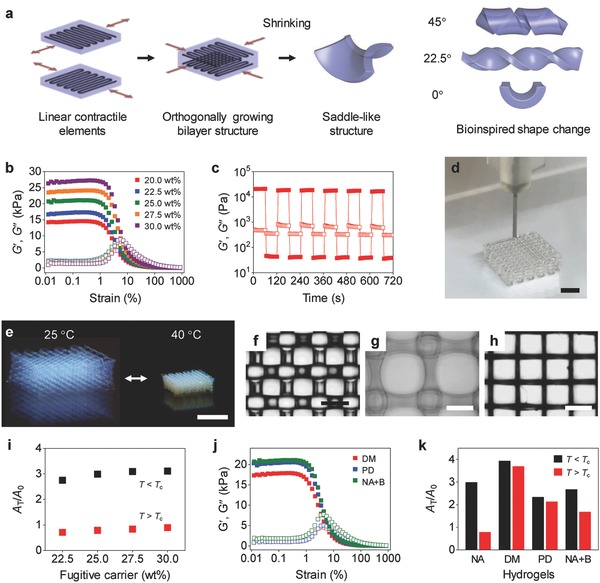
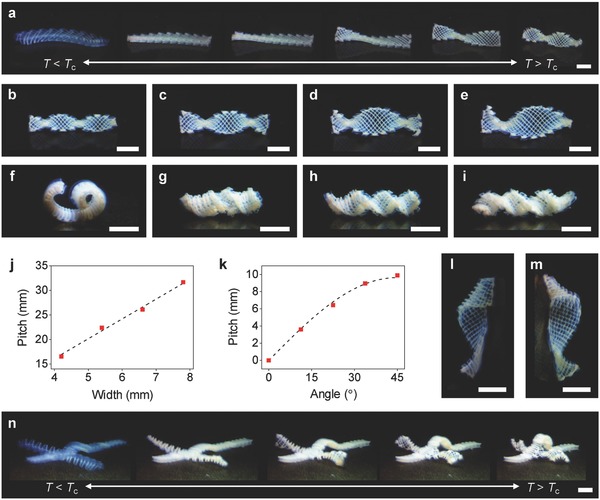
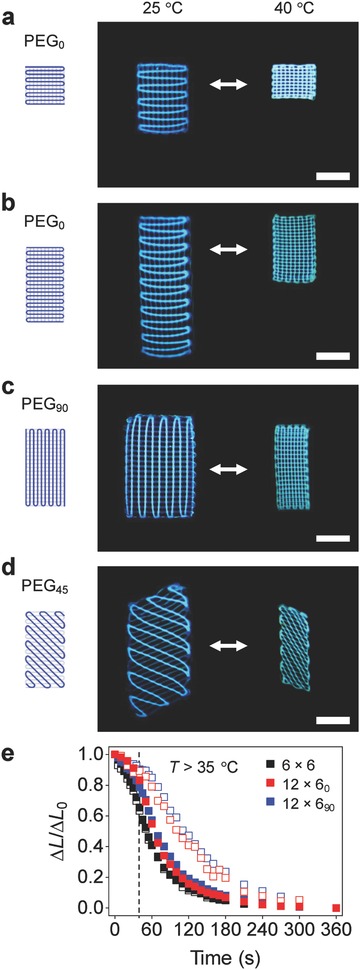
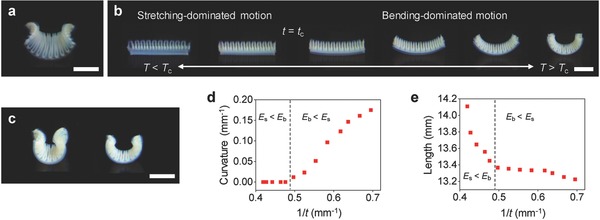
Motion in biological organisms often relies on the functional arrangement of anisotropic tissues that linearly expand and contract in response to external signals. However, a general approach that can implement such anisotropic behavior into synthetic soft materials and thereby produce complex motions seen in biological organisms remains a challenge. Here, a bioinspired approach is presented that uses temperature-responsive linear hydrogel actuators, analogous to biological linear contractile elements, as building blocks to create three-dimensional (3D) structures with programmed motions. This approach relies on a generalizable 3D printing method for building 3D structures of hydrogels using a fugitive carrier with shear-thinning properties. This study demonstrates that the metric incompatibility of an orthogonally growing bilayer structure induces a saddle-like shape change, which can be further exploited to produce various bioinspired motions from bending to twisting. The orthogonally growing bilayer structure undergoes a transition from a stretching-dominated motion to a bending-dominated motion during its shape transformation. The modular nature of this approach, together with the flexibility of additive manufacturing, enables the fabrication of multimodular 3D structures with complex motions through the assembly of multiple functional components, which in turn consist of simple linear contractile elements.
生物有机体中的运动通常依赖于各向异性组织的功能排列,这些组织会根据外部信号线性地膨胀和收缩。然而,一种能够将这种各向异性行为应用于合成软材料并由此产生生物有机体中所见复杂运动的通用方法仍然是一项挑战。在此,提出了一种受生物启发的方法,该方法使用类似于生物线性收缩元件的温度响应线性水凝胶致动器作为构建块,以创建具有编程运动的三维(3D)结构。这种方法依赖于一种可推广的3D打印方法,该方法使用具有剪切变稀特性的逃逸载体来构建水凝胶的3D结构。这项研究表明,正交生长的双层结构的度量不相容性会引发鞍状形状变化,这种变化可被进一步利用来产生从弯曲到扭转的各种受生物启发的运动。正交生长的双层结构在其形状转变过程中经历从拉伸主导运动到弯曲主导运动的转变。这种方法的模块化性质,连同增材制造的灵活性,使得通过组装多个功能组件来制造具有复杂运动的多模块3D结构成为可能,而这些功能组件又由简单的线性收缩元件组成。