Department of Molecular Epidemiology, Shenzhen Center for Disease Control and Prevention, Shenzhen, Guangdong, China.
MPH Education Center, Shantou University Medical College, Shantou, Guangdong, China.
Breast Cancer Res. 2019 Jan 29;21(1):16. doi: 10.1186/s13058-019-1096-1.
Epidemiologic evidence suggests that certain dietary patterns were associated with breast cancer risk, but the results have been inconclusive. We assessed the associations between different dietary patterns and the risk of breast cancer by conducting a meta-analysis of observational studies.
Relevant articles were searched in PubMed, Embase, and Cochrane library databases through September 2017. Multivariable-adjusted relative risks (RRs) and 95% confidence intervals (CIs) comparing the highest and lowest categories of Western and prudent dietary patterns were combined by using the random-effects meta-analyses.
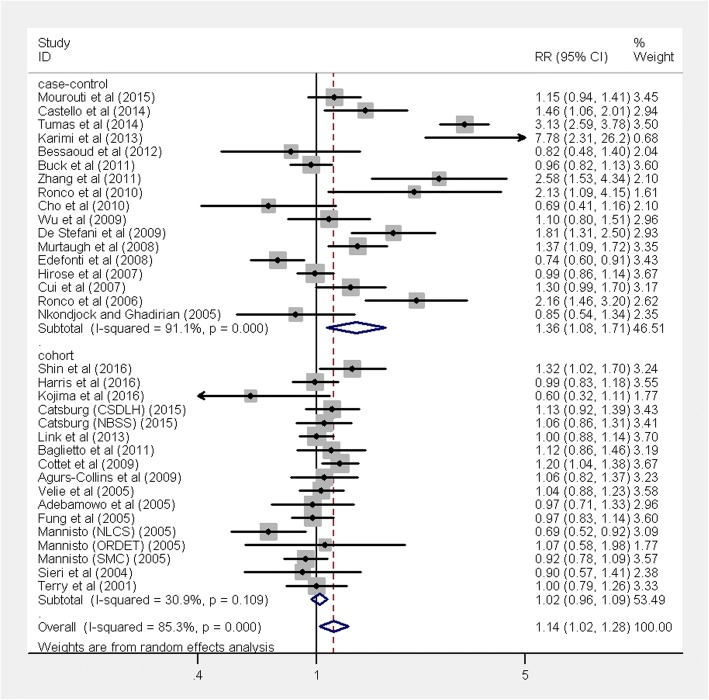
We identified 32 eligible articles including 14 cohort and 18 case-control studies (34 Western and 35 prudent studies). The pooled analyses found that a Western dietary pattern was associated with a 14% increased risk (RR 1.14, 95% CI 1.02, 1.28), whereas a prudent dietary pattern was associated with an 18% reduced risk of breast cancer (RR 0.82, 95% CI 0.75, 0.89). In addition, sub-group analyses showed that the positive association between a Western dietary pattern and breast cancer risk was significant among postmenopausal (RR 1.20, 95% CI 1.06, 1.35), but not premenopausal women (RR 1.18, 95% CI 0.99, 1.40), and significant for hormone receptor-positive tumors (RR 1.18, 95% CI 1.04, 1.33), but not receptor-negative tumors (RR 0.97, 95% CI 0.83, 1.12). In contrast, the inverse association between a prudent dietary pattern and breast cancer was significant in premenopausal (RR 0.77, 95% CI 0.61, 0.98), but not postmenopausal women (RR 0.88, 95% CI 0.74, 1.03), and significant for both hormone receptor-positive and receptor-negative tumors.
The results of the current meta-analysis suggest a possible increased risk of breast cancer associated with a Western dietary pattern and a reduced risk with a prudent dietary pattern. Large-scale cohort studies with a high quality need to be conducted to further confirm the findings of the current meta-analysis. As dietary patterns are modifiable, these findings may provide viable strategies for breast cancer prevention through changes in dietary intake.
流行病学证据表明,某些饮食模式与乳腺癌风险有关,但结果尚无定论。我们通过对观察性研究进行荟萃分析,评估了不同饮食模式与乳腺癌风险之间的关系。
通过检索 PubMed、Embase 和 Cochrane 图书馆数据库,截至 2017 年 9 月,我们查找了相关文献。采用随机效应荟萃分析,综合比较西方饮食模式和谨慎饮食模式中最高和最低类别之间的多变量调整相对风险(RR)和 95%置信区间(CI)。
我们共纳入 32 篇符合条件的文献,包括 14 项队列研究和 18 项病例对照研究(西方饮食模式 34 项,谨慎饮食模式 35 项)。汇总分析发现,西方饮食模式与乳腺癌风险增加 14%相关(RR 1.14,95%CI 1.02,1.28),而谨慎饮食模式与乳腺癌风险降低 18%相关(RR 0.82,95%CI 0.75,0.89)。此外,亚组分析显示,在绝经后妇女中,西方饮食模式与乳腺癌风险之间存在显著正相关(RR 1.20,95%CI 1.06,1.35),但在绝经前妇女中无此相关性(RR 1.18,95%CI 0.99,1.40),且在激素受体阳性肿瘤中存在显著相关性(RR 1.18,95%CI 1.04,1.33),但在受体阴性肿瘤中无此相关性(RR 0.97,95%CI 0.83,1.12)。相反,谨慎饮食模式与乳腺癌风险之间呈负相关,在绝经前妇女中具有显著相关性(RR 0.77,95%CI 0.61,0.98),但在绝经后妇女中无此相关性(RR 0.88,95%CI 0.74,1.03),且在激素受体阳性和受体阴性肿瘤中均具有显著相关性。
本荟萃分析结果表明,西方饮食模式可能会增加乳腺癌的发病风险,而谨慎饮食模式可能会降低乳腺癌的发病风险。需要开展大规模高质量的队列研究来进一步证实本荟萃分析的结果。由于饮食模式是可以改变的,这些发现可能为通过改变饮食摄入来预防乳腺癌提供可行的策略。