Department of Primary Care Medicine, Faculty of Medicine, University of Malaya, Kuala Lumpur, Malaysia.
Department of Applied Statistics, Faculty of Economics and Administration, University of Malaya, Kuala Lumpur, Malaysia.
J Glob Health. 2019 Jun;9(1):010405. doi: 10.7189/jogh.09.010405.
Population health indices such as disability adjusted life years (DALY) and quality adjusted life years (QALY) are often used in an effort to measure health of populations and identify areas of concern that require interventions. There has been an increase of number of population health indices since the last review published more than a decade ago. Therefore, this study aims to provide an overview of existing population health indices and examine the methods used to develop them.
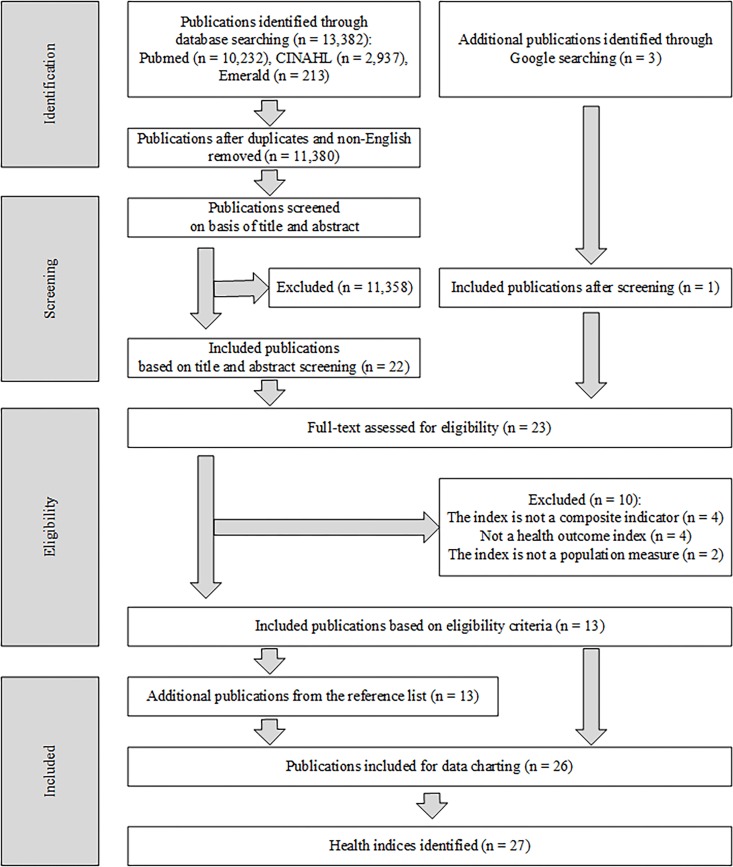
The search was conducted across three databases: PubMed, CINAHL and Emerald using four key concepts: 'health', 'index', 'context', 'develop', which was supplemented with Google searching and reference scanning. A researcher screened the titles, abstracts and subsequently full texts and confirmed the findings with the research team at each stage. Data charting was performed according to the included publications and identified indices. The collation was performed by describing the indices and made observation on its development method using framework consist of four processes: underpinning theory, model or framework; data selection and processing; formation of index; testing of index.
Twenty-six publications describing population health indices were included, and 27 indices were identified. These indices covered the following health topics: overall health outcomes (n = 15), outcomes for specific health topics (n = 4), diseases outcome (n = 6), assist health resource allocation for priority minority subgroup or geographic area (n = 4), quality of health or health care (n = 2). Twenty-one indices measure health for general populations while six measure defined subpopulations. Fourteen of the indices reported at least one of the development processes according to the framework: underpinning theory, model or framework (n = 7); data selection and processing (n = 8); formation of index (n = 12); testing of index (n = 9).
Few population health indices measure specific health topics or health of specific sub-population. There is also a lack of usage of theories, models or framework in developing these indices. Efforts to develop a guideline is proposed on how population health indices can be developed systematically and rigorously to ensure validity and comprehensive assessment of the indices.
人口健康指标,如伤残调整生命年(DALY)和质量调整生命年(QALY),常用于衡量人群健康状况,并确定需要干预的关注领域。自 10 多年前发表的上一次综述以来,人口健康指标的数量有所增加。因此,本研究旨在概述现有的人口健康指标,并研究其开发方法。
本研究在 PubMed、CINAHL 和 Emerald 这三个数据库中使用了“健康”“指标”“背景”“制定”这四个关键概念进行了检索,并辅以谷歌搜索和参考文献扫描。研究人员对标题、摘要,随后是全文进行筛选,并在每个阶段与研究团队确认结果。根据纳入的出版物和确定的指标进行数据图表制作。对指标进行描述,并使用包括四个过程的框架(理论基础、模型或框架;数据选择和处理;指标制定;指标检验)来观察其开发方法。
共纳入 26 篇描述人口健康指标的文献,确定了 27 个人口健康指标。这些指标涵盖了以下健康主题:总体健康结果(n=15)、特定健康主题的结果(n=4)、疾病结果(n=6)、辅助健康资源向优先少数民族亚群或地理区域分配(n=4)、健康或医疗保健质量(n=2)。21 个指标用于衡量一般人群的健康状况,6 个指标用于衡量特定的亚人群。根据框架,14 个指标报告了至少一个开发过程:理论基础、模型或框架(n=7);数据选择和处理(n=8);指标制定(n=12);指标检验(n=9)。
少数人口健康指标用于衡量特定的健康主题或特定亚人群的健康状况。在开发这些指标时,也缺乏对理论、模型或框架的使用。我们提出了一项努力,即制定一个指南,说明如何系统和严格地开发人口健康指标,以确保指标的有效性和全面评估。