Centre for Youth Mental Health, The University of Melbourne, Melbourne, 3052, Australia; Melbourne School of Psychological Sciences, The University of Melbourne, Melbourne, 3010, Australia; Orygen, the National Centre of Excellence in Youth Mental Health, Melbourne, 3052, Australia.
Wellcome Trust Centre for Neuroimaging, University College London, London, WC1N3BG, UK.
Phys Life Rev. 2019 Dec;31:104-121. doi: 10.1016/j.plrev.2018.10.002. Epub 2019 Jan 10.
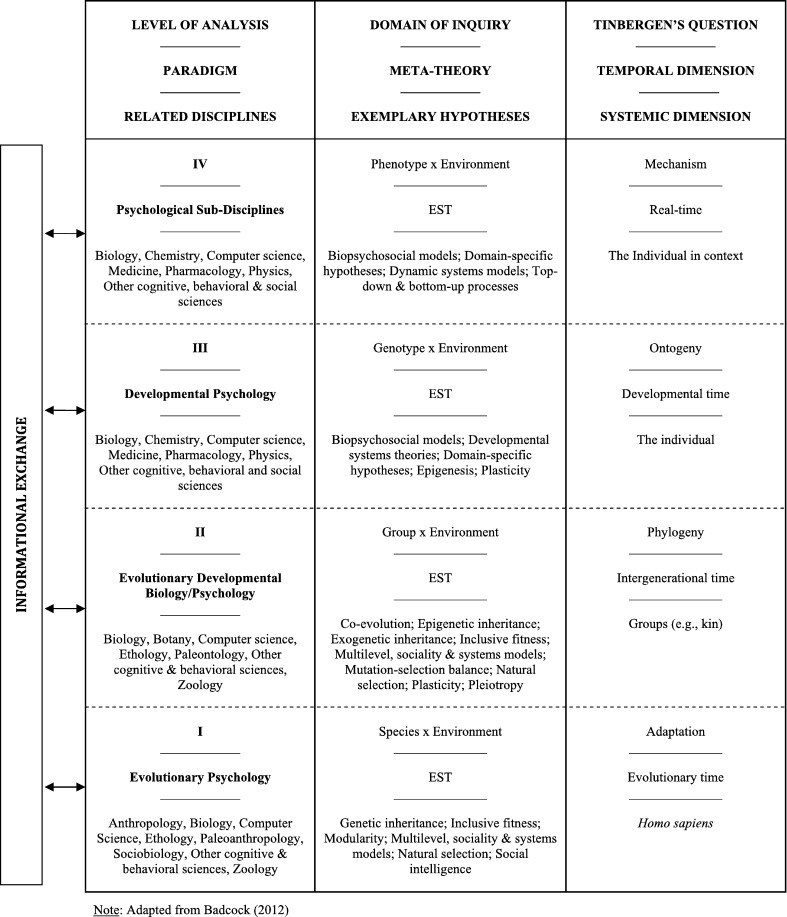
This article presents a unifying theory of the embodied, situated human brain called the Hierarchically Mechanistic Mind (HMM). The HMM describes the brain as a complex adaptive system that actively minimises the decay of our sensory and physical states by producing self-fulfilling action-perception cycles via dynamical interactions between hierarchically organised neurocognitive mechanisms. This theory synthesises the free-energy principle (FEP) in neuroscience with an evolutionary systems theory of psychology that explains our brains, minds, and behaviour by appealing to Tinbergen's four questions: adaptation, phylogeny, ontogeny, and mechanism. After leveraging the FEP to formally define the HMM across different spatiotemporal scales, we conclude by exploring its implications for theorising and research in the sciences of the mind and behaviour.
本文提出了一种统一的具身、情境化人脑理论,称为层次化机械论心智(HMM)。HMM 将大脑描述为一个复杂适应系统,通过在分层组织的神经认知机制之间的动态相互作用产生自我实现的动作感知循环,主动最小化我们的感觉和身体状态的衰减。该理论将神经科学中的自由能原理(FEP)与心理学的进化系统理论相结合,通过诉诸廷伯根的四个问题:适应、系统发生、个体发生和机制,来解释我们的大脑、思维和行为。在利用 FEP 为不同时空尺度正式定义 HMM 之后,我们通过探索其对心智和行为科学的理论化和研究的影响来得出结论。