Women's Health in Neuroscience Program, Neuroscience and Experimental Therapeutics, Texas A&M College of Medicine, Bryan, TX 77807, United States of America.
Women's Health in Neuroscience Program, Neuroscience and Experimental Therapeutics, Texas A&M College of Medicine, Bryan, TX 77807, United States of America.
Horm Behav. 2019 May;111:87-95. doi: 10.1016/j.yhbeh.2018.10.010. Epub 2018 Nov 20.
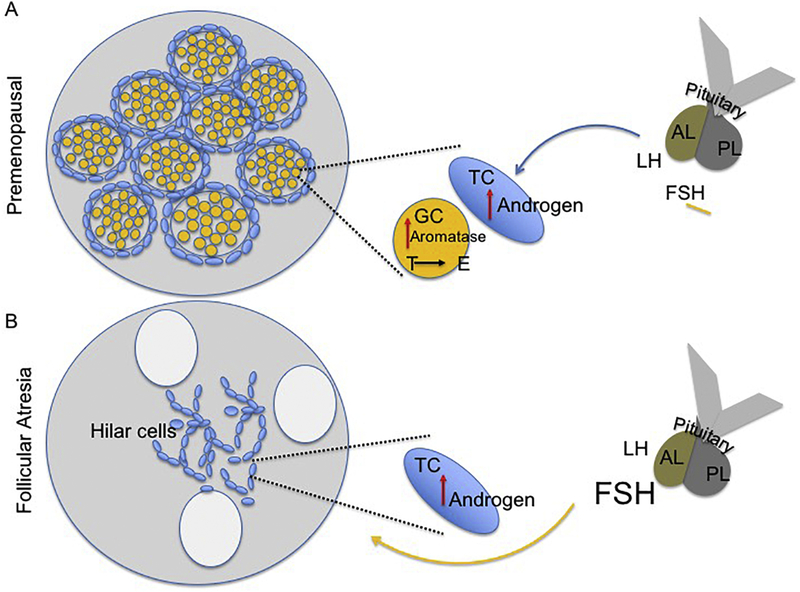
Stroke risk and poor stroke outcomes in postmenopausal women have usually beeen attributed to decreased levels of estrogen. However, two lines of evidence suggest that this hormone may not be solely responsible for elevated stroke risk in this population. First, the increased risk for CVD and stroke occurs much earlier than menopause at a time when estrogen levels are not yet reduced. Second, estrogen therapy has not successfully reduced stroke risk in all studies. Other sex hormones may therefore also contribute to stroke risk. Prior to menopause, levels of the gonadotrophin Follicle Stimulating Hormone (FSH) are elevated while levels of the gonadal peptide inhibin are lowered, indicating an overall decrease in ovarian reserve. Similarly, reduced estrogen levels at menopause significantly increase the ratio of androgens to estrogens. In view of the evidence that androgens may be unfavorable for CVD and stroke, this elevated ratio of testosterone to estrogen may also contribute to the postmenopause-associated stroke risk. This review synthesizes evidence from different clinical populations including natural menopause, surgical menopause, women on chemotherapy, and preclinical stroke models to dissect the role of ovarian hormones and stroke risk and outcomes.
绝经后女性的中风风险和较差的中风预后通常归因于雌激素水平降低。然而,有两条证据表明,这种激素可能并不能完全解释该人群中风风险升高的原因。首先,与 CVD 和中风相关的风险增加发生在绝经之前,此时雌激素水平尚未降低。其次,在所有研究中,雌激素治疗并未成功降低中风风险。因此,其他性激素也可能导致中风风险。在绝经之前,促性腺激素卵泡刺激素 (FSH) 的水平升高,而性腺肽抑制素的水平降低,表明卵巢储备总体减少。同样,绝经后雌激素水平的降低显著增加了雄激素与雌激素的比值。鉴于雄激素可能对 CVD 和中风不利的证据,这种睾酮与雌激素比值的升高也可能导致绝经后相关的中风风险。本综述综合了来自不同临床人群的证据,包括自然绝经、手术绝经、接受化疗的女性和临床前中风模型,以剖析卵巢激素与中风风险和结果的关系。