Johnson Ashley R, Procopio Adam T
Merck & Co., Inc, Kenilworth, NJ, USA.
3D Print Med. 2019 Feb 4;5(1):2. doi: 10.1186/s41205-019-0039-x.
Microneedle patches are arrays of tiny needles that painlessly pierce the skin to deliver medication into the body. Biocompatible microneedles are usually fabricated via molding of a master structure. Microfabrication techniques used for fabricating these master structures are costly, time intensive, and require extensive expertise to control the structure's geometry of the structure, despite evidence that microneedle geometry is a key design parameter. Here, a commercially available 3D printer is utilized, for the first time, to quickly and easily manufacture microneedle masters.
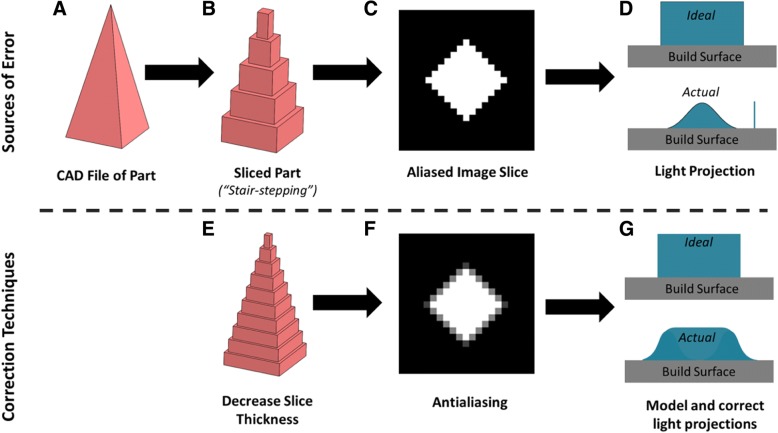
DESIGN/METHODOLOGY/APPROACH: Because commercially available 3D printers are not typically used for micron-scale fabrication, the influence of three different sources of error- stair-stepping, aliasing, and light abberations- on the resulting structure is investigated. A custom Matlab code is written to control the light intensity projected off of each individual micromirror (through grayscale) at a given time. The effect of the layer height, the number of layers, and grayscale on the sharpness, surface texture, and dimensional fidelity of the final structure is described.
The Autodesk Ember is successfully utilized to fabricate sharp microneedles with a tip radius of approximately 15 μm in less than 30 min per patch (as compared to weeks to months for existing approaches). Utilization of grayscale improves surface texture and sharpness, and dimensional fidelity within ±5% of desired dimensions is achieved.
ORIGINALITY/VALUE: The described 3D printing technique enables investigators to accurately fabricate microneedles within minutes at low cost. Rapid, iterative optimization of microneedle geometry through 3D printing will accelerate microneedle research through improved understanding of the relationship between microneedle structure and function.
微针贴片是由微小针头组成的阵列,可无痛穿透皮肤将药物输送到体内。生物相容性微针通常通过母模成型制造。尽管有证据表明微针几何形状是关键设计参数,但用于制造这些母模结构的微加工技术成本高昂、耗时且需要广泛的专业知识来控制结构的几何形状。在此,首次利用商用3D打印机快速、轻松地制造微针母模。
设计/方法/途径:由于商用3D打印机通常不用于微米级制造,因此研究了三种不同误差源——阶梯效应、混叠和像差——对所得结构的影响。编写了一个自定义Matlab代码,以在给定时间控制从每个单独微镜投射出的光强度(通过灰度)。描述了层高、层数和灰度对最终结构的锐度、表面纹理和尺寸保真度的影响。
成功利用Autodesk Ember打印机在不到30分钟的时间内制造出尖端半径约为15μm的尖锐微针(相比之下,现有方法需要数周至数月)。使用灰度可改善表面纹理和锐度,并实现尺寸保真度在所需尺寸的±5%以内。
原创性/价值:所描述的3D打印技术使研究人员能够在几分钟内以低成本精确制造微针。通过3D打印对微针几何形状进行快速、迭代优化,将通过更好地理解微针结构与功能之间的关系来加速微针研究。